Quantcast
Channel: Long-Forgotten
Viewing all 128 articles
Browse latest View live

Long Remembered

$
0
0
.
Just a quick post to commemorate Long-Forgotten's 500,000th visitation by unseen guests (that's you).  Two and a half years it's been, close to 100 posts, and half a million viewings.  Who'da thunk it?  I want to say thank you to all readers and especially to the commenters.  The blog's reception has been consistently positive and intelligent.  To date there have been no more than two or three nasty comments that had to be deleted before they saw the light of day (or dark of night, or whatever twilight zone we're inhabiting here).  Mansionites are a classy lot.  Breeding will out, as they say. *taps silver box, pinches some snuff*

The pace will continue to be slower than it was the first year.  For awhile it's been about one post per month, but peering into my crystal ball, I can't promise you even that in future. *sneezes* I would rather the posts be infrequent but of good quality than let the blog degenerate into a stream of trivia for trivia's sake.  Don't worry; there are still many stories to tell.  *sneezes again*  Even as I type, I've got two or three posts in the can or getting there.

****************

So as not to entirely disappoint those of you who came here not for self-congratulatory
speeches but for a fresh slice of juicy Mansionology, here's a light snack to hold you over till dinner.

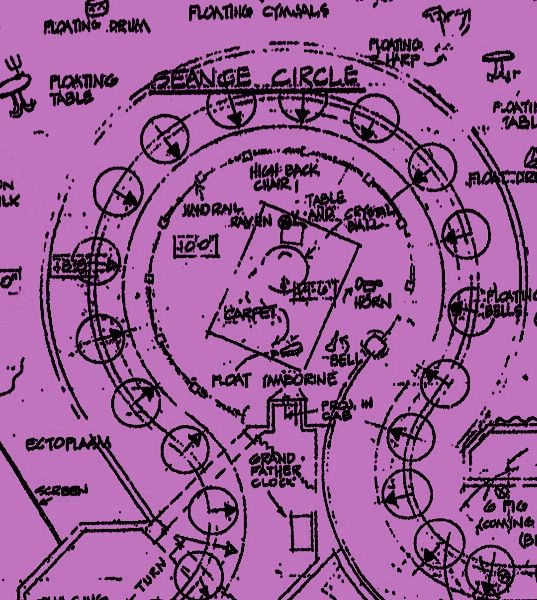
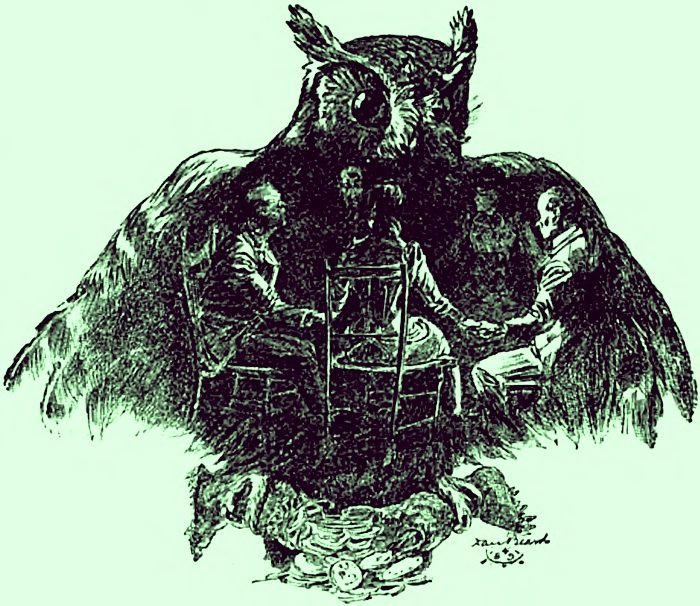
Let's go to the Séance Circle and take a look around.  Funny, even though it's a séance we are witnessing, it doesn't look much like a séance down here at floor level.  Where's the ring of people touching hands?  This is what a proper séance looks like:


I blush to point out something that never really occurred to me until recently but which no doubt was immediately self-evident to many of you.  On the chance that other Forgottenistas have also overlooked it, let me point out that WE represent that circle.  Once you notice it, it's ridiculously obvious.  The old show script used by the Ghost Host on the "Story and Song" souvenir album makes it even clearer:  "We're about to participate in a séance," he intones.  Note that it's always been called the Séance Circle, not the Séance Room, and perhaps this best explains why our "sympathetic vibrations" give a serious boost to Madame Leota's efforts.

Raise your hands if you've never noticed that.  Okay, put them down.  I feel better.


One reason I missed it, I suppose, is that the medium in this case is not sitting at the table like we are.  The comic irony is that Madame Leota is herself a ghostly manifestation.  She's opening the doors from the other side, you might say.  The other comic irony is that she says "wherever they're at," and no one seems to mind.

Speaking of comics, Leota may be unique, but ghostly manifestations
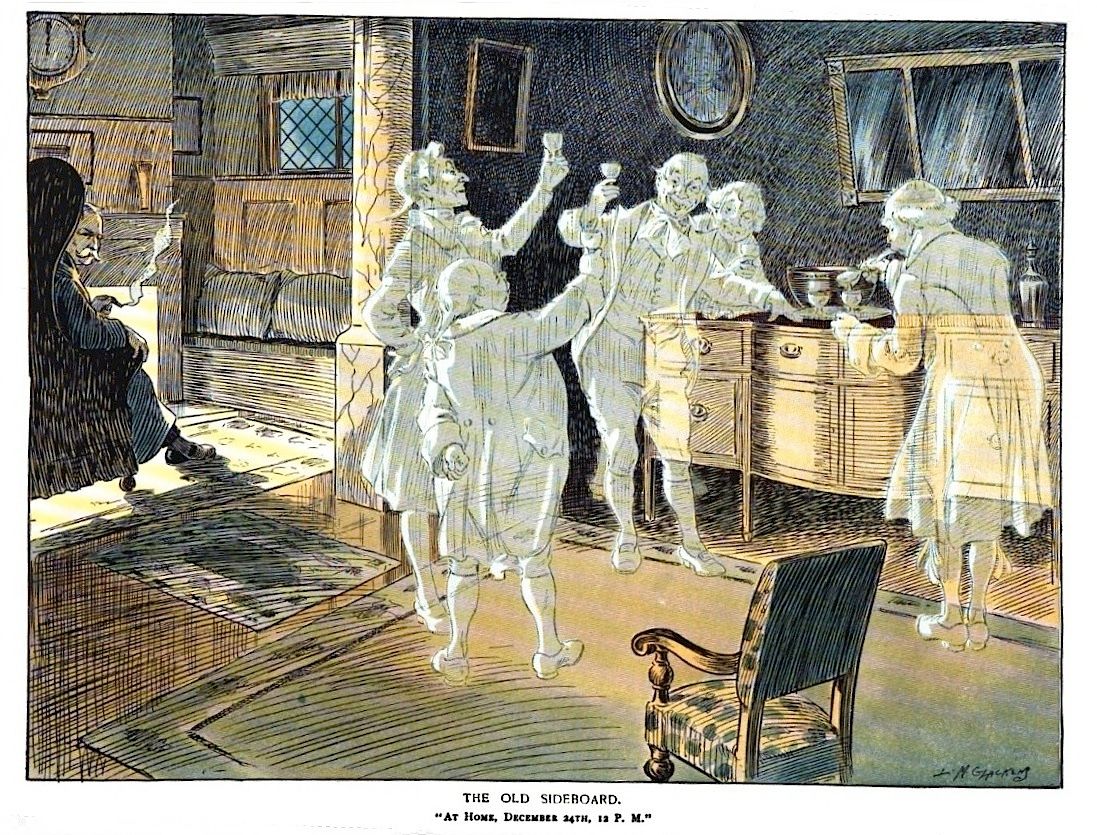
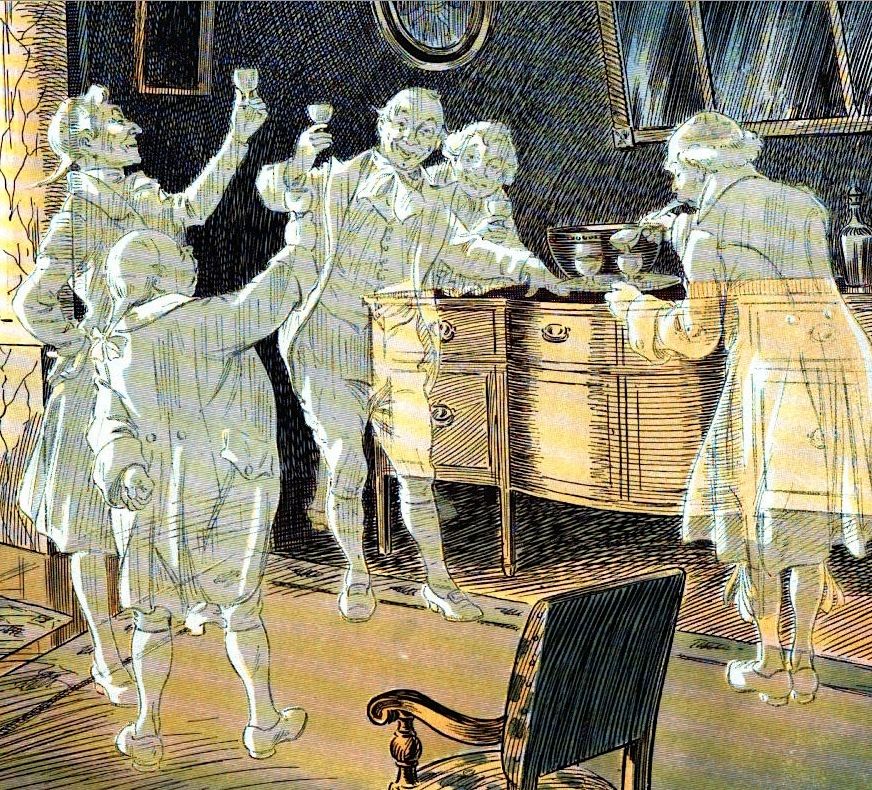
in the middle of the séance table are not unknown to pop culture.

"Good Lord, did it actually just say, 'Wherever they're at' "?


The Forgotten Headless Horseman Scene

$
0
0
.
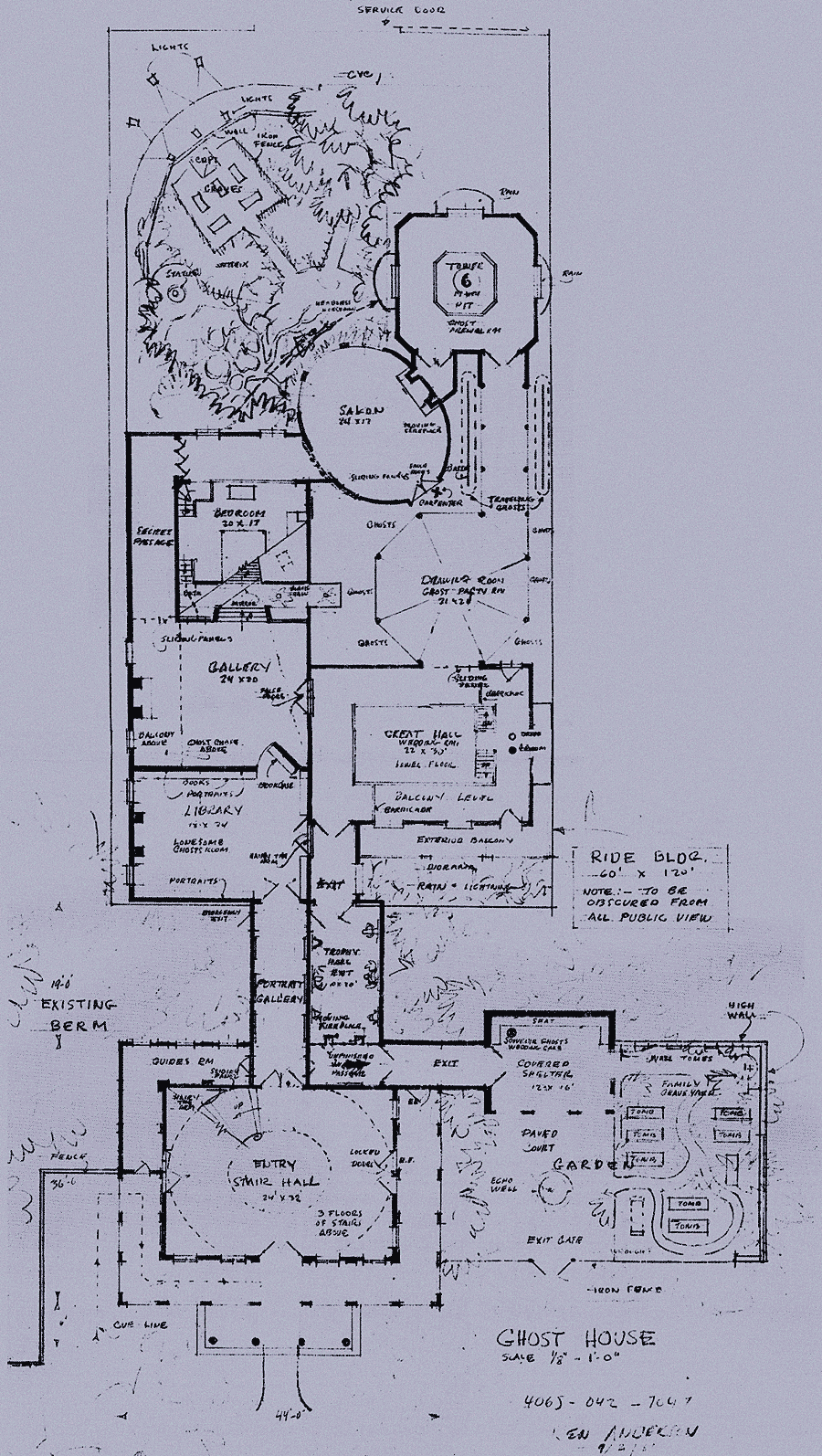
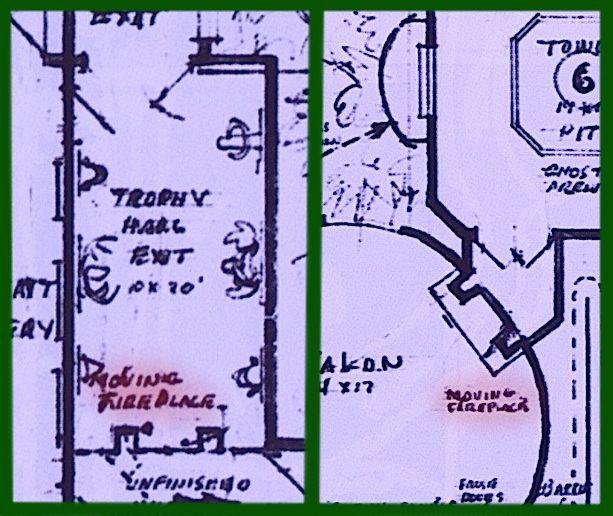
Long-Forgotten had a series of five (count 'em, five) posts devoted to the "Father of the Haunted Mansion," Ken Anderson, back in October of 2010.  And just last month (Nov 2012), the last of the five received a major addition, thanks to the discovery of a new blueprint.  Today's post will be our sixth look at Ken's contributions.

In the course of those earlier discussions, we went through Anderson's "Ghost House" room by room.


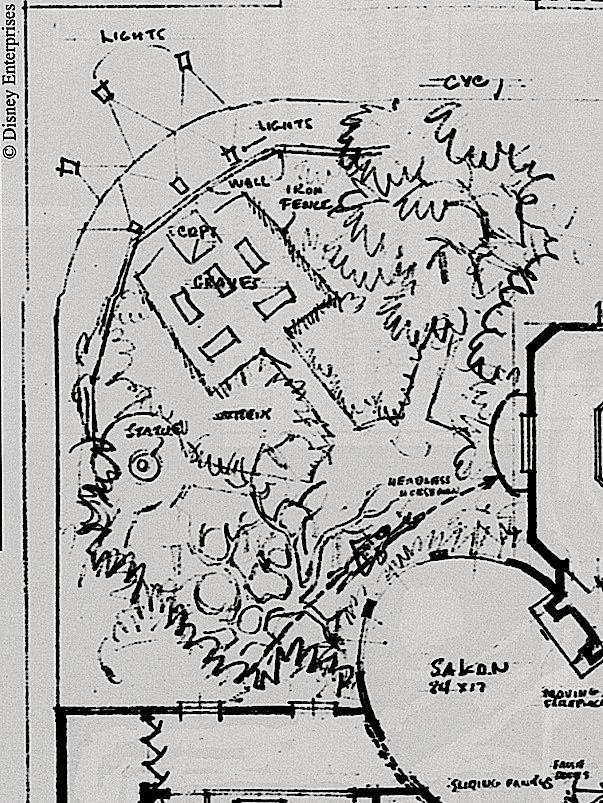
However, there was one item we passed by rather quickly: the large cyclorama.  I thought it might be interesting to
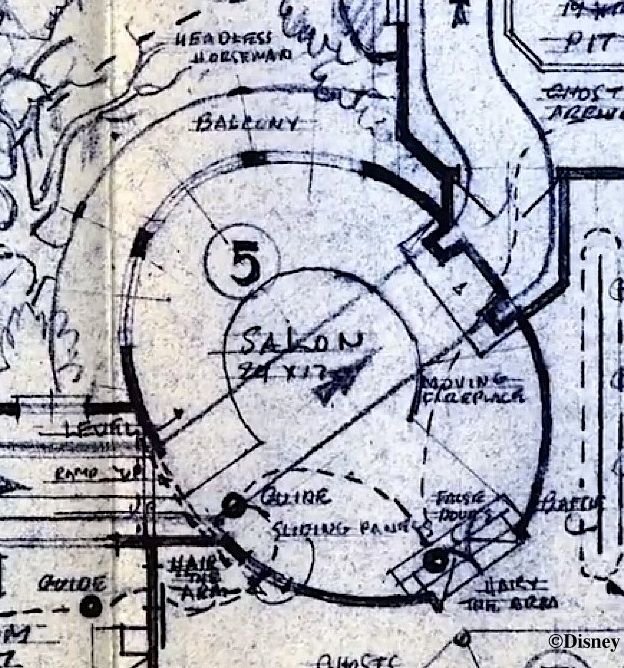
take a good look at that unseen scene seen in the upper left corner.  This is how it appears on the original blueprint:


I like how the cyclorama was to be partially visible through the windows in the hallway leading to the Salon.
That hallway was going to have an unfinished appearance, and with the two windows on the left side actually
overlooking the graveyard scene below, we have something eerily similar to the actual Haunted Mansion attic.


The new blueprint reproduces the original faithfully.  The only real change is that an "outside" balcony has been added to
the Salon, and consequently the path of the Headless Horseman figure (toward the lower right) has been relocated slightly.


In addition to these blueprints, Anderson left behind at least three different descriptions of
the scene, plus at least two pieces of artwork, both of which have been posted previously.


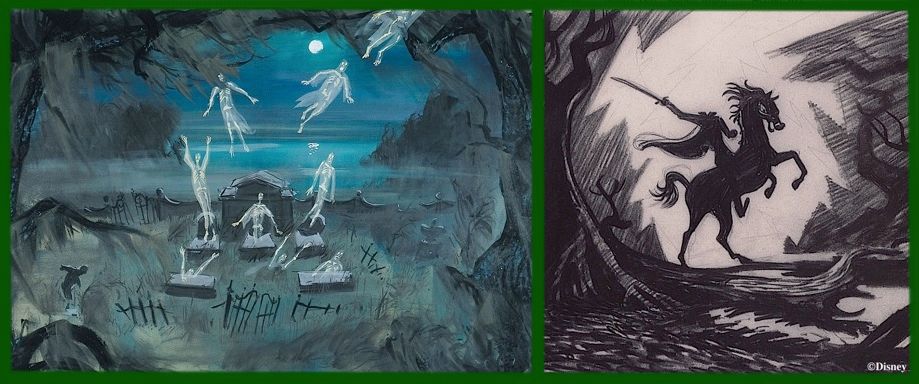
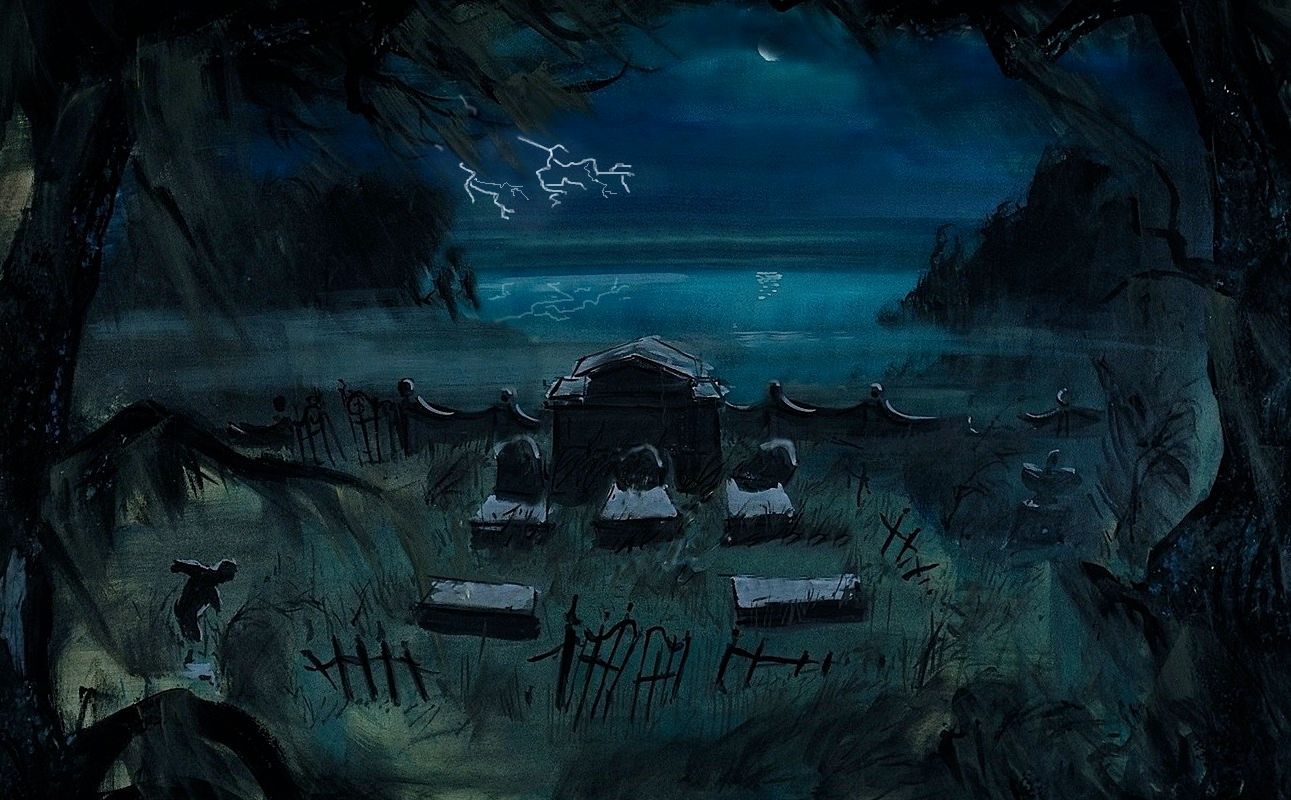
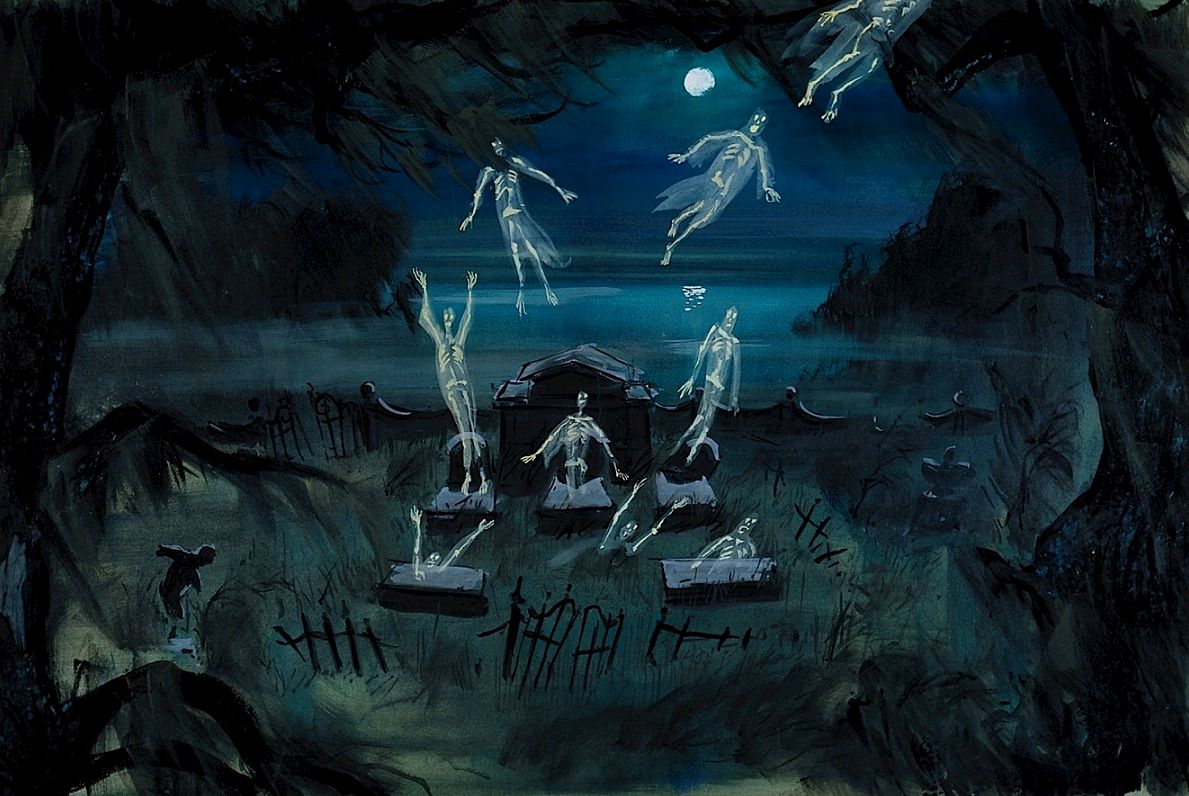
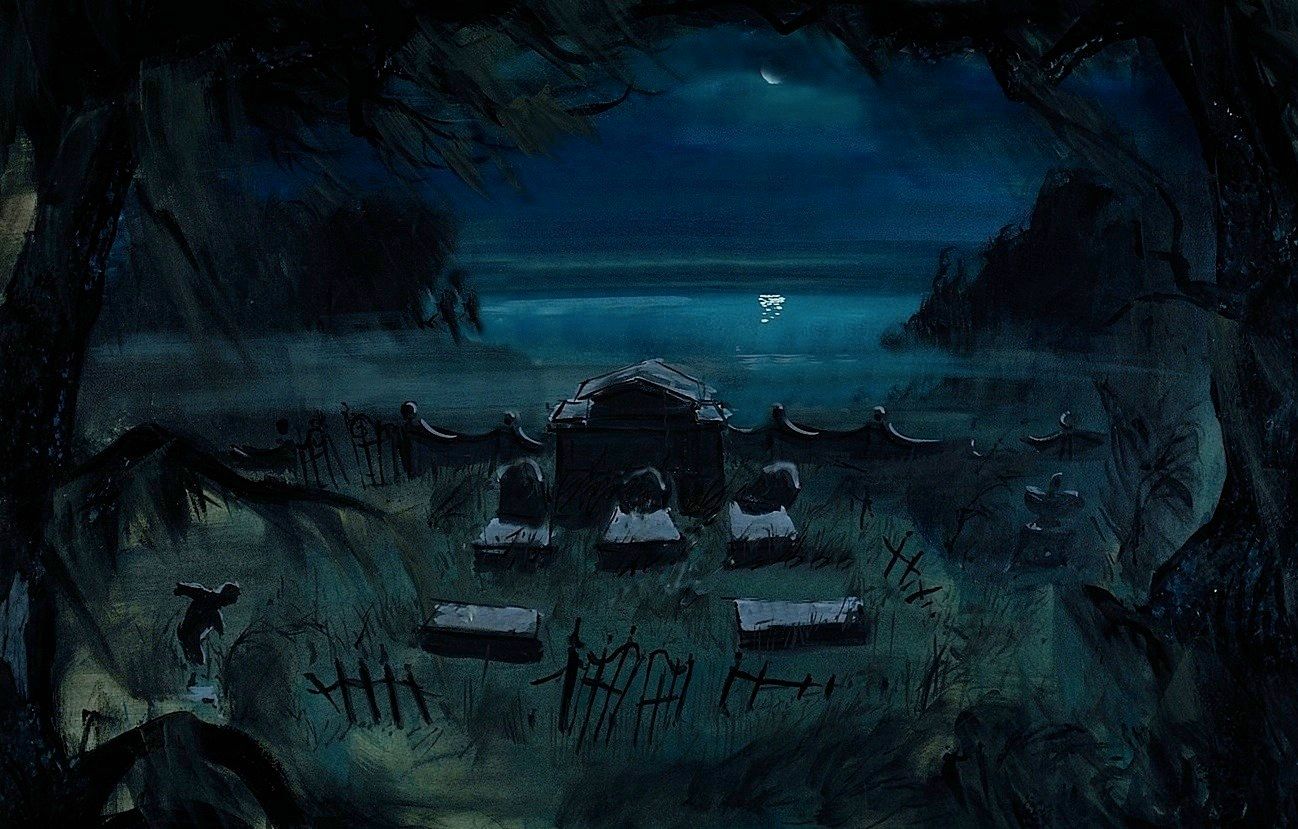
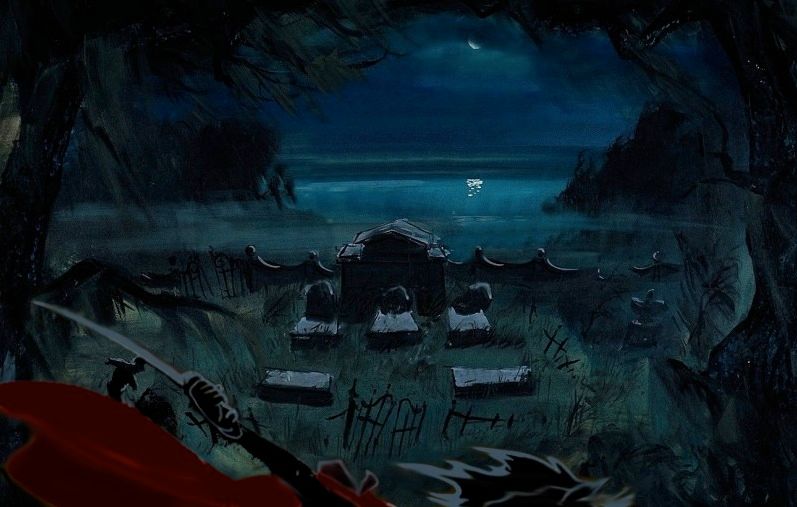
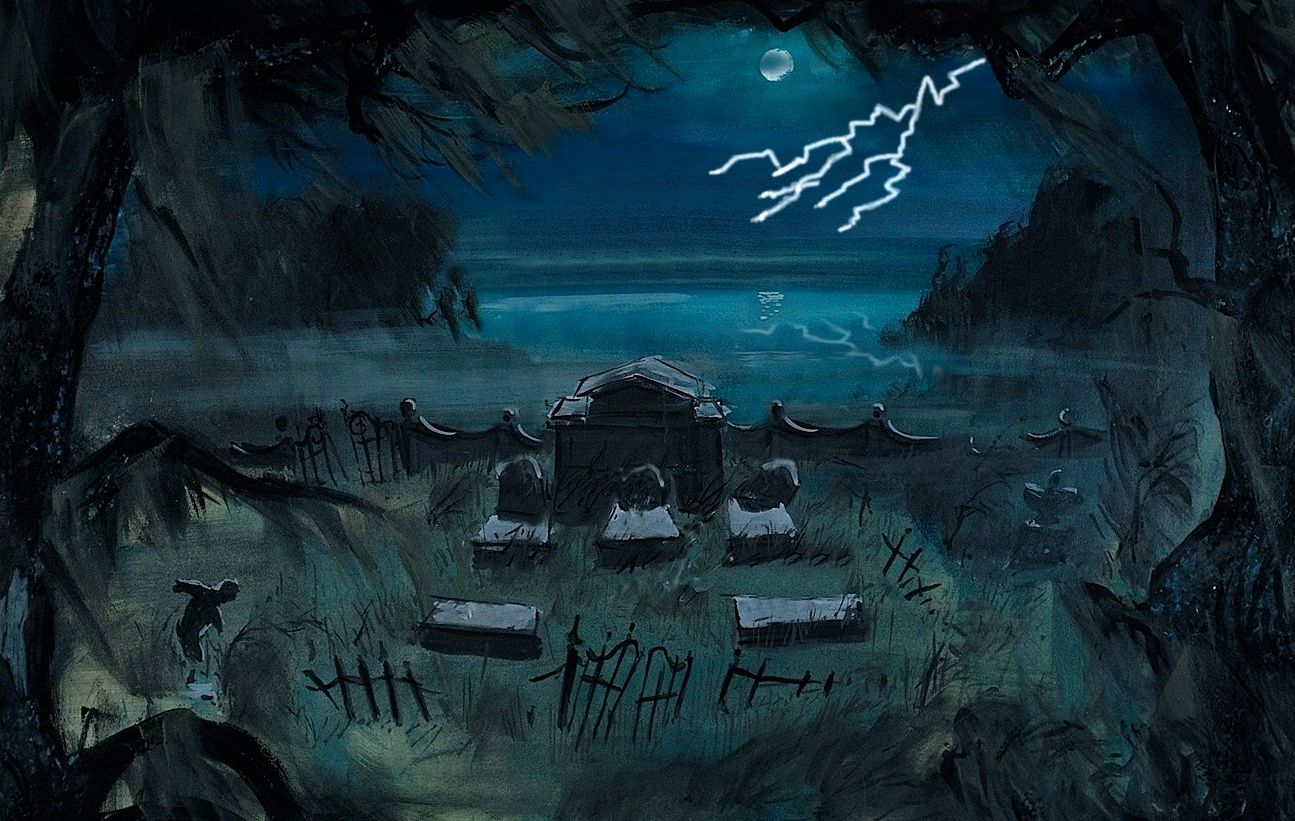
That concept painting on the left is not some sort of free composition but a careful rendering of the cyclorama in the Ghost House as seen by guests through the windows of the Salon.  The correspondance between it and the blueprints is exact and detailed.

With a little cunning photoshoppery, and following Anderson's written texts, the original artwork can be expanded into a sort of "storyboard" for the scene.  Since there is more than one version, each of them securely dated, the exercise is pleasantly similar to participating in the creative process as Anderson first devises and then revises his storyboard.  You can almost hear the wheels turning as he improves the show script.

Someone like David Witt could do much more with this than I can.  On the other hand, there's something to be said for the storyboard format when you're comparing two different ways to block out a basic script.  Then again, I did add some sound effects, so . . . whatever.


The Headless Horseman

Surveys of the Mansion's history routinely mention the early idea of basing the attraction on the Headless Horseman character from The Adventures of Ichabod and Mr. Toad, but in truth he never amounted to very much.  As far as I can tell, this cyclorama in Anderson's Ghost House was virtually the only place where the HH was definitely incorporated into any known Mansion plans.  But dang, it was an impressive scene.

Two of the descriptions Anderson wrote are fairly detailed.  The first version presented here is storyboarded from his earliest script, using artwork I have adapted from his two actual sketches.  Take it away, Ken.


September 9, 1957

"At the centerpiece of our tour, we find ourselves in the ruins of a grand salon."


"The once-ornate domed ceiling is high above us, and the rotting planked floor slopes down towards the shattered ruins of a grand bay window looking out over a moonlit scene of wind-swept, moss-filled trees and bayous beyond.  A broken wall in the middle distance fences in an abandoned family graveyard of above-ground vaults typical of the marshy New Orleans area."


"Far off, a werewolf howls, and the scene outside darkens as clouds obscure the moon."


"Lightning flashes on the horizon and a distant rumble warns of the approaching storm..." 


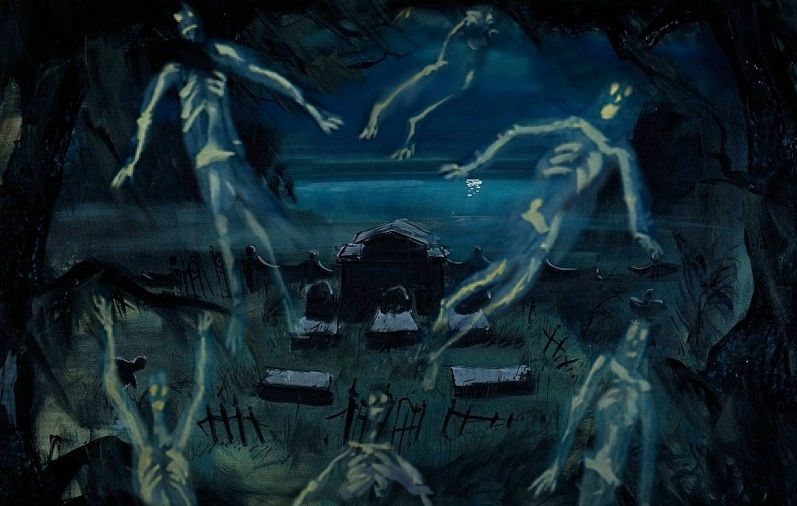
"...but our attention is closer as ghostly skeletons rise from the tombs..." 


"...growing larger as they approach the window then seem to enter the room above us."


"These are the guests arriving for the wedding, and the sound of galloping hoofs
approaching heralds the arrival of a guest of honor:  the Headless Horseman."


"We don't glimpse him until he thunders past just outside the window, his dark
cape billowing behind, but eerily fastened to shoulders that hold no head above."


End.

In another description, also dating from September, Ken wrote: "The distant sound of pounding hoofs signal the approach of the Headless Horseman, who finally crosses the scene outside the windows as his horse gallops through the tops of the trees."  In that last line, I take it he means that you are looking over the tops of some trees in front of the Salon's windows, and only part of the Horseman is visible.

One month later, Anderson revised the script.  It storyboards quite differently, and I think it's a definite improvement.


October 16, 1957

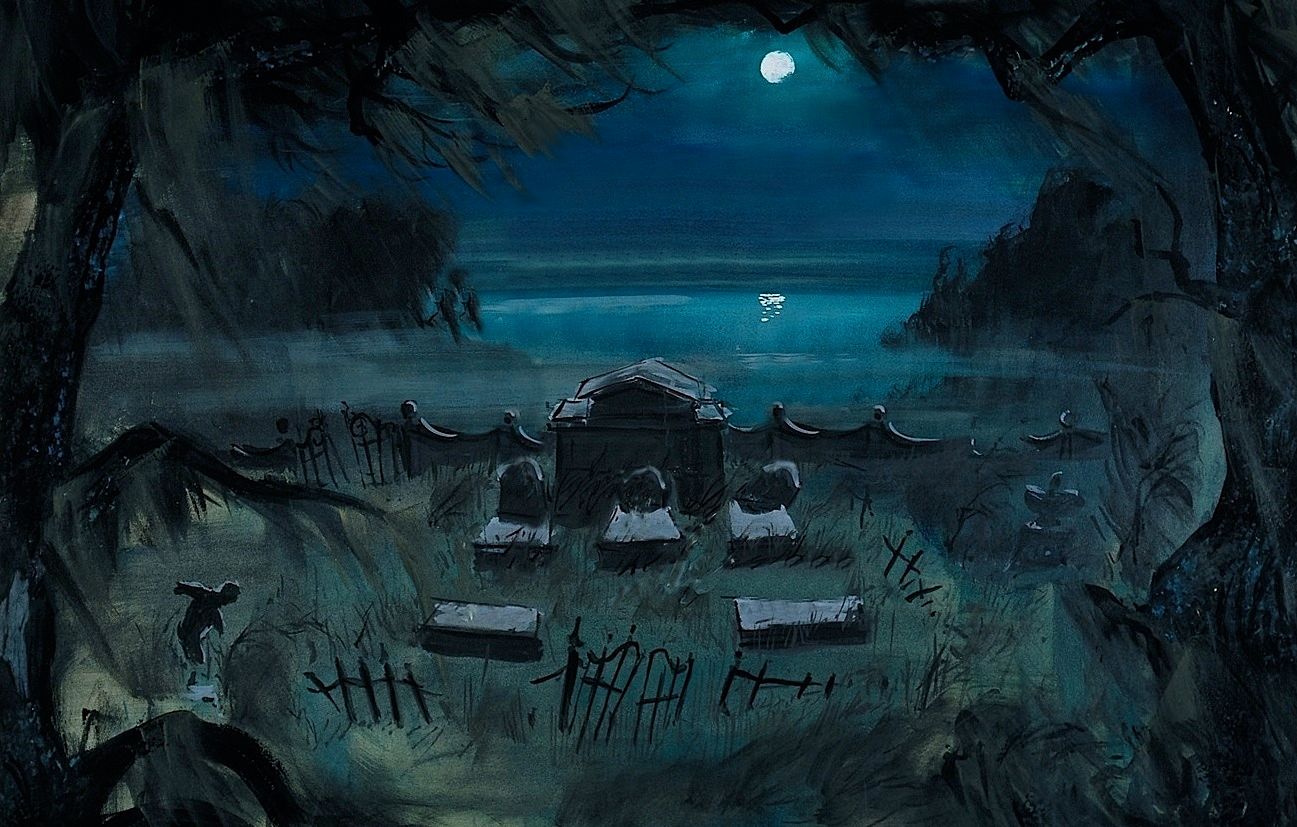
"Commence with a windy moonlit night, with the reflection of the moon in the bayou beyond the graveyard."


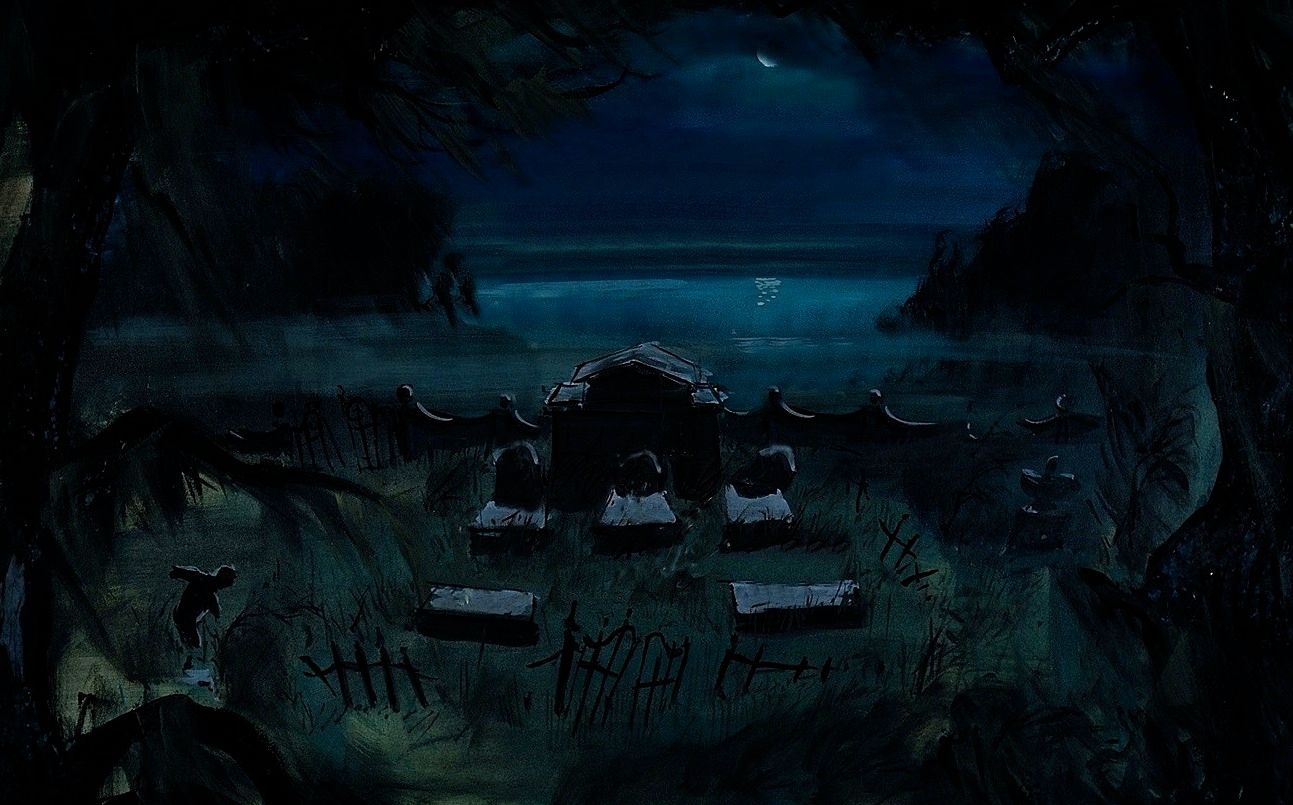
"The clouds will obscure the moon..."


"...and distant flashes of lightning and sounds of thunder will next be heard."


"While the sky is darkening, the ghostly apparition of the Headless Horseman will fade into view or
appear from behind a distant tree and gallop toward the graveyard and house from right to left foreground."


"He will disappear behind some trees to the left, but the sound of
his horse's approaching hoofbeats will continue to grow louder."


"Suddenly, he bursts into view in the courtyard just outside the windows and gallops across from left to right...reining
to a noisy halt just out of view below the balcony on our right.  His cape is the only part of him we need to see at this last
crossing, since the shrubs will obscure the horse.  His cape must match in color and value with the previous projected mirage."


"Next, a bolt of lightning against the sky and a werewolf's howl..."


"...signal the appearance of the ghosts rising from the tombs, first one, and then two, and more,
until ghosts are materializing from the earth around the tombs as well as the tombs themselves."


"Finally, a blinding flash of lightning fills the room and dazzles the spectators, while a tremendous thunder clap ends the
scene.  The room illumination will increase at this point for the benefit of the spectators so they may see to exit."

**********

In this October treatment, there follows a lot of technical instructions, which includes some interesting notes about special effects:

OPTICAL ILLUSIONS

1. HEADLESS HORSEMAN

a. 1st part is projection with Ub's special loop projector using Kronar based film.  b. 2nd part is fluorescent jap silk cape on a wire frame and moved by an aluminum arm from above past the windows.  Match the color to the projected image.

2. GHOSTS

a. Projection by slides on scrims.  1. Experiments to be made by Wathel for Ub on panning projectors and placement of projectors in relation to scrims and cyclorama.  Also try arc hanging on scrims to give effect of ghosts getting closer to viewers.

It should hardly be necessary to remind you Forgottenistas that ghosts done by "projection by slides on scrims" is exactly what we got in the graveyard scene of the actual attraction, twelve years later.

(pic by Jeff Fillmore)

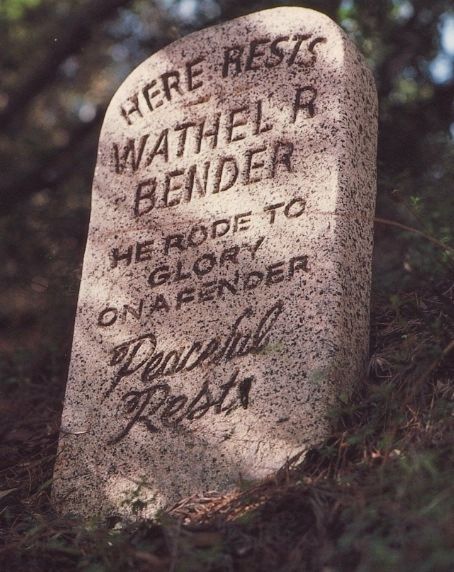
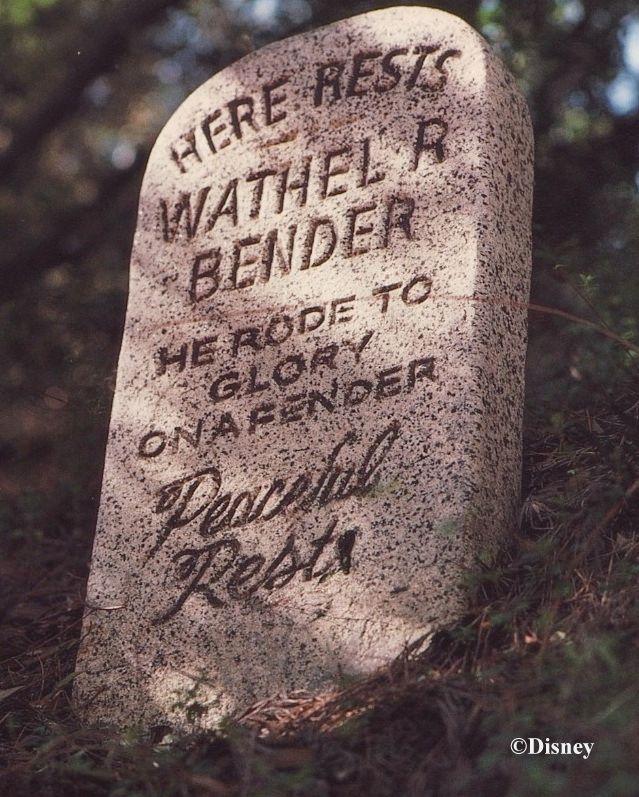
Note the involvement of Wathel Rogers already at this early date in special effects for the Ghost House project.  A mechanical genius, Rogers was the audio-animatronics go-to guy in those early years.  He eventually merited a tribute tombstone at the Haunted Mansion for his abundant contributions to its success.  Many of you knew that already, but did you know he was sporatically involved as early as 1957?


Anderson also mentions "Ub." Of course that's Ub Iwerks, the great Disney legend, the first animator-turned-special-effects-whiz in a long line of such geniuses at Disney.  His name is not usually associated with the Haunted Mansion, but did you know that according to legendary Studio cameraman Bob Broughton, it was Iwerks who discovered the "Leota effect," more or less by accident, using a wig stand?  Yale Gracey and Rolly Crump have always been credited with making the same discovery, and perhaps they did so independently (see Jeff Kurtti, Walt Disney's Imagineering Legends [NY: Disney Editions, 2008] 123-24).

3. CYCLORAMA

Starts with a stormy moonlit sky...the moon reflected in the bayou is to be accomplished by the actual reflection in a water pan below the cyc.  The stormy clouds will be by slide projection on the neutral sky background and will obscure the moon.  The flash lightning and the lightning bolt will also be by slide projector.  Test for diorama as well as Haunted House.

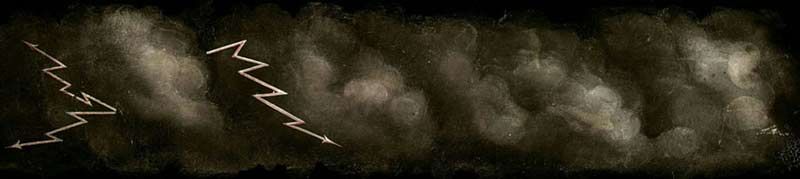
Clouds and lightning flashes by slide projector, you say?  Dude, that effect goes back to the 18th century:

Actual 18th century magic lantern slide

The "diorama" may be a reference to the Sleeping Beauty walk-thru diorama, which Ken was working on during this exact same time period.


4. WIND EFFECTS

Use multiple fans to blow moss and tree branches and to ripple the water and reflections.  Try letting scrims blow a little to see if ghosts are improved by it.

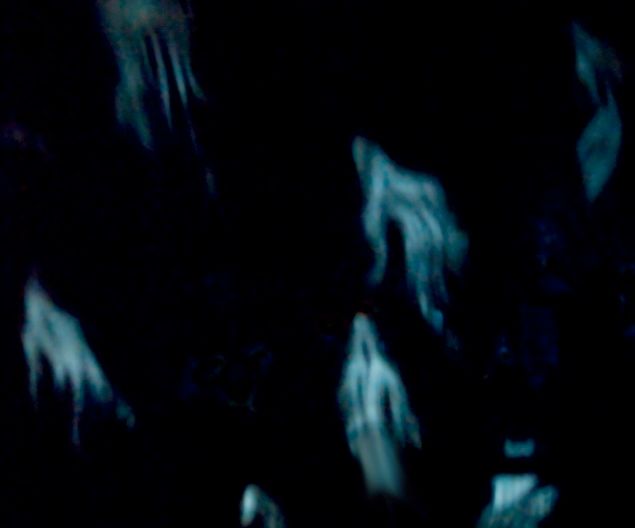
Blowing on the scrims didn't work, apparently, but as we've pointed out before the Mansion does use a fan blowing on a ghost painted on silk in the graveyard crypt.  Not the easiest thing to photograph, but the indefatigable Dave DeCaro has managed to get a nice shot:


The Blue Bayou: An Influence?

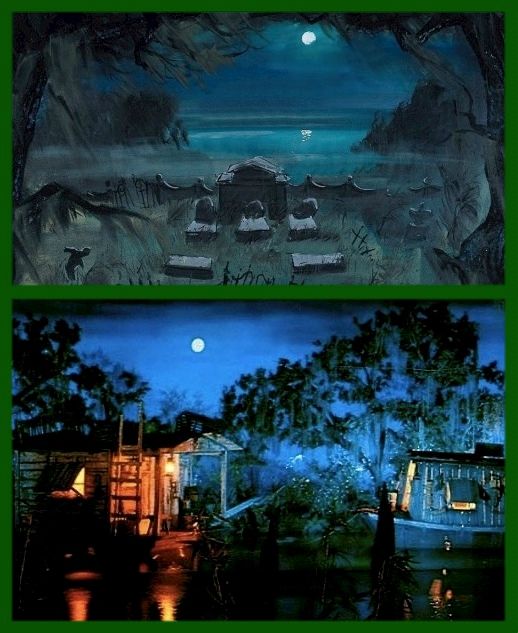
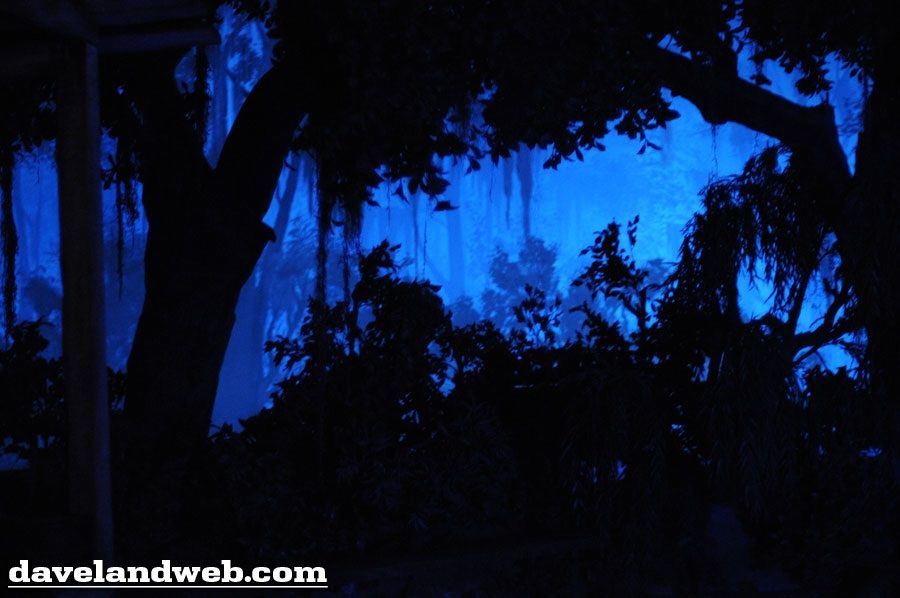
There are some striking visual similarities between Anderson's concept painting and the Blue Bayou lagoon in Pirates of the Caribbean.


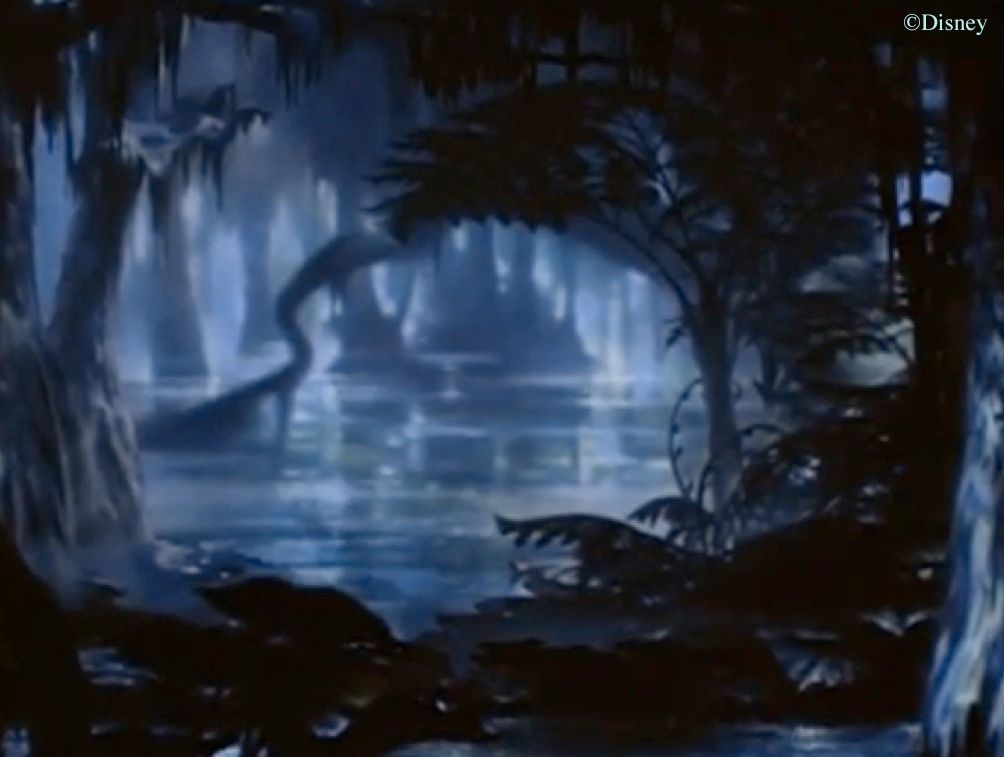
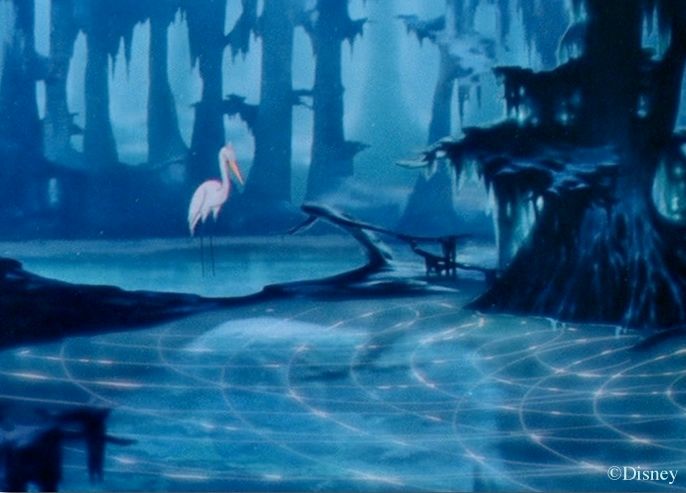
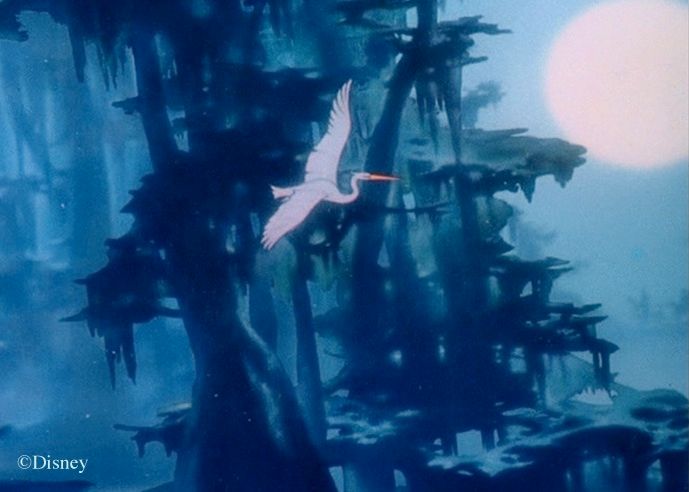
What we may have here are two different works of art using the same source of inspiration, in this case the Disney short, "Blue Bayou: A Tone Poem," included in the 1946 film, Make Mine Music.  "Blue Bayou" was originally "Claire de Lune" and created for Fantasia but cut because of length considerations.  There can be little doubt that it was a major source of inspiration for the look of the Blue Bayou lagoon in POTC.  I mean, come on, the name alone . . .


Compare those with any typical section of the POTC cyclorama:


The bayou in the background of Anderson's painting is similar in appearance, and for the cyclorama he suggests having the moon reflected in real water and rippled with a fan.  As it happens, a lengthy section of "Blue Bayou" is devoted to the play of the moon's reflection in rippling water.


So if the POTC masterpiece and Ken Anderson's concept art for his Headless
Horseman cyclorama have a similar look, there may be a simple reason for it.


Does Size Matter?

$
0
0
.
No.  Well . . . okay, for awhile it did.  Or it almost did.  But not for long.

This is one of those "road not taken" posts.  Not taken, and as a result . . . long forgotten.

In our Walls and Stares post (May 2012), we talked about scaring people by resurrecting their childhood fears; in particular, how the Mansion takes wicked advantage of our propensity for finding frightening faces in seemingly innocent patterns and designs.  Is this kind of psychological exploitation cruel or cool?  Both, you say.  That's it!  It's crool.  In this post we're going to discuss another crool strategy for giving folks goosebumps: intimidation through sheer size.  My hunch is that this particular fear factor is another throwback to the vulnerability of childhood, of living in a grown-up world, where everything is (too) big.  We already touched on this idea a few posts back as we scratched around for an explanation for the anomalous and absurdly oversized bass fiddle in the scale model of the HM attic and in Collin Campbell's artwork.


As a scare tactic, "Big = Scary" is nothing new.  It features prominently in the very first Gothic novel, Horace Walpole's The Castle of Otranto (1764), a book we have referenced before.  A giant helmet falls out of the sky and kills somebody right at the beginning of the book, and further humangous ghostly manifestations follow.  You could say that spectacular size, plays a big, big role, as a horror device, in Horace Walpole.

(You could say that, yes, you certainly could; but I'm guessing you probably won't.)


"No it doesn't.  PAPER covers ROCK."

Whether or not the Imagineers were influenced by Walpole, some of them did consciously plan to use a similar strategy in the Haunted Mansion.  As an Imagineering trick, it's a twisted, unfriendly reversal of forced perspective.  With forced perspective, things that are actually small look larger than they are, but with size intimidation, grotesquely oversized things are used to make you feel smaller than you are.

Have you got that, shrimp?

At the Mansion, discussion of this strategy begins and ends in a familiar place.


Once Again, the Stretching Gallery

Time and again we've highlighted the "actually happening or your imagination?" dilemma posed by the stretching gallery.  It's an essential key for understanding the experience in store for us.  Either the ghosts have power to manipulate the very fabric of the building, or they are able to trick the mind, perhaps even induce hallucinations.  Either of those prospects is scary enough, but our inability to even know which of the two is in operation only adds to the disorientation and unease.  And so the table is set, and we're off and running on a haunted house adventure.

Something we haven't discussed is the specific nature of the manipulation/hallucination.  The room stretches.  It gets bigger, much bigger.  So one thing the gallery does is make you feel small.  When the place is fully expanded, it really is an impressively big room.  This is something I've particularly noticed in my most recent trips to Disneyland.  The sense of smallness and vulnerability that guests are liable to feel reminds me of Alice during one of her shrinking episodes.  As with her, it is like a dream that is turning into a nightmare.


(I couldn't decide which of these two photos better conveyed that sense of hugeness, so you're getting both.)

(pic by orbitalpunk)

After the gallery finishes stretching, you are plunged into darkness for a few moments, and then you exit into the next room, the changing portrait hall, where everything is once again normal in size.  You're still in a fear-inducing environment, but the specific sense of smallness is left behind.  What you probably don't know is that once upon a time they seriously considered keeping you small and vulnerable, at least for awhile.


Changing the Changing Portrait Hall

We know this, because in a 1964 show script, Marc Davis spoke of the portrait hall as a room "filled with oversized furnishings, paintings, and sculptures."  In other words, everything was going to continue to look BIG.  This would have been consistent with our experience in the stretching room, and the dilemma was going to become a trilemma:  (1) Is the room really expanding? or (2) is it your imagination? or (3) are you shrinking?

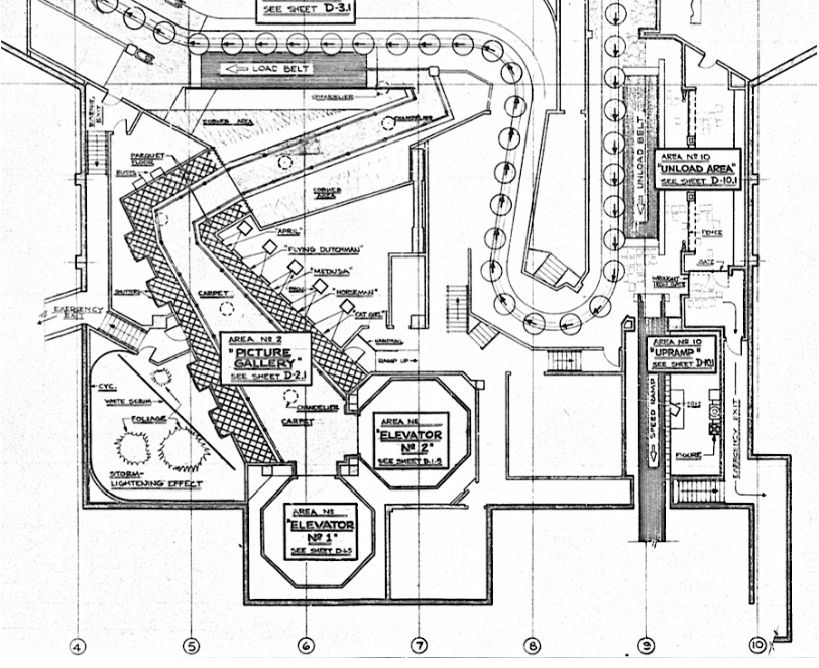
Interesting, but how could they have accomplished this gargantuan feat?  Well, to begin with, they had plenty of room.  The space where the changing portrait hall would eventually go was already there when they finished the 1962 façade building.


The foyer and stretching elevators were built into the familiar white mansion during construction, and down below, the passageway under
the railroad tracks was cleared, leading out to the area where the main show building would be constructed in 1968.  This is a 1964 photo.


Hellooo-ooo in there -ere -ere -ere.   Here's another view, from 1966 -ix -ix -ix.


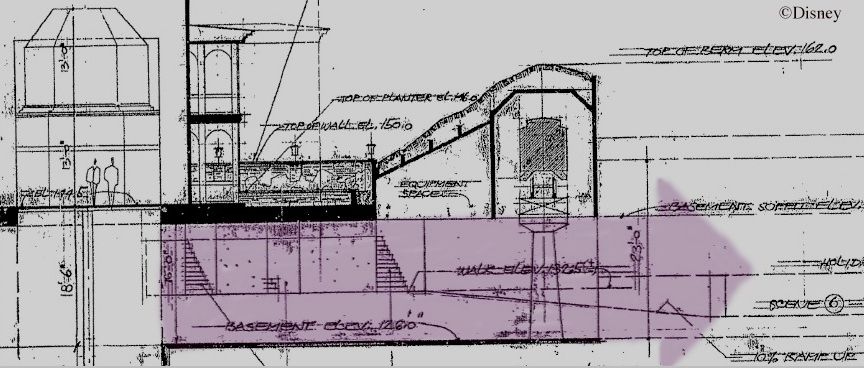
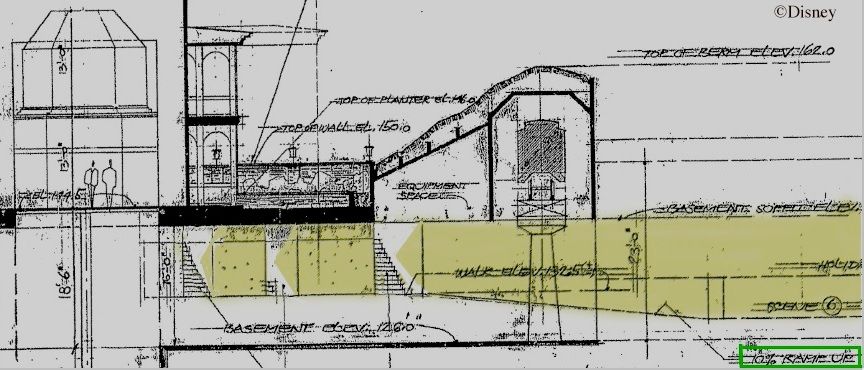
In those early years, the Haunted Mansion was going to be a walk-thru, and in order to handle the traffic, they were going to have two complete versions of the attraction side by side.  (That's the original reason for building two stretching rooms.)  So when you look at that open space, cut into halves by the trestle support in the center, you should also try to envision each side being further divided in half, making a total of four passageways coming out from under the tracks, because you need a departure corridor and a return corridor for each of the two walk-thrus (or should that be "walks-thru"?  I'm a grammar freak; I should know this).  Anyway, even after the division into four, each of the hallways would still have been an impressively large, cavernous structure with a high "ceiling" (i.e. the RR bridge).  Not only that, but there are clear indications on the above blueprint that they intended to make the return hallways something much closer to a normal size for a house, thereby leaving even MORE room for the departure halls, which could be made that much loftier and wider.

You emerge from the stretchroom and depart via a hallway with an approximately 16-foot ceiling:


You returnvia a hallway with a ceiling that is already a few feet lower by that point, and you go up a "10% ramp" until the hallway has a normal nine or nine and a half foot ceiling, and you finally return to the outside world via one of three staircases.  (And now your curiosity is aroused, isn't it?  Don't worry; we'll talk about those stairs in the next post——and that thing is going to be a humdinger.)


So the room following the stretching gallery would have been . . . BIG, perfect for Davis's oversized furniture and artwork.  Already in Ken Anderson's ghost house, the hallway leading under the berm to the show building was going to be a changing portrait gallery, and as far as I can tell this plan was never altered.  So it may be that the massive size of the area encouraged Imagineers to think of an equally massive room for the changing portraits.

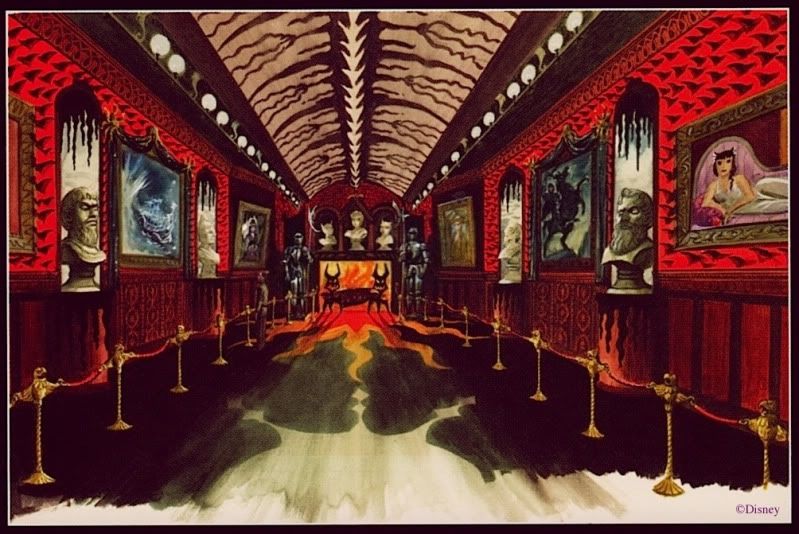
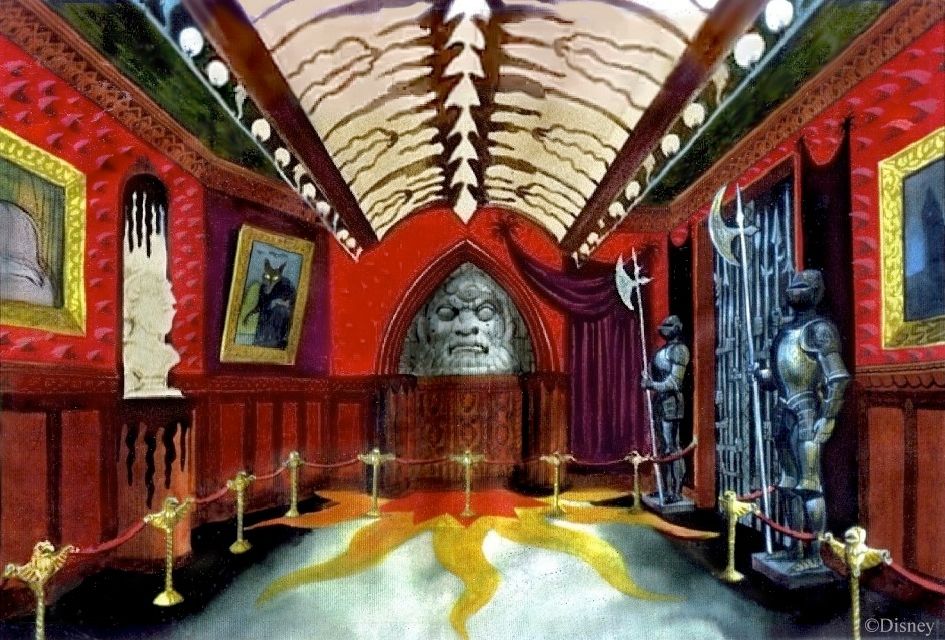
When Marc Davis got around to doing some concept art for the portrait
hall, it reflected this idea, although it's something very easy to miss.


That room is bigger than it may look.  Notice the size of the man on the left, and compare him with the suits of armor or the busts.


"I'm feeling a little . . . little."

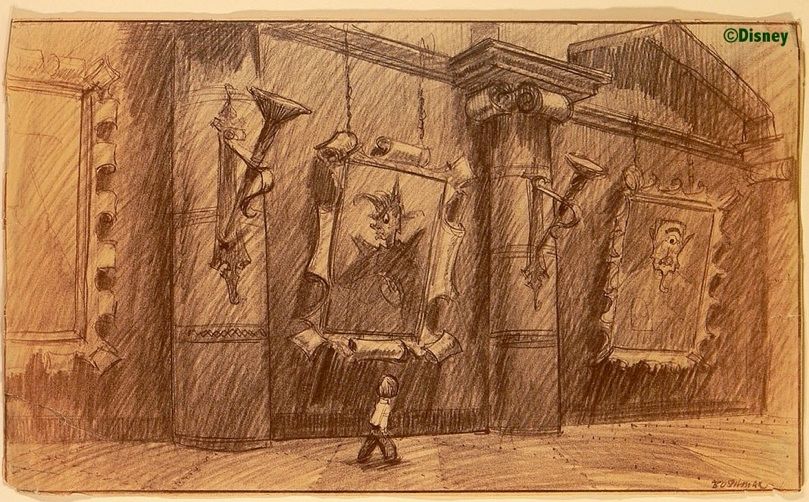
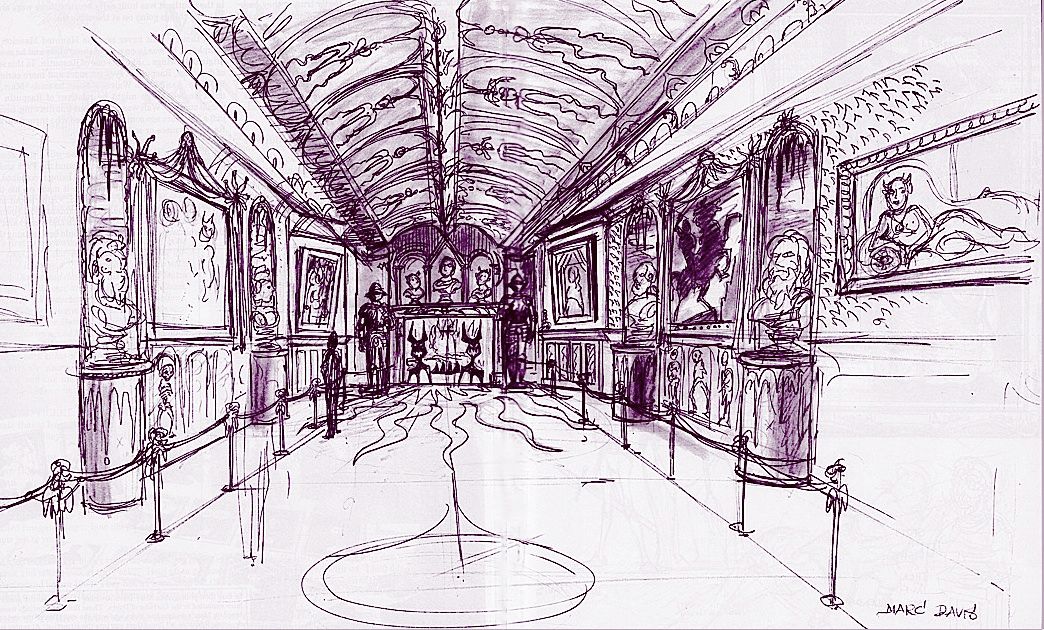
Disney artist Bruce Bushman, a name not usually associated with the Haunted Mansion, did a concept sketch for this hallway that uses
the same approach, intimidation through sheer size.  In fact, this sketch may illustrate the idea better than any other HM artwork.


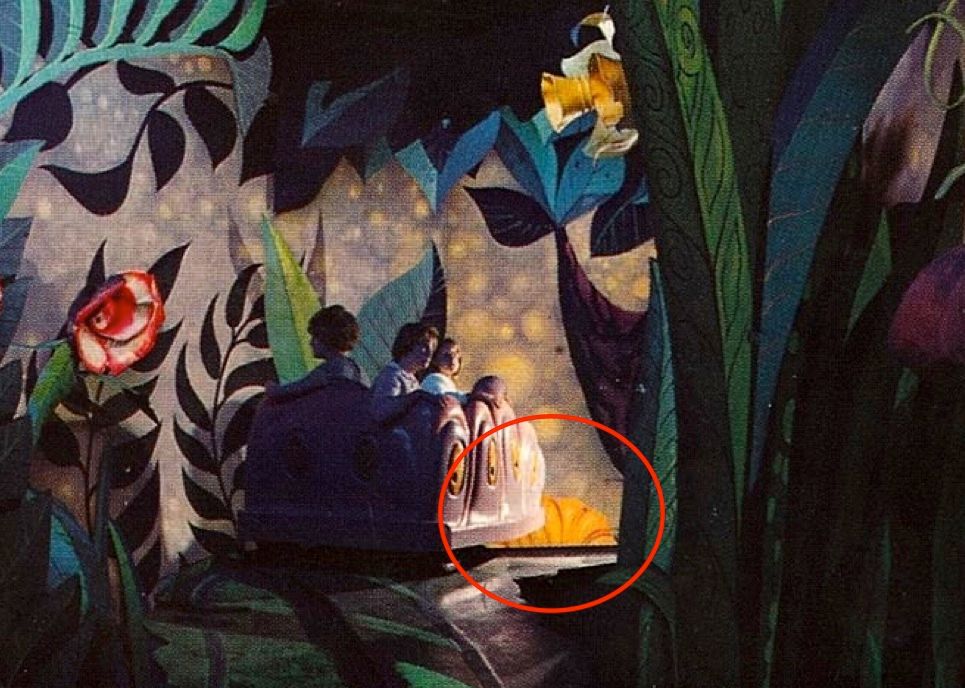
Architecturally, it isn't too difficult to imagine that scene as one of the four hallways fitting into the space under the train tracks, is it?  It makes me think of Mickey's visit to Willie the Giant's castle in "Mickey and the Beanstalk," or poor Alice, shrunk to the size of a caterpillar.  I mentioned Alice earlier, and as a matter of fact, it was the Alice in Wonderland ride that seized on this idea and actually used it, as can be seen from this rare interior photograph of the classic 1958 dark ride:


If you ask me, THAT is scary.  It also illustrates well what is perhaps the greatest strength of this gimmick: repeatability.  This scene feels intimidating no matter how many times you look at it.  (It was bad enough to have that cat laughing at you continuously, but as soon as you went under his chair, he popped down in front of you on the other side, upside down.  You can see him by the girl, already there.)  It's not surprising that this section of the original Alice ride featured a great Haunted Mansion forerunner: the first pop-up bogey in the park.  Toward the end of the garden of live flowers, a Tiger Lily used to pop up on your left with a roar and a scowl.  I've found no pictures, but in this one you can see the top of his head.  He's poised and ready to jump.


When I was a wee one, I had to close my eyes at this point.  I'm not kidding.

Anyway, back, back, back we go to the changing portrait hall, and plainly none of this oversizing was implemented.  I don't know why.  Perhaps they couldn't figure out how they would sustain this surrealistic motif for the entire ride, or perhaps they thought it would wear out its welcome after awhile.  And when the ghosts finally materialized, what were they going to be, giant ghosts, à la Otranto?  Then again, it could have been a purely practical decision.  It must have taken a LOT of "padding" to prevent the sound and vibrations from the train from leaking through, so there was probably no way the ceiling could have remained quite so high as they may have liked.

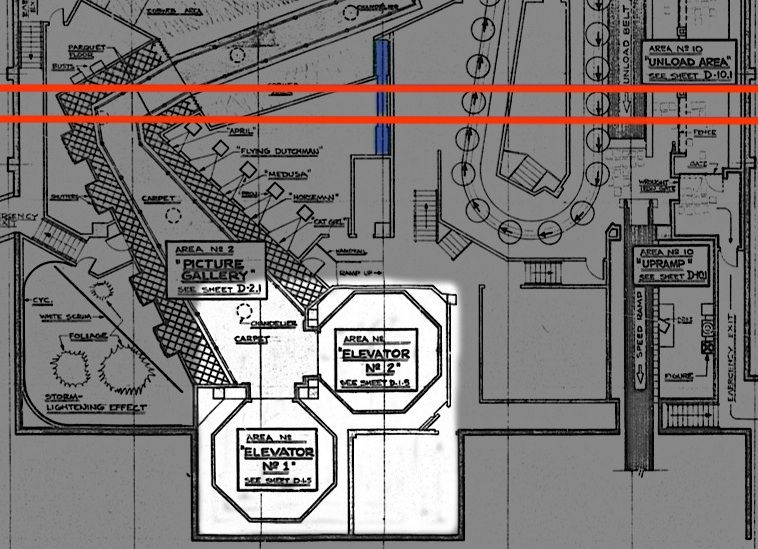
This is how the space was eventually utilized, with both elevators spilling into the same changing portrait hall, going off at an angle.  The red shows approximately where the railroad tracks are, and the central trestle support is in blue.


Bigness Elsewhere

You might say that in the end, the changing portrait hall was not a big deal.  You might also say, "Not one of your better puns."  You might also say, "Get on with it."  Okay, is there any place else where size intimidation made it into the Haunted Mansion?  The stretching gallery is still there, of course, but it has no furnishings to set the true scale for the house, one way or the other.  (But did you know they almost put a piece of furniture in there?  See below.)  There is a bass fiddle in the attic, but it is a normal size, so that prop didn't materialize.  At eight and a half feet, the grandfather clock that we discussed a few posts back is tall, but not extraordinarily so.  In their heyday, longcase clocks were commonly six to eight feet tall.

Unless I'm overlooking something, the only example of a giant thing in the HM beyond the stretching rooms is the jumbo
spider web with its oversized spider that framed the entrance of the doombuggies into the Limbo loading room until 2001.


Tokyo still has its giant spiders further along in the ride, but WDW lost theirs to the Grand Staircase scene in 2007.  I suppose that technically, "giant spiders" qualify as an example of size intimidation, but . . . meh.  Weak example. They're alive, and therefore monsters, arachnophobic nightmares, not evidence that you are small.  They're also campy Halloween decor, as we've discussed before, and you could even say they're a Disney cliché.  If the spiders are all that's left of the size intimidation scare tactic, then there isn't much.

So I guess that's it.  We're pretty much done.  Except I do have one idle speculation left, offered for what it's worth.

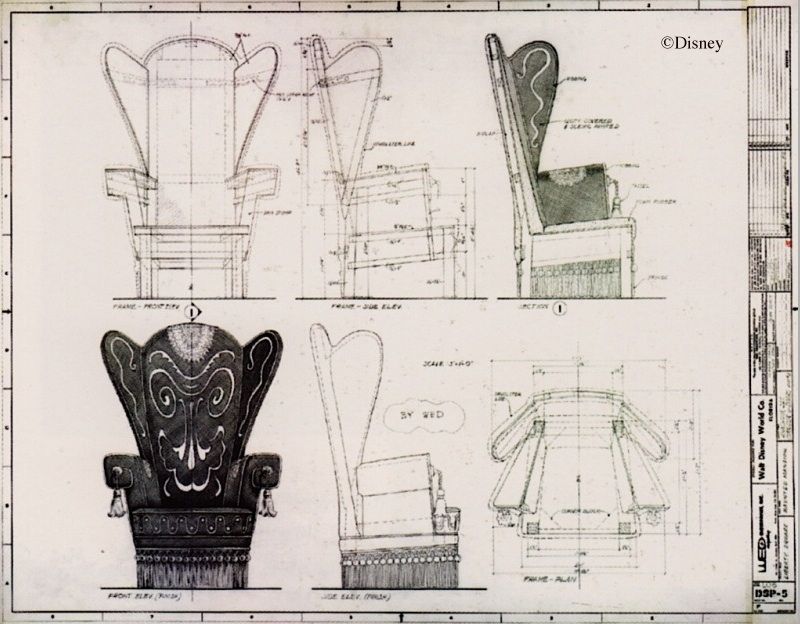
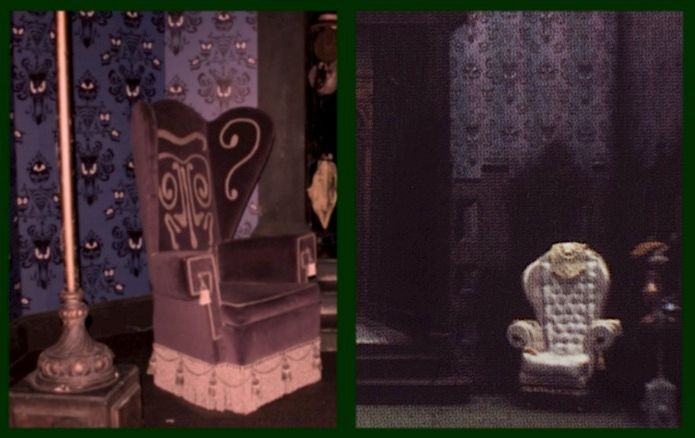
It's always seemed odd to me that the so-called "Donald Duck chair" was designed absolutely from scratch.  It seems like a lot of bother for such a relatively unimportant prop.  Couldn't they have simply found an appropriate looking overstuffed chair and put the creepy embroidery designs on that? perhaps with a few other modifications?  With its chunky wooden skeleton, it strikes me that the blueprints for the chair look like the sort of thing you might expect if it were originally going to be a huge, Alice-in-Wonderland-sized prop, one of Marc Davis's "oversized furnishings."  I wonder.  Is it possible that after the oversizing gimmick was scrapped, they salvaged their plans for a crool, sinister-looking, giant chair and simply scaled it down to normal size?  To judge by Davis's concept art, oversized = about twice normal size, so it would have been a simple matter of halving all of the original dimensions.


This is only conjecture, I admit.  But we've all seen giant prop furniture, most commonly in old
sci-fi movies and TV shows, and doesn't this chair design have that same artificial, boxy look?

(pic by Loren Javier)

So there you have it, as the Brits say.  At one time the Imagineers thought they would unnerve you by making you feel very, very small, but that approach was rejected in the finished attraction and subsequently forgotten, long forgotten.  You had to go on the Alice ride if that kind of creepy feeling was your cup of tea.  (Just half a cup if you don't mind.)


A Post Script on the Bookcase that Never Was

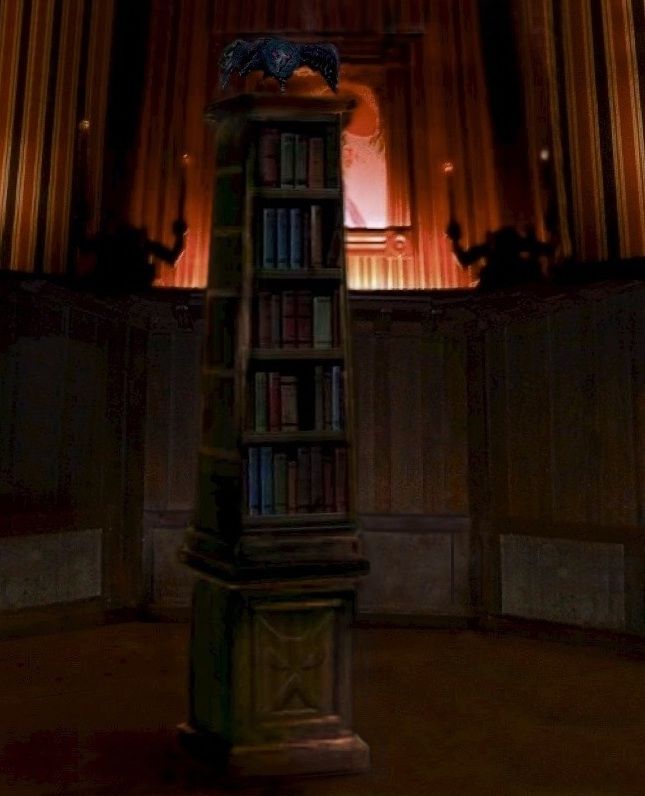
There is no furniture in the stretching gallery, but as late as the spring of 1969 they had plans to put a raven in there, taunting the Ghost Host. ("caw caw, the coward's way," etc.)  Apparently the bird was going to be sitting on a bookcase.  What kind of bookcase, and where they were going to put it, no one seems to know.  For what it's worth, here's a photoshopphotoslop I threw together.  It at least gives you an idea of one way they could have done it.  There must be artwork somewhere.  It would be fun to know what they were actually going to do.


To Find a Way Out

$
0
0
.
.                                                                               1963 publicity shot.  The back reads:
. "WAITING FOR THE GHOSTS -- Disneyland's Haunted Mansion rises in Frontierland beside the Rivers of America.  Slated as a major attraction
.  for the future, the Mansion will be peopled by the world's most famous ghosts now being rounded up by Walt Disney's artists and craftsmen."

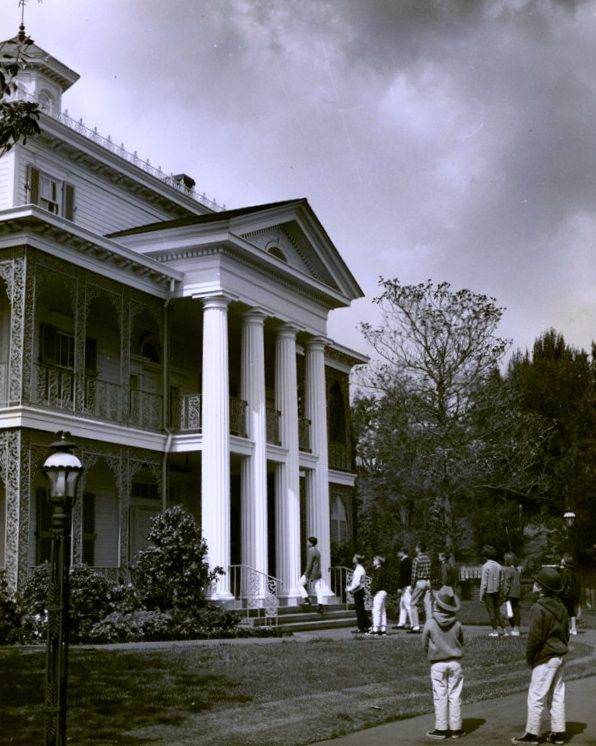
The familiar white building that we see today was constructed a full half century ago by artists and engineers planning a very different attraction than what actually went into it.  Major changes were made to the grounds and to parts of the interior before the ride finally opened seven years later.  During the first decade of operation, further changes were necessary in the enclosed queue area to the south of the house.  It's a place we have come to know well.  We did a post on the modest and whimsical "family plot" that used to be there and another post on the ornate and monumental "lost graveyard" that was originally going to be there but was never built.

What is, what was, and what might have been.


Today's post is essentially a sequel to the Lost Graveyard post, reflecting information taken from old photos and 1962 blueprints that were unknown to me until recently.  It turns out there are still more surprises in the history of that queue area, a history that is clearer now than ever before, and I've uncovered a few other long forgotten goodies, including what is more or less a second "lost graveyard."  Here's a summary:

On the grounds of the Haunted Mansion are two sites that were originally graveyards but which have been altered beyond recognition, for reasons known today only to a few.  There are hidden passageways leading to both sites that were extremely important at the time they were built, intended to serve a central and essential purpose, but which today are infrequently used and unknown to most people.  The exit for one of these secret passages is hidden from view, seldom seen by any visitors today.  Visible remnants of these older structures remain, having been incorporated into new structures or put to different use altogether.  These are changes that happened so long ago that there are very few people still alive who can explain them, or who even know about them.  They are part of a narrative unrecorded and long forgotten, a history unknown even to the Mansion's current occupants (i.e. Disney employees). 

These mutations all stem from pragmatic, logistical issues which arose in the construction and subsequent operation of a popular theme park ride.  In other words, none of it has anything to do with the imaginative world of the attraction itself.  But if so, why does it almost feel like it does? With a few nips and tucks, that red paragraph could serve as background material for the plot of an interesting haunted house mystery.


This Old House

I briefly alluded to this phenomenon in an older post about The Missing Door.  You will recall that the HM blueprints call for a door in a wall across from the Conservatory, but at Disneyland the door isn't there.  In any other ride, a missing door like this would barely be of interest even to the most hardcore Disney freaks, but at the Mansion, a missing door is instantly romantic, easily absorbed into the imaginative world of the ride itself.  You might ask yourself what the ghosts were up to as easily as you might ask yourself what the Disney architects were up to.

It's just the nature of the beast.  With a haunted house, the house qua house is part of the story.  When you read about some haunted hotel somewhere, it's not just that some guy committed suicide and now haunts, it's that some guy committed suicide in this very room and now haunts this building.  That window right there is mysteriously found open all the time, etc.  Unlike Pirates or Small World, if the park engineers fiddle with the grounds around the Haunted Mansion, there is a tendency for the changes to be sucked into the backstory of the ride if possible.  And consider this Disneyan observation:  Is there any other attraction where the prospect of "a backstage tour" somehow or other feels like it might make the fantasy more vivid rather than less, even though you should know better?  It's because the house is not separable from the show.

Maybe that's why a real-world historical probe like this one appeals to more than just DL history geeks.  In some strange way it seems to augment the experience of the attraction.  It enhances the pleasurable illusion that this is a very old house with a shadowy past.  Thanks to the freakishly long and convoluted history of the original Anaheim Mansion, it has an archaeological depth that is simultaneously genuine and feels like it belongs to the attraction's imaginary world.

All of this is unintentional of course, but in even the finest art, some things are just dumb luck.


A Tale of Two Courtyards

At the time I wrote "The Lost Graveyard," it wasn't completely clear to me how that cemetery was connected to the rest of the attraction.  Also, I ignored the similar enclosure on the other side of the house that begged for its own explanation.  But now, thanks to new information and some stimulating observations by a friend I call Lonesome Ghost, things are much clearer.  There are not one but two "lost graveyards," and what is more, anyone can still get to them from inside the Mansion, and in much the same way that they would originally have been entered.

You can get to one of them today by not being bold enough.
You can get to the other one by being much, much too bold.

You will recall from our Does Size Matter? post that when the building went up in 1962, plans called for a walk-thru haunted house in duplicate in order to handle the crowds, two complete versions of the attraction side-by-side.  Already in 1957-58, Ken Anderson had come to realize that a single walk-thru wouldn't hack it, but until the fall of 1967 (a full decade later!), no satisfactory mode of conveyance had been settled upon.  In the meantime the default was still the walking tour.  By doubling capacity, that option had managed to stay alive as a realistic possibility.

The two stretching galleries would have marked the beginnings of the separate shows.  Apparently, the two tours would have gone up the middle, side-by-side, done their thing outside the berm, and then turned outward and returned along the outer perimeters inside of the show building.  They would have been mirror images of each other, in other words.  But what about the exits for the two tours? Ironically, I think the basic concept for those exits is most clearly and simply articulated in plans drawn up for another Haunted Mansion, one which was never built.

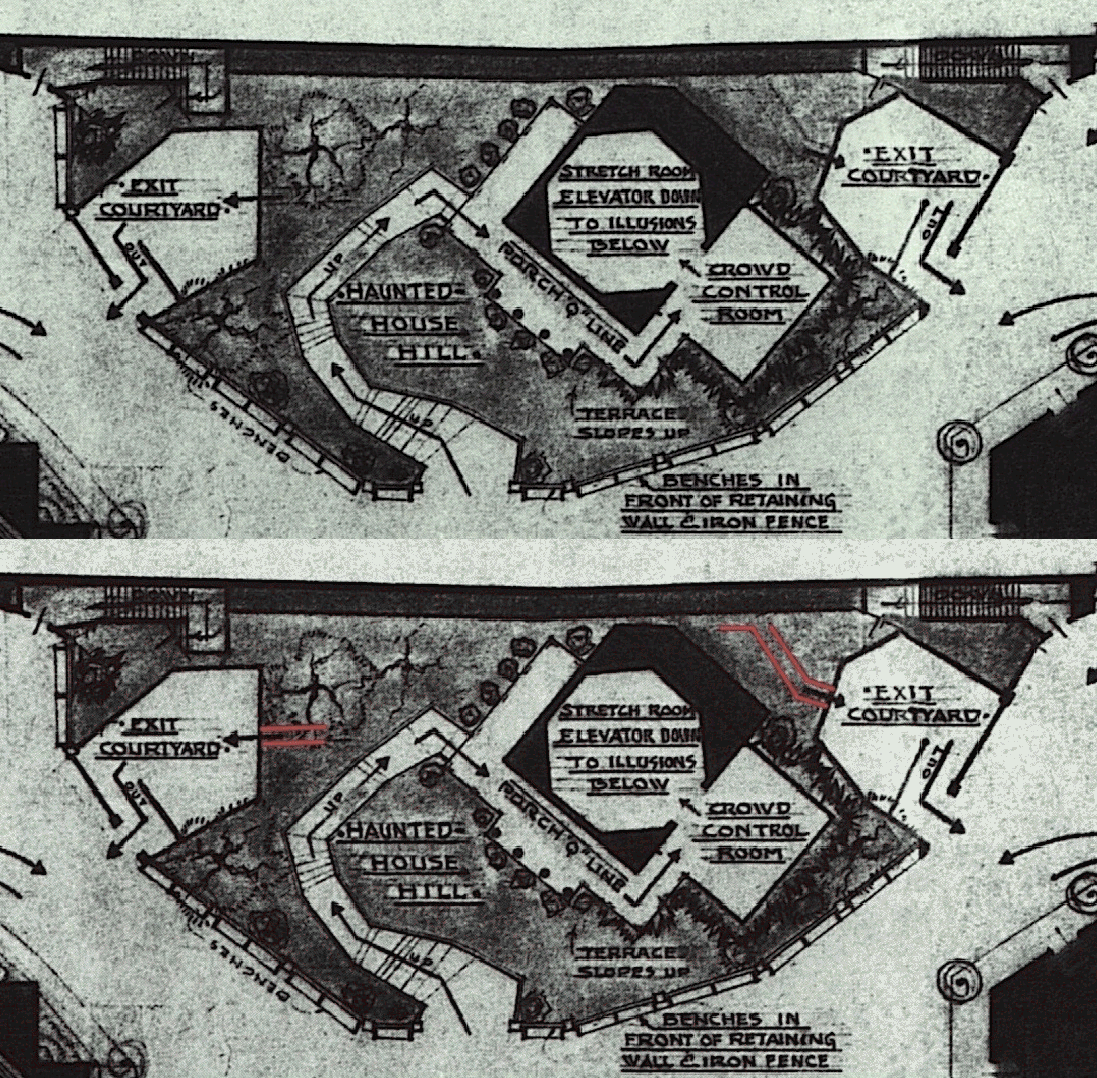
It's funny how a lot of Disney fans have never heard of the "St. Louis Project."  In 1963 and 1964, Walt was considering building a small version of Disneyland in St. Louis, taking up an entire city block, four stories high—all of it indoors.  The park would have included a Haunted Mansion, with a smaller scale building on a hill above ground but a complete attraction inside the hill and below ground.  There was to be only one stretching elevator, but apparently there would still have been two tours below ground, culminating in two exits into two courtyards.  Check out this blueprint, and notice that you can see partial indications of the tunnels leading up from underground into the two exit courtyards.


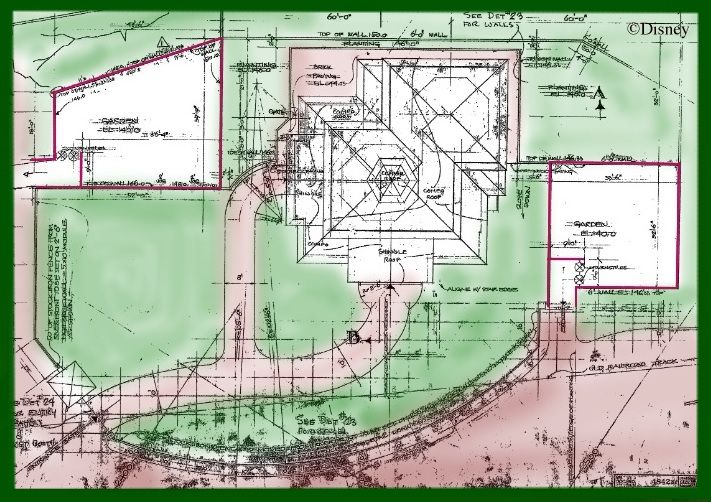
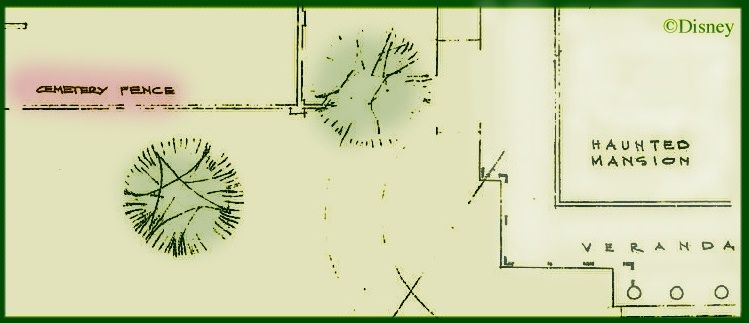
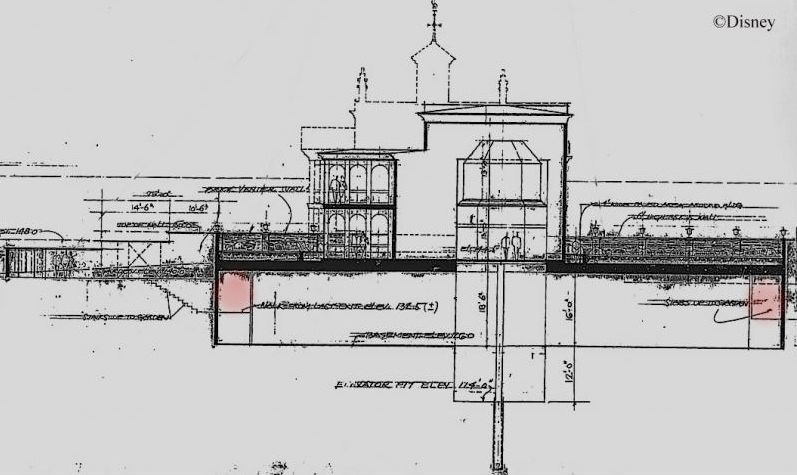
With that in mind, check out this rarely seen 1962 blueprint for the Anaheim HM (color added):


There are many interesting things here, but for the present, notice the two exit courtyards, much like the St. Louis
layout.  We know they're exits for the attraction not only by the "exit" arrows, but by the presence of the turnstiles.


On this blueprint they're called gardens, but as we shall see, even in
1962 they were really going to be cemeteries, as on this 1965 blueprint:


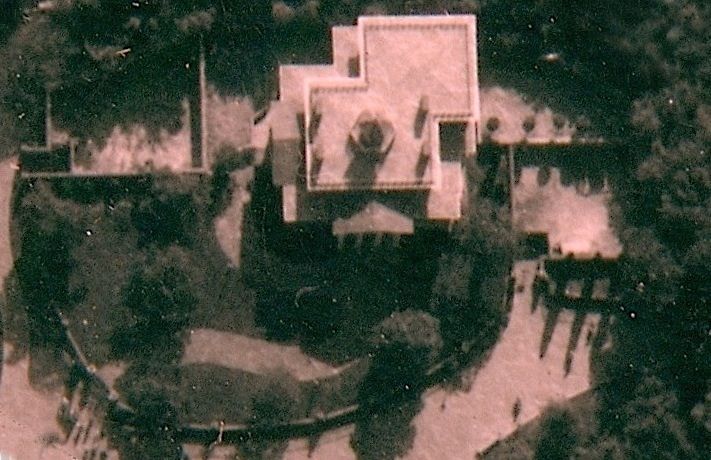
What was actually built closely resembled the '62 print above.  Here's a 1965 aerial view we've seen before:


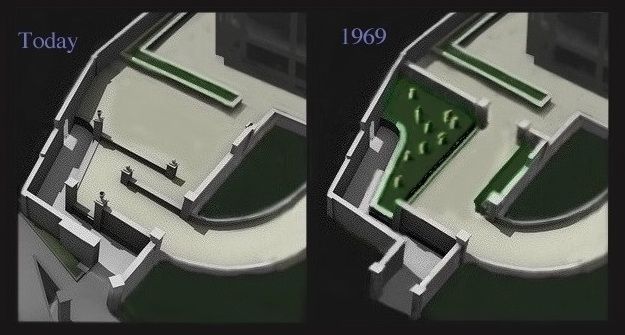
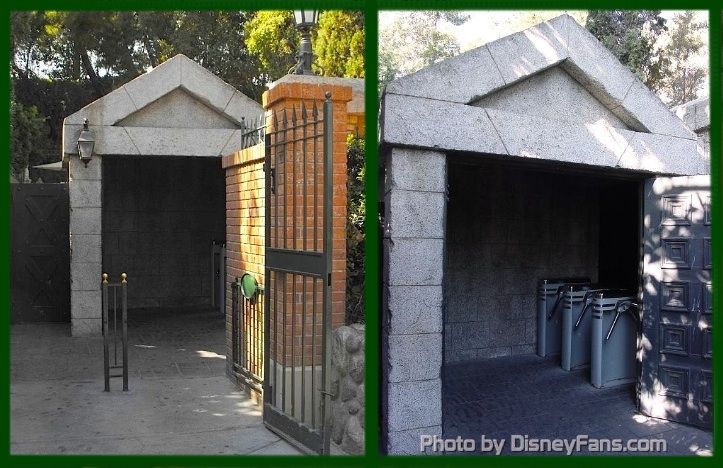
Today, the square courtyard on the right is still the site of the exit area for the ride,
while the trapezoidal courtyard on the left is the site of our now-familiar "lost graveyard."

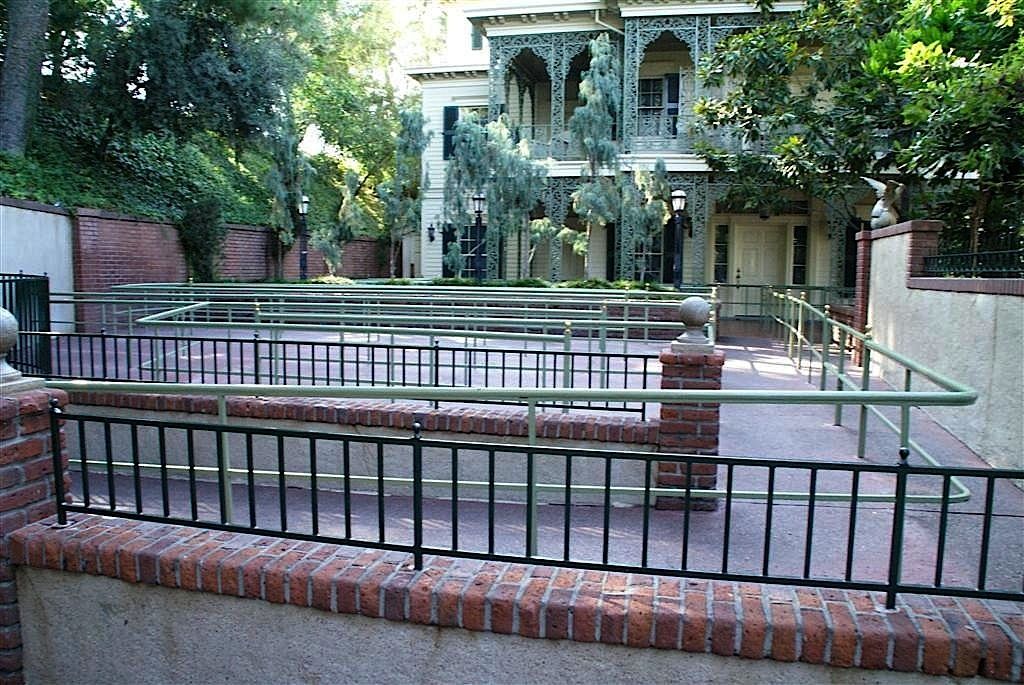
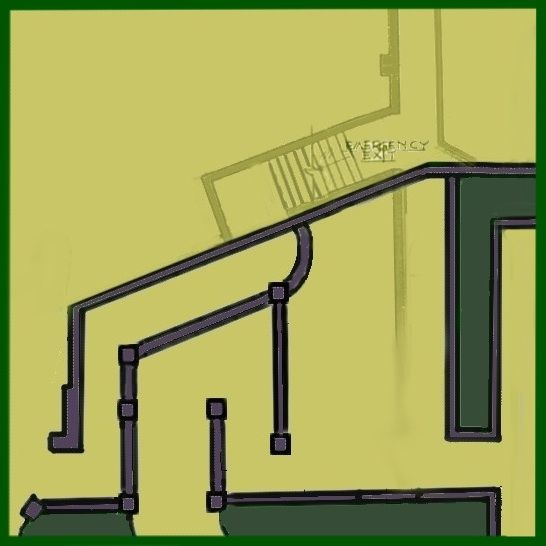
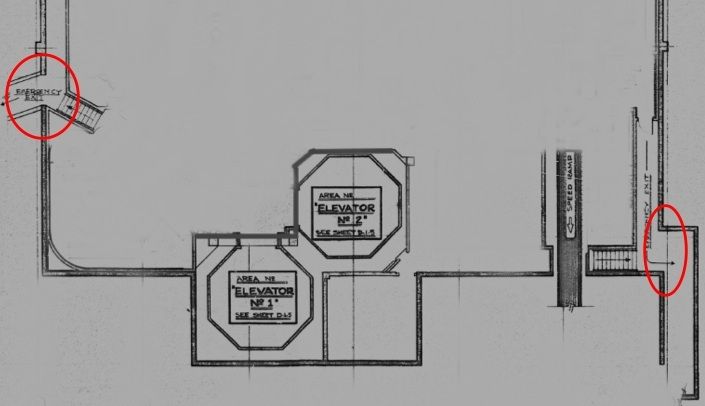
The trapezoid is still accessible from inside by means of an emergency exit, which empties into a trench-like structure:


That "emergency exit" is nothing less than the original main exit for
the Haunted Mansion walk-thru intended for the left (southern) side.


(Regions Beyond)

You will recall that the whole place would have been down at that trench level, and the courtyard would have been a spill area after the walk-thru, a grandiose graveyard in which you could mill around until you exited through the turnstiles, as in that blueprint above.  It's essentially the way Ken Anderson conceived the finale for his Ghost House.  We knew most of that.  What we now know is how everybody got into the place.

You can still use that original exit without there being an emergency:  It's also the "chicken exit" from the changing portrait hall.  Yep, if you're yeller, you can use one of the exits actually intended as a main exit for the attraction in 1962.  That's the one you see if you're not bold enough.

It stimulates the imagination to realize that these plain hallways and stairs would
likely have been fully themed to the rest of the house if the original plans had held.
(Bear in mind also that Rolly Crump was the main interior decorator at this point!)

(original pic by Datameister)


Unlike the trapezoid on the south side, the square courtyard on the north not only became a cemetery but remained one.


In a way, this too is a lost graveyard.  Lost, because we don't know exactly what they intended to put in there when it was built—with one important exception—and lost because most of the courtyard is generally closed to the public.  Today, the zig-zag path of exit from the top of the speed ramp to the doorway into the open air is dressed out to look like three adjacent crypts.  The large structure outside of the courtyard at the top is roofing/access over the speed ramp, cleverly disguised as a big sarcophagus slab, and it lies in the older and more "secret" of the two pet cemeteries.  Oh all right, I guess it's worth a quick look, since many of you have never seen it and never will.


In this photo you can see how the exit tunnel is cleverly made up to look like several distinct crypts.  On
the far right, that's the back of the final exit crypt you're looking at.  They use the area behind it for storage.

(pic by Datameister)

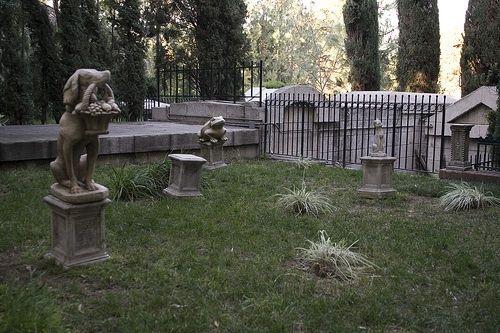
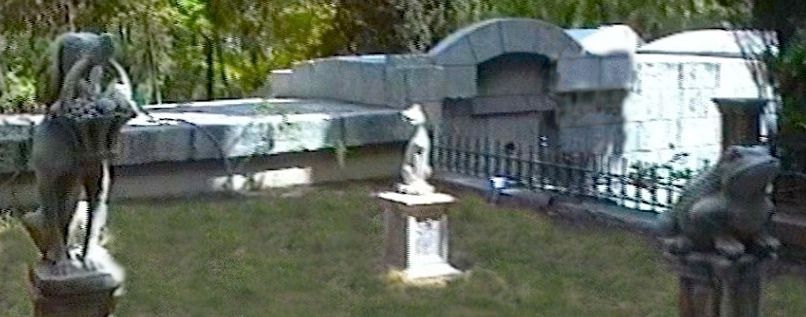
Some of this is clearer (and frankly, better-looking) in photos taken before the mid 90s, which is approximately when they put in a lot of new fencing.  Alas, they replaced the original "lost graveyard" ironwork atop the wall——the top actually being at ground level from this side.  Oh, and your eyes are not deceiving you; the animal grave markers sometimes get moved around.  Nobody seems to care much where they are.  Or if we want to approach it in the spirit of this post's opening paragraphs, "What are those pranky spirits up to?"  *insert your leapfrog joke here*


Enough of that.  Of greater relevance to the present subject is the small crypt to which the emergency exit leads, marked with an asterisk on the map above.  (The smaller unit above it is just a storage closet.)  What's so special about that crypt, back there where no one can even see it?


The main exit for the northern HM walk-thru was likewise by means of what is today an
emergency exit, not the current exit approached from inside by an ascending speed ramp.  


Today, it's not only an emergency exit, it's also used by park security if they have a very naughty guest down below.  This ain't no chicken exit, bruddah.  If you are so exceedingly bold (and stupid, and evil) as to try to pilfer something, you're sure to get caught and whisked up the stairs, out of that little crypt, and interrogated right there in the lower right hand corner of the courtyard.  That's what happened August 13, 2006, when a couple of teenage rocket scientists snatched a wicker suitcase from the attic as they went by.  With walls and lockable gates all around, that corner of the courtyard is a semi-secure, makeshift holding cell until the cops show up, if it comes to that.  Not exactly San Quentin, but at least there will be no sudden dashing off and losing oneself in the crowds.  Oh, and there is no truth to the rumors that there used to be iron rings bolted into the masonry there and bloodstains on the wall, no truth at all.  (How do these things get started, I wonder.)

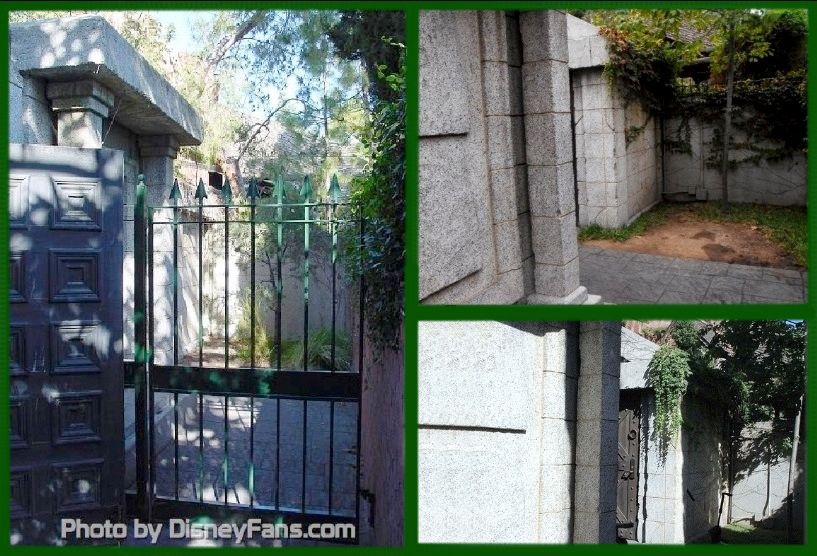
Psst, hey, wanna see some forbidden mysteries?  You know you do.  Come, we're going back towards the exit, against the flow, you might say.  However, we'll casually hang a right around the corner rather than go into the exit crypt.  Dee dee dum dee dee...lovely day...dee dee dum

(L: Regions Beyond, R: Allen Huffman.  The lamp was added in 2006)

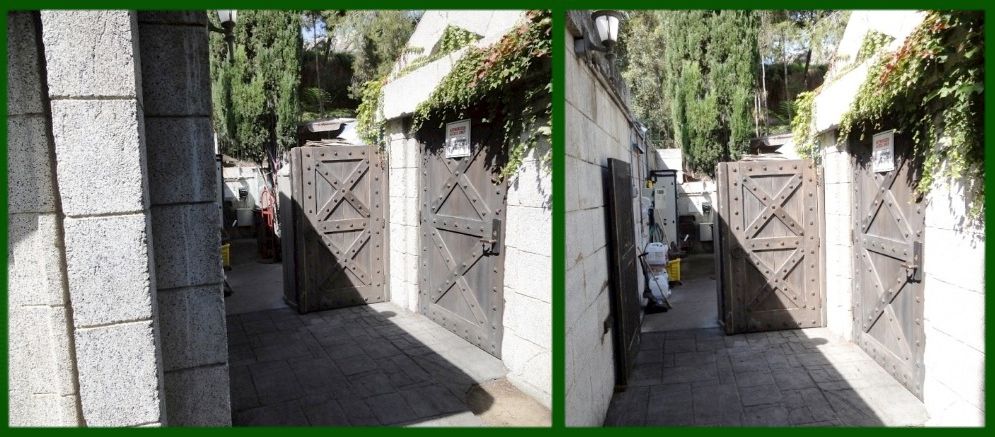
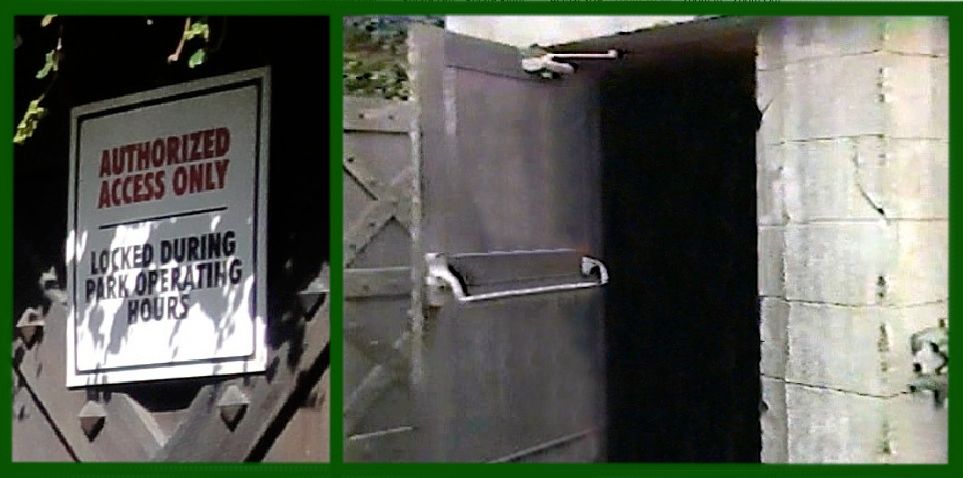
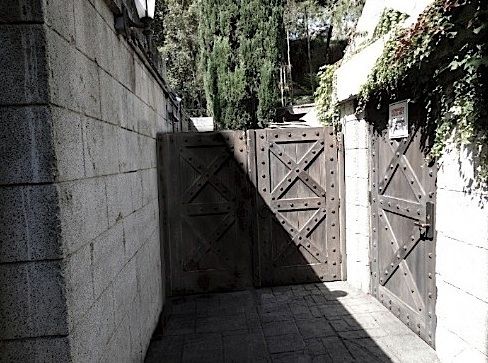
Curses, a locked gate!  Let's make like ghosts and magically pass through as if it weren't there.  What are those stains on the dirt in
the corner?  Rumor has it . . . never mind, but yeah, that's the area.  As we peek around the corner, we glimpse a wooden door...

(L: Allen Huffman; R: Regions Beyond (top) Datameister (bottom))

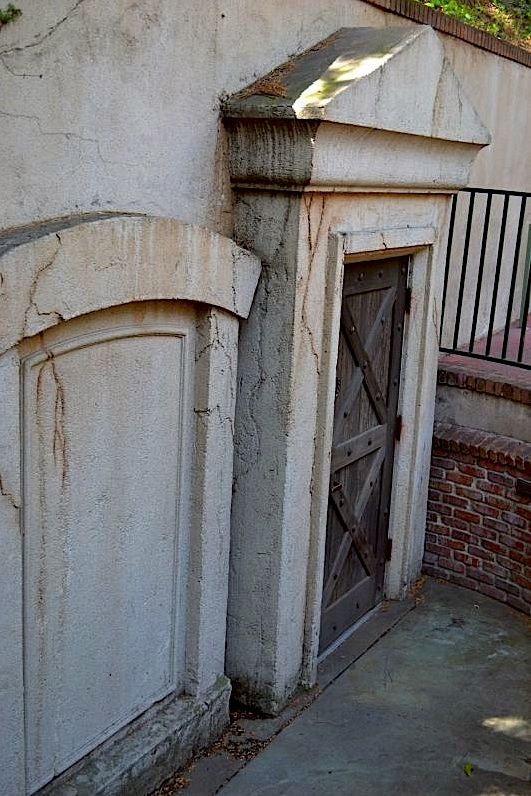
. . . and there it is: the little crypt that marks the emergency exit.  (On this particular day, one of the double door-gates
was left open, and you can see what the area back there is used for.)  Many Bothans died to bring us this information.

(pix by some guy)

It's out of sight back here now, but in 1962 this handsome little crypt was going to serve as the main exit for the right-side walk-thru.
We can't open the door, but Sandy Duncan did, in her 1974 Disneyland special, so I was able to cobble together a photo from that.


I was curious, so I 'shopped that other door closed, just to see how it looks.  Heh.  Imagine standing there guilty with this as the visual backdrop
while big, unsmiling security men debate among themselves whether to call in the Anaheim police or simply throw you out of the park.


Stairing into the Abyss

.              Before going any further, I had better justify my confident assertions that these
.              emergency exits were going to be the original main exits.  Back to the blueprints.


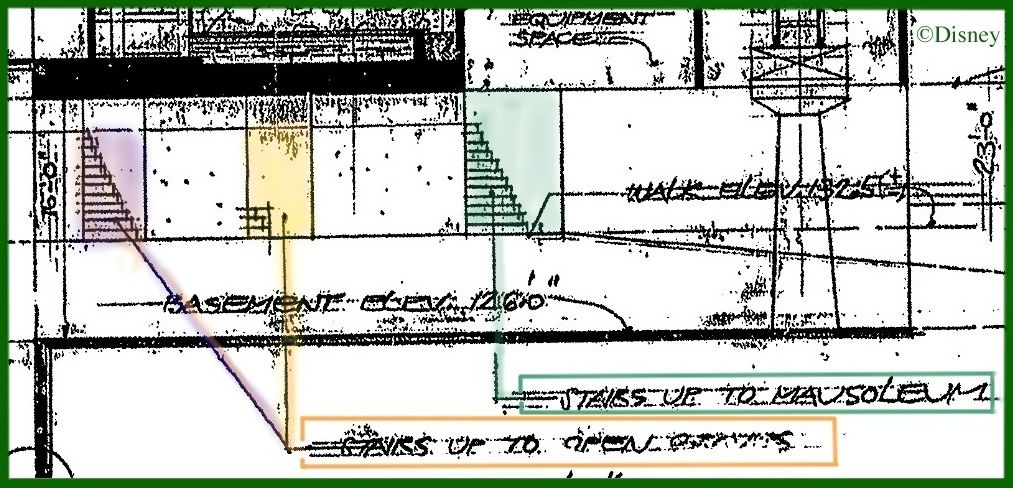
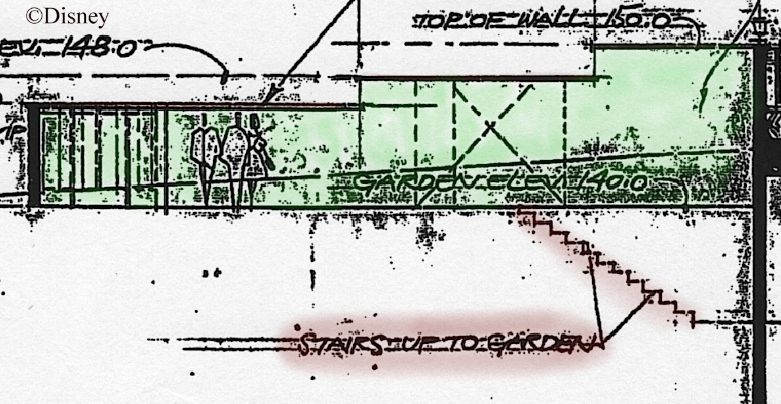
We've seen that one before, in our Does Size Matter? discussion.  Let's blow up the pink area this time.


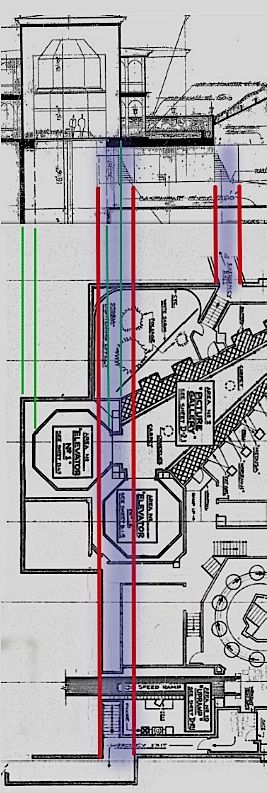
There are three staircases.  Two of them are "stairs up to open graves," and one
is "stairs up to mausoleum," and if you line up that blueprint with this one . . .


. . . the pink staircase lines up PRECISELY with the opening for the emergency exit on the right,
and the green staircase lines up PRECISELY with the opening for the emergency exit on the left.


We've mentioned in other posts that the main show building was not erected until 1968, after they had settled on the omnimover system for the ride, but the two outer walls going under the berm and RR tracks were built in 1962, and the two openings intended for the two exits were carefully engineered and cast in concrete at that time.  Later, they would be demoted to emergency exit status, but like I said, those tunnels and staircases were originally going to be fully themed and part of the attraction, probably presented as secret passages to the outside cemeteries.

Among other things, we discover that this "mausoleum" was probably going to be part of the original "lost cemetery."
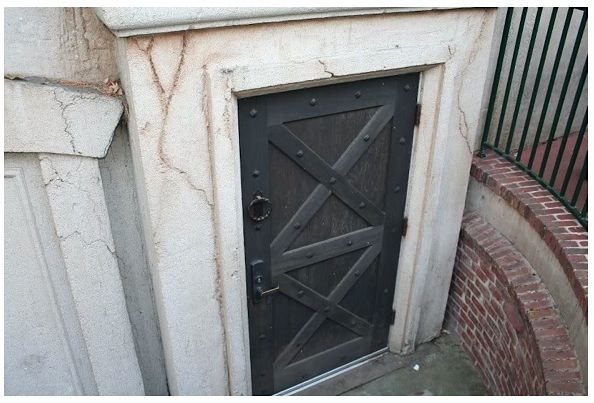
And incidentally, note that the door is exactly like the door on the emergency exit crypt in the other courtyard.

pic by Regions Beyond.  A bit of micro-trivia: The rings used to be the doorknobs. Sometime in the last 10 years
they were replaced with regular door handles, and the rings were moved up.  I just thought you should know. )


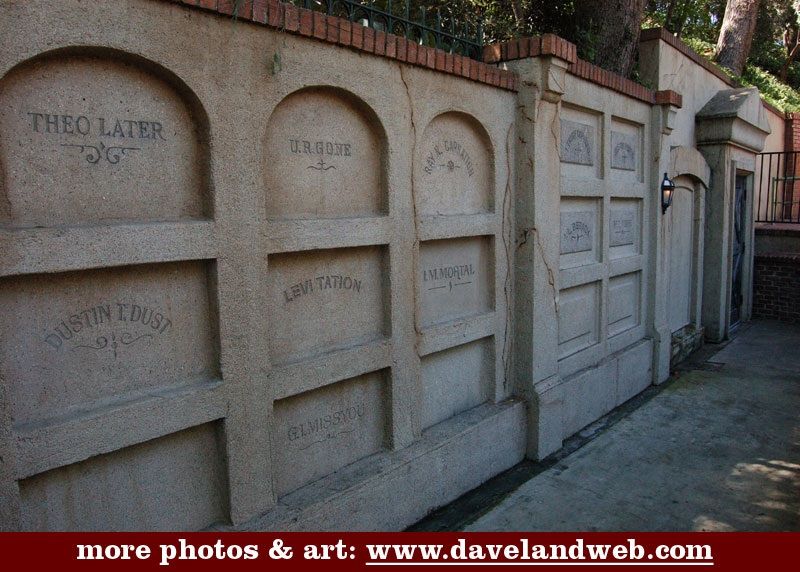
Moreover, it seems probable that this entire wall of crypts should be included along with the
"mausoleum," as both of those jogs in the height of the wall are indicated on the 1962 blueprint.

Behold, the only part of the "lost graveyard" that was ever realized.

(pic by Regions Beyond)

And you know, it's hardly changed.  Originally the tombs were blank...


. . . and if we want to get reeeeally picky, the original light fixture (right) was
replaced about five years ago with a model undoubtedly more weather-proof
and more guest-proof (left), but also less charming.  Otherwise, no changes.


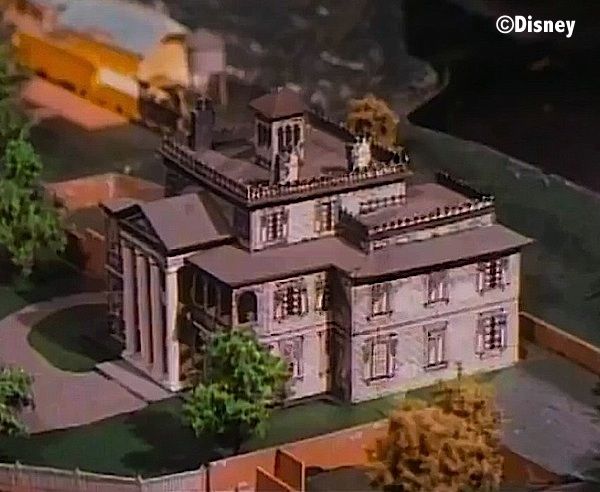
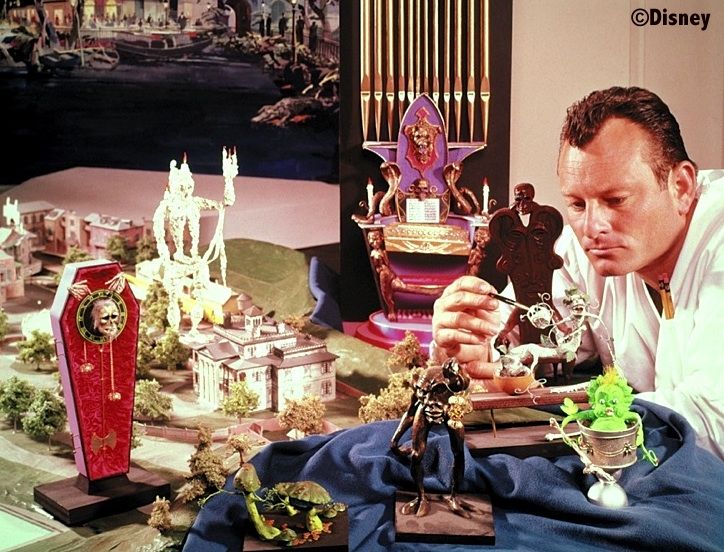
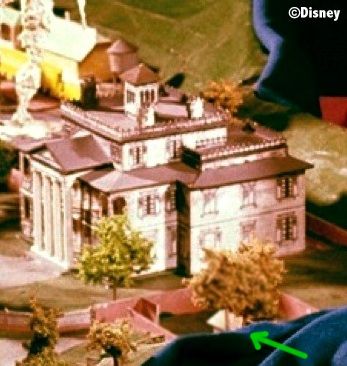
Over on the other side, that little crypt which today is an emergency exit was in 1962 the site of an "open grave," which might call into question whether the current crypt structure was the original idea.  Granted, it's an infelicitous choice of words, but yes, apparently that crypt was indeed what the blueprint called an "open grave."  In fact, it's the only thing there today that we know was part of the original plans for this area.  We know this because it was part of a WED model of the Mansion and its grounds, which model is most familiar to us from the 1965 "Tencennial" TV program.  The model was already several years old even then, since the house reflects a design that was obsolete by the end of 1961.


You can see parts of both courtyards in the model.  The northern one, in the foreground, is only half
visible, and the crypt cannot be seen, but luckily, this isn't our only photography.  When they did a photo
shoot of Rolly Crump's "Museum of the Weird" maquettes, they spread them out on the same table top.

And guess what?


Bingo.


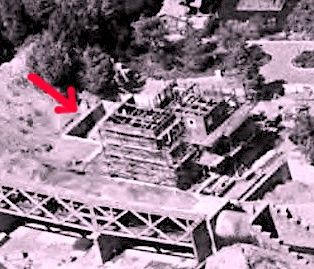
You can also see the opening in the wall in this 1962 construction photo:


Behold, the only known part of the other lost graveyard that was realized.


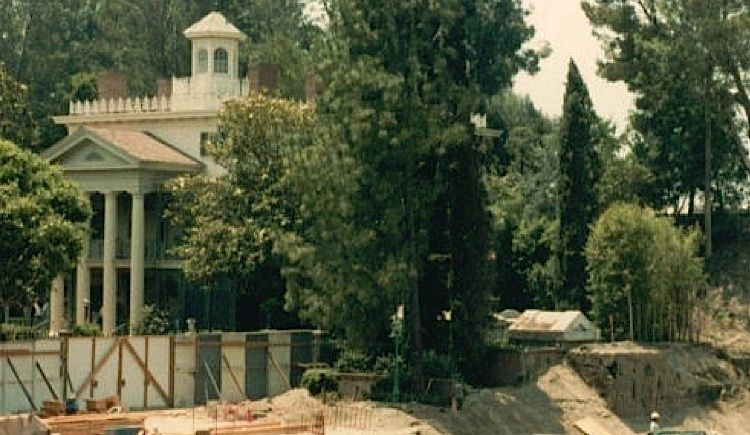
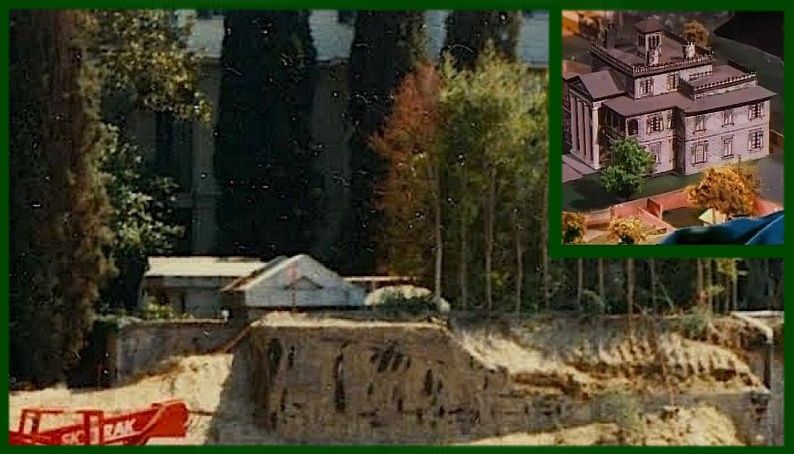
Here's something fun:  During the construction of Splash Mountain, excavation came up right to the edge of this enclosure, giving us a once-in-a-lifetime view of the courtyard from the northern side, a point of view not too terribly different from that of the photos of the model we've been looking at.  The original exit crypt is prominent in these pix, and dig how the contours of the exit staircase are visible in the exposed dirt.


(main pic from Outside the Berm)

The Third Staircase

Now at last we turn to the third staircase.  And . . . I got nuthin.  The staircase marked in yellow on our blueprint section up above was also supposed to lead to an "open grave," but on the other blueprint it doesn't line up with anything that's there now.  My guess is that it hooked around and came out where the speed ramp is today, that is, the current exit, because I should think that the gap in the perimeter wall at that point was original to 1962, like the other openings.  The "open grave" to which it lead would have been accessed via staircase rather than escalator.  Ironically, this may have been the original emergency exit, servicing both walk-thrus, but as I say, this is guesswork.


The Missing Brick Wall

.      Let's return to the current exit crypt, set back inside the mouth of what we now
.      know was a cemetery courtyard to be accessed through a different crypt entirely.


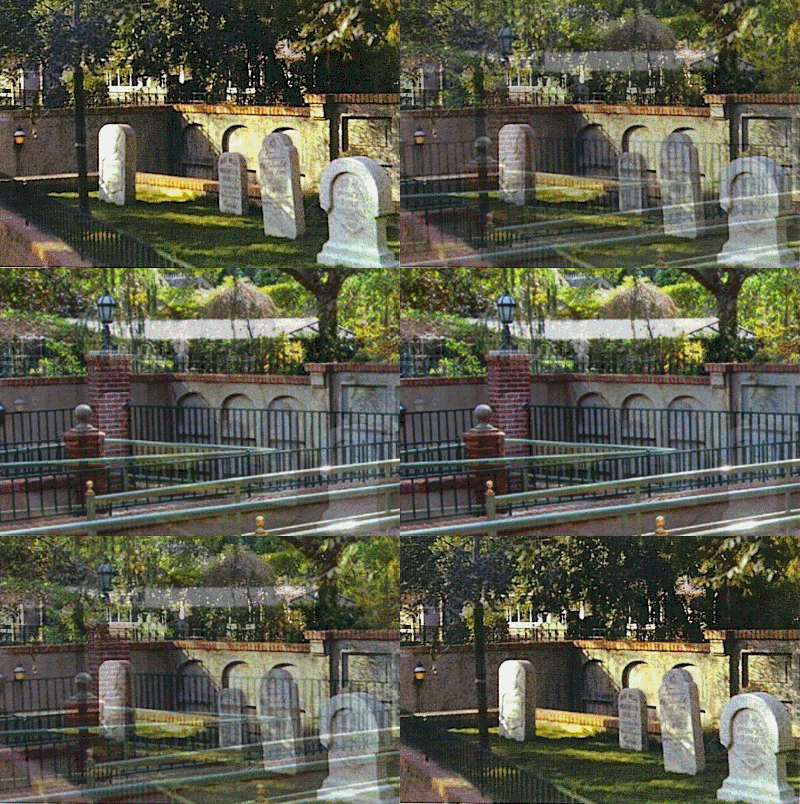
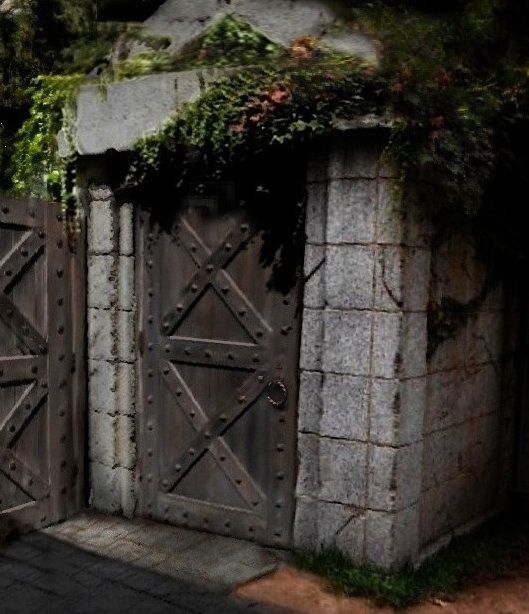
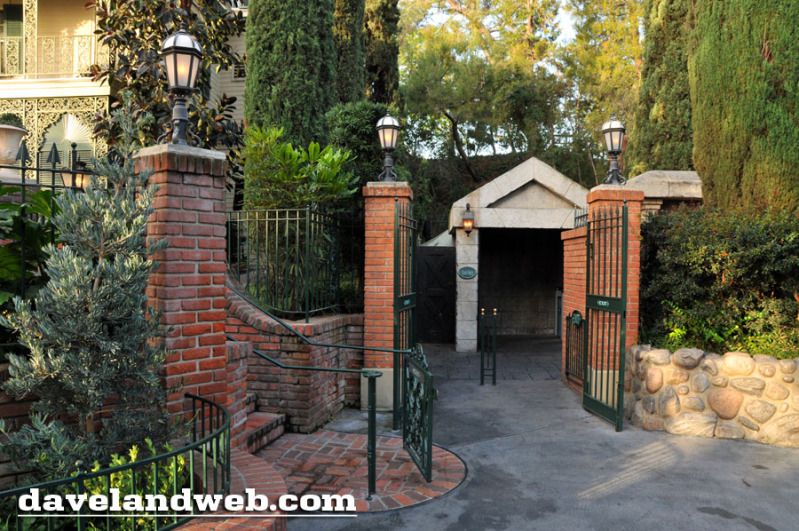
Curiously, the face of that crypt is exactly where a short brick wall was originally.


Let's superimpose this modern view on a photo from 1966 and . . . fade away.


(This photo sequence is adapted from this original Davelandweb photo, which contains a distracting and irrelevant sign that I have photoshopped out.)

So if you stand in the doorway of the exit crypt and think, "There used to be a brick wall right here," isn't there something vaguely . . . I don't know . . . Cask of Amontillado-ish about it?  See, this is a good example of the Missing Door effect.   With any other attraction, "There used to be a wall where this doorway is now located" is the blandest sort of park trivia.  But at the Mansion, your imagination may take a playfully perverse turn, treating that real-world factoid as part of the attraction's make-believe world, toying with loose connections and possible correlations, all quite unseriously of course.  Come to think of it, aren't there crypts in there where the reverse is true; that is, crypts that used to have open doorways that are now bricked up?  Intriguing . . . intriguing.  No doubt there is a long forgotten story behind all of this.

"Oh yeah, right, a backstory.  And I suppose I'm the Sea Captain now.  Enough.  I'm innta here.  I'm throwing in the trowel."


Got Concept Art?

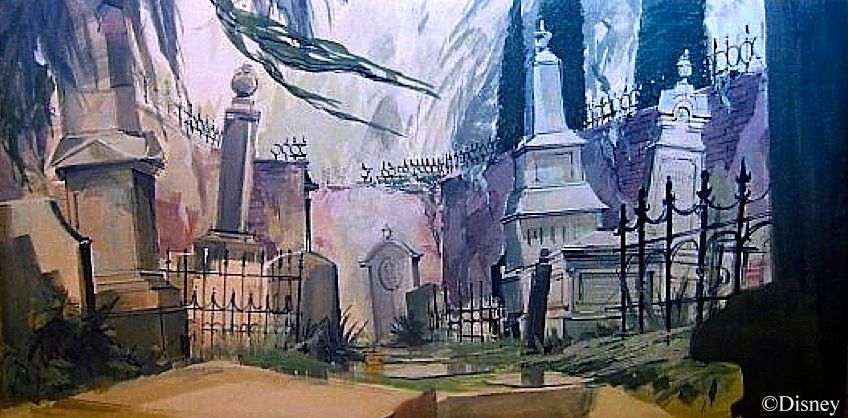
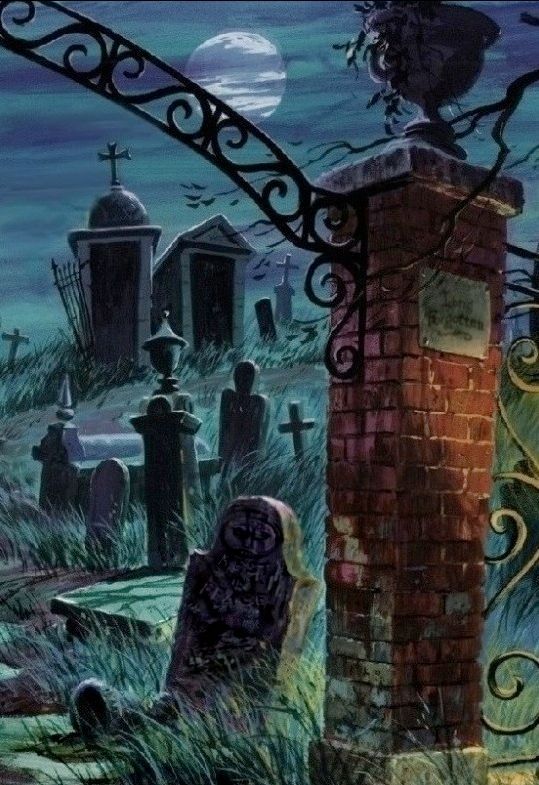
We have a nice piece of concept artwork for the "lost graveyard" on the south side; viz, that striking watercolor near the top of this post which was a star feature in the previous post on the subject.  Do we have anything similar showing what the north side graveyard would have looked like?  Not that I'm aware of.  There IS a graveyard there, of course: the current exit crypt complex.  But that can't be the original layout.  The small courtyard is clogged with bulky structures, dividing the space inefficiently and creating areas difficult to access (which are today used for storage or break areas).  Among these, the only structure we know was going to be there is the emergency exit crypt.

But don't despair quite yet.  We DO have one piece of artwork which I suspect is widely unrecognized for what it actually depicts.

In his well-known and well-loved artwork for the "Story and Song" booklet, Collin Campbell gives us this illustration, supposedly depicting the exit crypt into which Mike and Karen must go in order to escape from the graveyard.  ("That's a crypt!  That's the one by the fence!  It's the way out!" exclaims Karen.  How in hell she would know this, no one explains.)  Oddly enough, the model for Collin's exit crypt from the inside to the outside is none other than the actual crypt that would lead you from outside to inside if you went into it.  Everything's backwards, in other words.


In the montage below, take note in Campbell's painting not just of the crypt but of the brick wall alongside of it, topped with decorative ironwork, and compare all that with the actual exit crypt (lower right).  In that modern picture, the greenery above the wall is too thick to let us see the house, but let's make like silly spooks and manipulate space and time.  Let's (1) back away from the opening, and let's (2) return again to 1966.  There.  Now the house is visible (lower left).  Compare it to the house in Campbell's painting.  There is just no doubt.


We've emphasized on more than one occasion Campbell's extreme conservatism in rendering anything based on others' concepts.  You can almost bet there is a Marc Davis sketch (or something) behind these paintings.  Even the ghoul on the right in this very painting is nothing more than an elongated but extremely faithful version of a photo of a basic, Blaine Gibson, pop-up head model.


And yet there are a number of things in Campbell's 1969 painting which correspond to nothing in that exit complex today, including a depiction of an open grave.  Could some old concept art for the northern cemetery be behind it?  It isn't much, but at this point conjectures based on the Campbell painting plus what happens to be in the courtyard today are all we've got to help us visualize this other lost graveyard.


Conclusions

We began the post by pointing out the unintentional but genuine archaeological depth possessed by this possessed manor, built half a century ago. Cryptic alterations* that actually have bland, unmagical, Glendale-ish explanations nevertheless make the Haunted Mansion seem that much more mysterious (if you know about them, and now you do).  The ghost show put on before you consists of the sort of fabricated authenticity you get with any good quality dark ride, but with the Disneyland Haunted Mansion you also get the opposite: a vaguely but pleasantly enhanced sense of age and secrecy springing not from the imaginations of storytellers but from the odd and accidental, clumsy, real-world history of the place.

* Hell yes that pun is intentional.

Heads and Details: New Concept Art Found

$
0
0
.
Some newly discovered (or rediscovered)* Haunted Mansion artwork has surfaced, and we're going to get out our magnifying glass.  In one sense you could say that this post is devoted to a very narrow slice of Mansionalia, but in another sense you could say that it opens a window, allowing us to catch a glimpse of the creative wheels turning inside Mansion Imagineering back in 1968. In yet another sense you could say that reading this post may lead to a cure for emphysema, but if you do, you're kind of nuts.


Maquettes, or Should We Say...McCopyquettes?

We're terribly fond of bad puns and Haunted Mansion concept art around here, in case you haven't noticed. The artwork is surprisingly plentiful, often beautiful, and always intriguing because of what it reveals about the creative process.  Same goes for the puns.

As we all know, between the concept sketches and the three-dimensional end product there are a great many stages, which include scale models, sometimes in several intermediate sizes. You may recall that we did a whole tour of the Haunted Mansion using nothing but pictures of its scale models.  We also know that these models are peopled with figurines called maquettes, and we've seen lots of photos of those around here too over the years (yes, years; we're approaching our third blogiversary, believe it or not).  We don't tend to think of maquettes as "concept art."  That could be because the single most outstanding feature of the surviving Haunted Mansion maquettes is their general fidelity to the original Marc Davis sketches.  They're copies.


They're delightful creations, but in cases like those above it seems reasonable to regard them as renderings of concept art rather than concept art per se.  They add color and dimensionality, and often enough they add a little zing of their own, but they bring all of this to an already existing concept.  Plus, I don't think Marc himself made very many maquettes, if he made any at all, and so they are indeed someone else's representation of Marc's original idea.

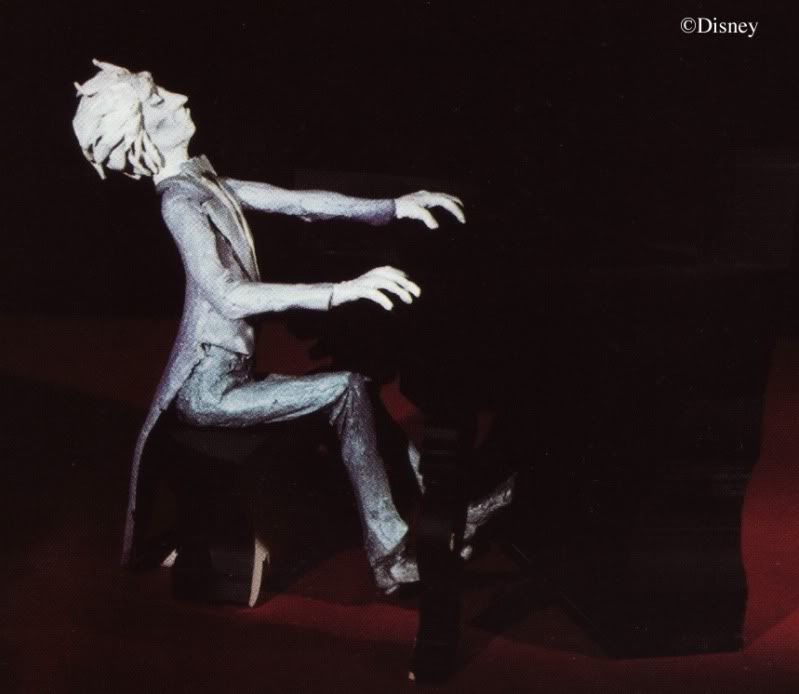
However, there are a few maquettes that bear little resemblance to any other known artwork.  They're probably based on sketches that have since disappeared or have remained unpublished.  In such cases they function for all practical purposes as the concept art itself.  No one who is interested in the organist character, for instance, can afford to overlook the utterly unique maquette version, which we've pointed out before.  It represents a very distinctive take on the character.


Likewise, the attic bride maquette that we've looked at previously is
much more sinister than the artwork upon which she seems to be based.


Incidentally, where are these statuettes to be found?  Some of them have been lost or destroyed, but a lot of them were rescued
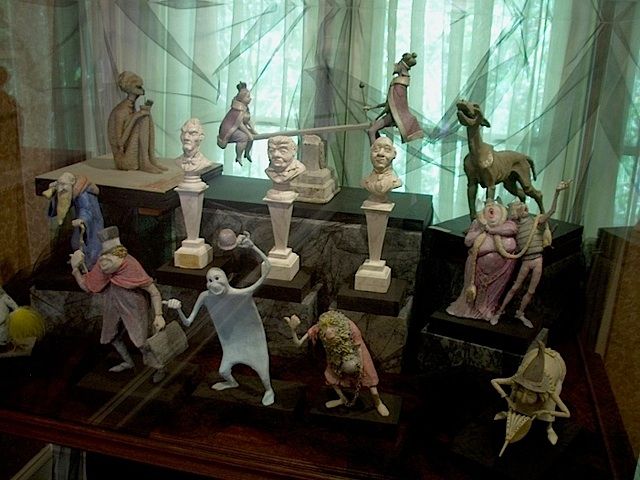
and archived, and these are brought out now and then.  In 2003, the Disney Gallery had a large number of them on display.


New Sets of Old Maquettes

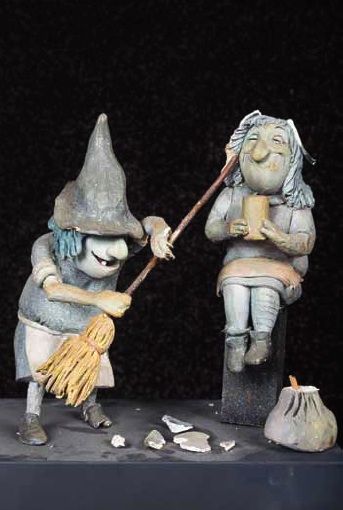
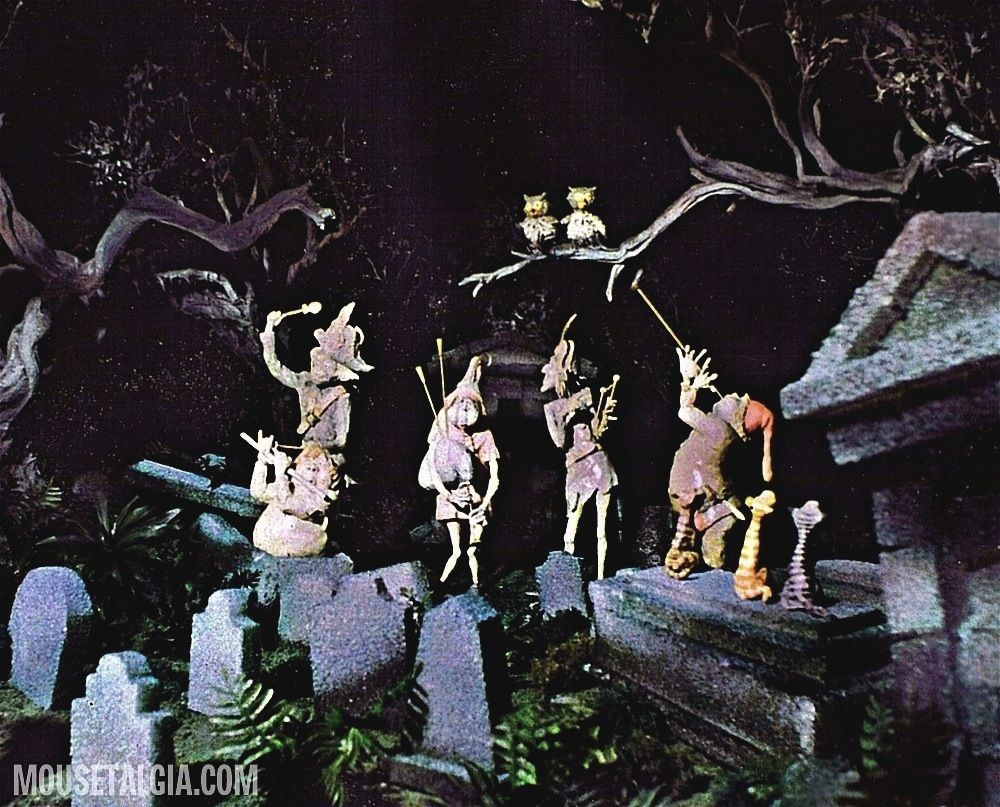
There is a third category: maquettes that survived and made their way into the collector's market.  The very existence of these is frequently unknown to the public until the owners decide to sell them. That happened recently when five somewhat battered maquettes showed up in the catalogue for the Heritage Animation Art Auction in New York.  The five were divided into two groups:  two witches together and three musicians together.  The musicians sold for $11,950, but the witches were not bought.


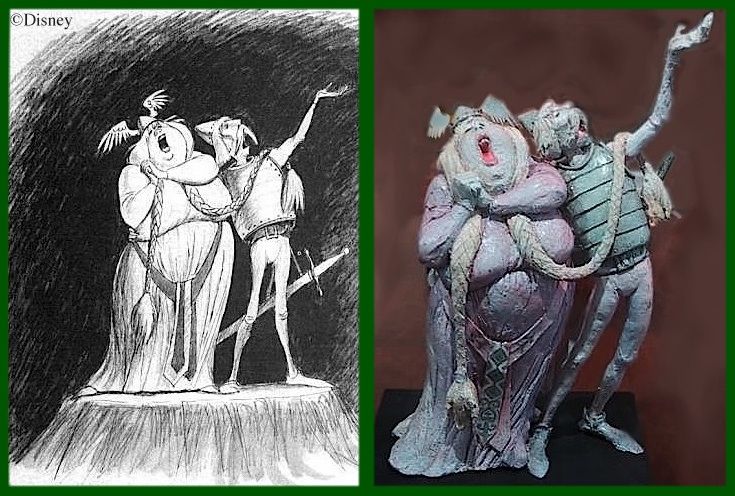
The witches are obviously these:


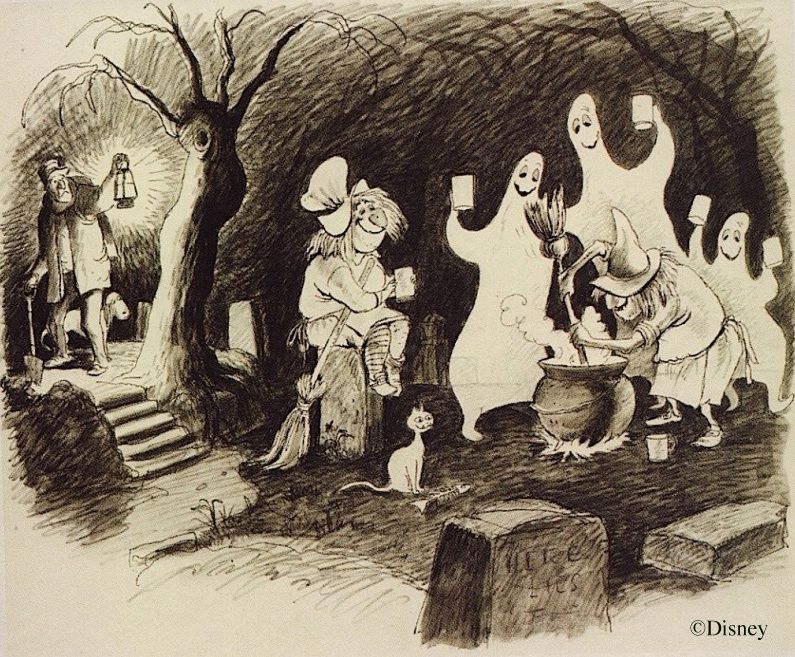
The maquettes are very faithful to the Marc Davis sketch. They're fun, but
they will not be our main concern today. I want to look at the musicians.


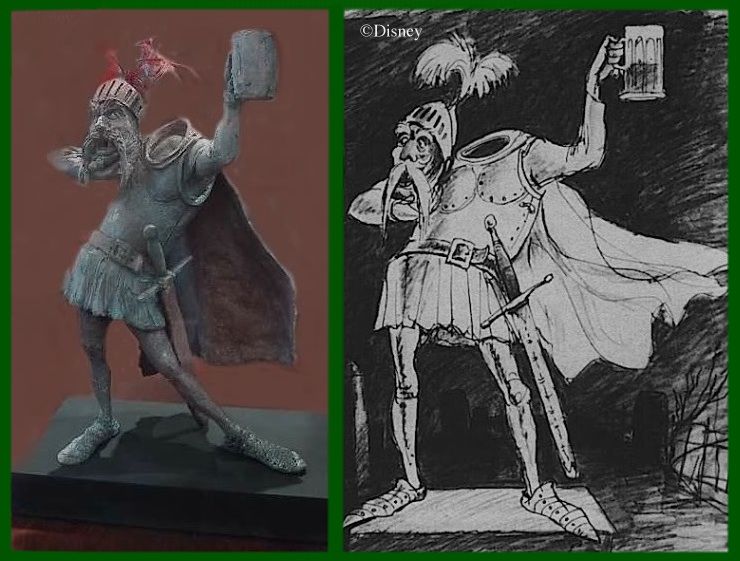
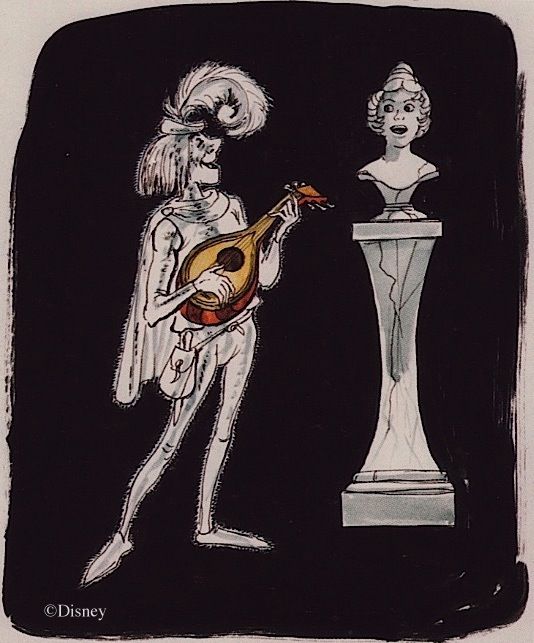
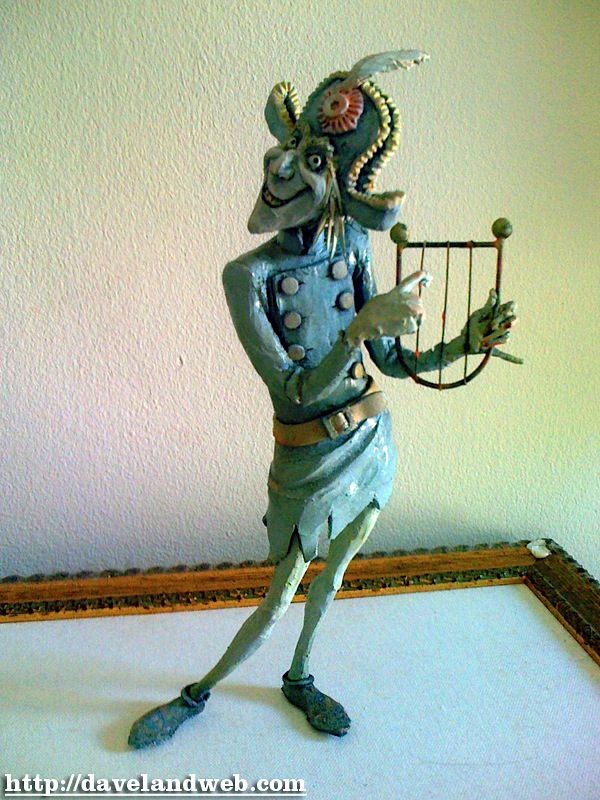
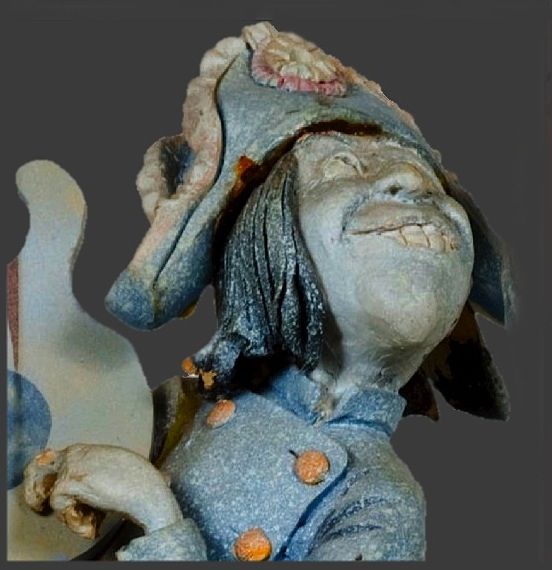
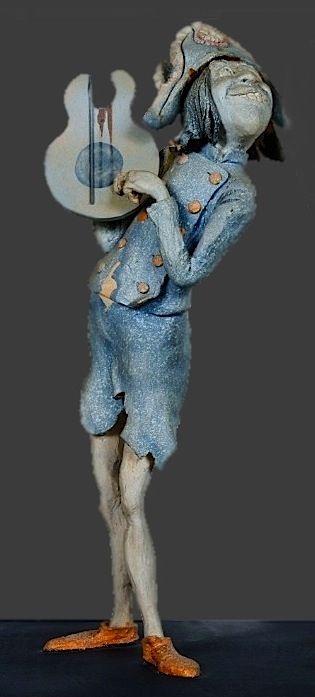
Let's deal with this fellow immediately and get it over with: Without any question, the masterpiece among
the three is the troubadour, an unused character known to us previously only from this concept sketch:


The maquette is simply superb.  (By the way, does anyone else think he looks a little like Johnny Carson?)

As for the drummer, we'll deal with him presently. It's the harpist who really piques my curiousity, because we already had a harpist maquette. Apparently they made at least two of them, and curiously enough it may be possible to discern why they made two of them; if so, this may give us an opportunity to follow Marc Davis through part of the creative process, however tentatively.


The other harpist maquette is in the hands of a friend of Dave "Daveland" DeCaro:


Harpists and Hairsplitting

If you compare them, the two harpists have very different personalities.  What most fascinates me is the strong possibility that you can trace the two personalities to two different sketches, where the difference is far less obvious.

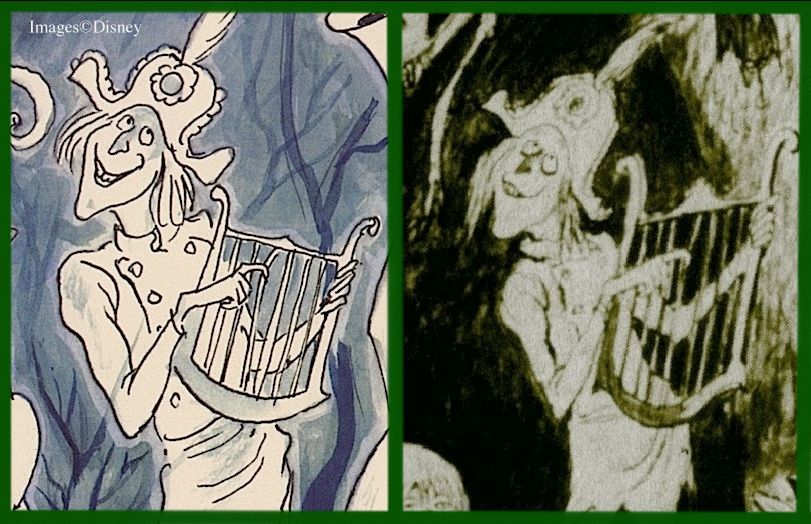
We have posted both of these before.  The story of their relationship and the evolution of the scene is told in the Phantom Drummer of Tedworth post.  The published copy of the older sketch leaves something to be desired, so I did a fresh scan and tried to sharpen it up as best I could.


Let's blow up the parts we're currently interested in.


What would you say?  90% the same?  75%?  Obviously they're similar.  But how do they differ?  Well, the older one (right) seems to have a bit of an overbite, almost but not quite bucktoothed.  At any rate, he's got a mouth that feels full of teeth.  He also is a teensy-weensy bit more cross-eyed than the newer harpist.  Those details aren't dramatic, but for me they drop his IQ by about 50 points below the newer guy's.  The newer harpist is more elongated. Just look at the two necks!  That, plus the higher IQ, makes him seem more quick and nervous somehow, more alert, more . . . I guess nimble is the word I have in mind.

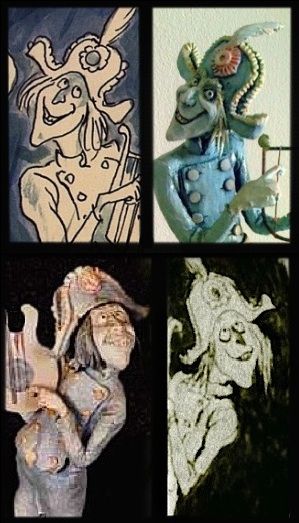
Admittedly, this is a hairsplitting analysis we're doing here, but that's exactly the point.  As minute as these differences are, they seem to form the basis for the two maquettes.  If I am correct, both maquettes are true to their respective sketches, but they emphasize the very qualities that make them different, so much so that the two maquettes end up much further apart than the two sketches, representing in the end two different concepts of the harpist's personality.

Look at these carefully, Forgottenistas, because my thesis stands or falls right here:


We have no idea whether both or just one sketch already existed when the first maquette was made, and for all we know there may have been more sketches of which we are ignorant, so it's risky to reconstruct too detailed a narrative, but we're probably on safe ground in surmising that Marc Davis didn't like the look of the first harpist maquette and had another one made (or made it himself).  We can be reasonably confident that we have the maquette sequence correct, because we know which one ended up being used when they set up the model:  the one now in the possession of Dave DeCaro's friend.


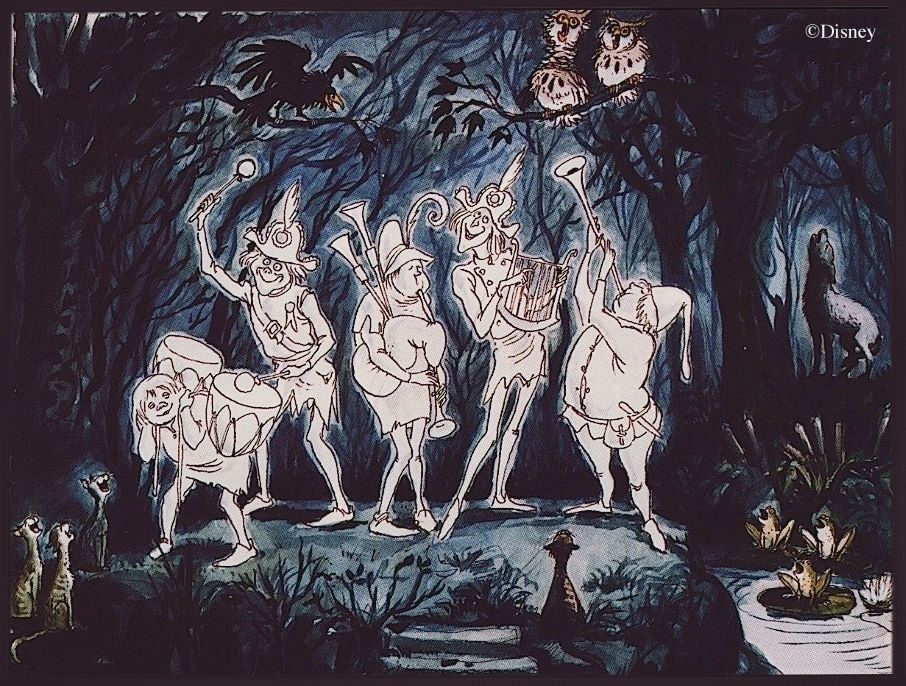
One can only speculate about Davis's reasoning, but perhaps with the ensemble growing in size into a real band, Davis thought that the putative bandleader needed to come across as a little more competent and a little less dippy.  In his second band sketch, I think Davis does indeed signal that the harpist is the bandleader.  Let's take a fresh look at this oh-so-familiar piece:


The harpist is the tallest character (yes, that matters), and he is evidently enraptured with the music surrounding him.  The drummer?  He's a fried-egg whack job, and he's looking away from the band.  The drum carrier?  Puhleeez. He's got an IQ not much higher than the drums he's carrying. The other two musicians have their eyes closed.  Davis was an animator of genius, and he knew how to send signals that viewers don't even realize they're receiving.  Without being consciously aware of it, you tend to read the harpist as the bandleader. One can imagine Marc being pleased with this new drawing and the way the harpist has been tweaked in order to reflect his new responsibilities. You can also imagine Davis now dissatisfied with the existing harpist maquette and having a new one made.


A Dumber Drummer

...and that's a bummer.  If you look closely, the drummer in the photo of the actual graveyard maquette set is indeed the same as the one in the newly discovered batch. That surprises me, because in my opinion he's the least impressive of the three. He's a true reflection of the drummers in the two sketches, which to my eye are more similar to each other than the sketches of the harpists, but neither this maquette, nor either of the sketches, can hold a candle to Davis's original sketch of the Drummer of Tedworth, which started this whole thing rolling.  So I'm a little surprised that they seemed content with the drummer.


It doesn't matter, though, because none of it mattered in the end, which brings us to the wistful part of the post.
There's a wist right over there, and another wist right here.  I can see a few more wists over yonder.  Lotta wists.


.                    Heading a Different Way

.                         As we all know, the final figures look very little like the sketches or maquettes. 
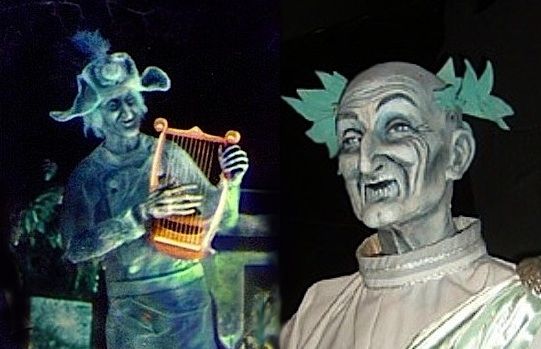
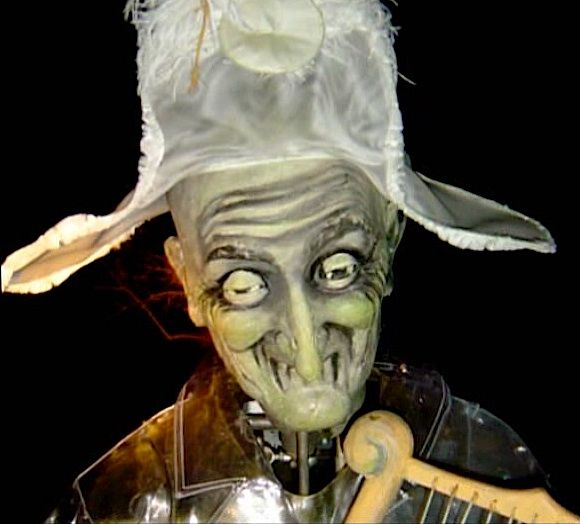
.                         The harpist uses a recycled head, the same one as Caesar in the ballroom.

(right pic: GRD)

As if that weren't bad enough, the same head passes within yards of Caesar,
borne upon the shoulders of the ballroom visitor I call the "Grand Dame."

This is what I mean by "ballroom visitors":

(bottom pic: K447)

. . . and this is who I mean by the "Grand Dame": 


above and below pix from Imagineering Disney

"Egads, he does look like me!"

If you find that a little surprising, pthhhhh.  That's nothing: The same head also appears on two
different characters in Pirates of the Caribbean, also divided between the sexes, and also within
yards of each other, and there the duplication is far more obvious than it is in the HM ballroom.


This is just scratching the surface.  As many of you already know, there are recycled heads all over both rides, some of them going back to the Carousel of Progress.  If you want to go headhunting and sort it all out, have at it.  I can't get into that.  It's like finding hidden Mickeys.

So the fiddling and fussing over the harpist's personality that we can now discern in the sketches and maquettes turned out to be wasted imagineering.  The reasons for this were probably economic.  You save time and money by using the same molds, and with hair and makeup,
the resultant characters are different enough, so why not?


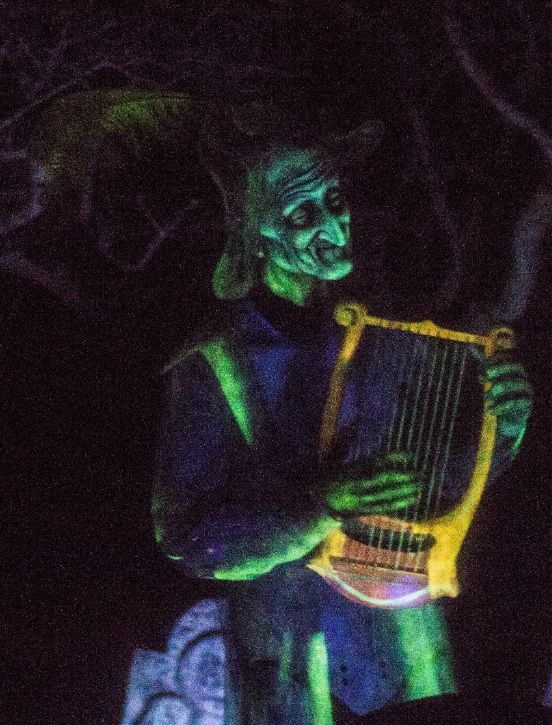
We know too that there was a consistent drift away from the cartoony figures in many of Davis's sketches toward more realistic human depictions, and possibly that was also a factor. There is also the fact that in the Haunted Mansion, it isn't always easy to make out such details anyway.  A lot depends on variables like how the lighting levels are set and how recently and in what way the figures have been repainted.  There can be wide variances between the various Mansions too.  Here's an unusually clear, relatively recent shot of the harpist in the Orlando graveyard scene.

(pic by Chris Hebert)

So in Conclusion...

Whether or not Davis tinkered with the nuances of this character in precisely the way we have conjectured, we can still see in the sketches and maquettes how much thought went into the creation of these personalities.  And even in examples like this where it didn't matter in the end, it's a treat to find previously unknown artifacts that help us appreciate anew the extreme attention to character and detail that these studio animators brought to their theme park imagineering.  The dippier, dopier harpist is a unique and amusing creation in his own right, and this maquette may rightly be regarded as a newly rediscovered piece of Marc Davis concept art.


(This pic looks a lot like the earlier one, I know, but it
IS a different photo, from a slightly different angle.)


*Edit:  According to Mike Cozart (see comments), these maquettes have been seen before, at an early
90's auction.  Still, they've been out of sight and virtually unknown for most of their existence.

Hat tip to Jeff Baham's Doombuggies Facebook feed and FigmentJedi
at Micechat, who called our attention to the auction items.


The Cat Lady, a Bewitching Mystery

$
0
0
.
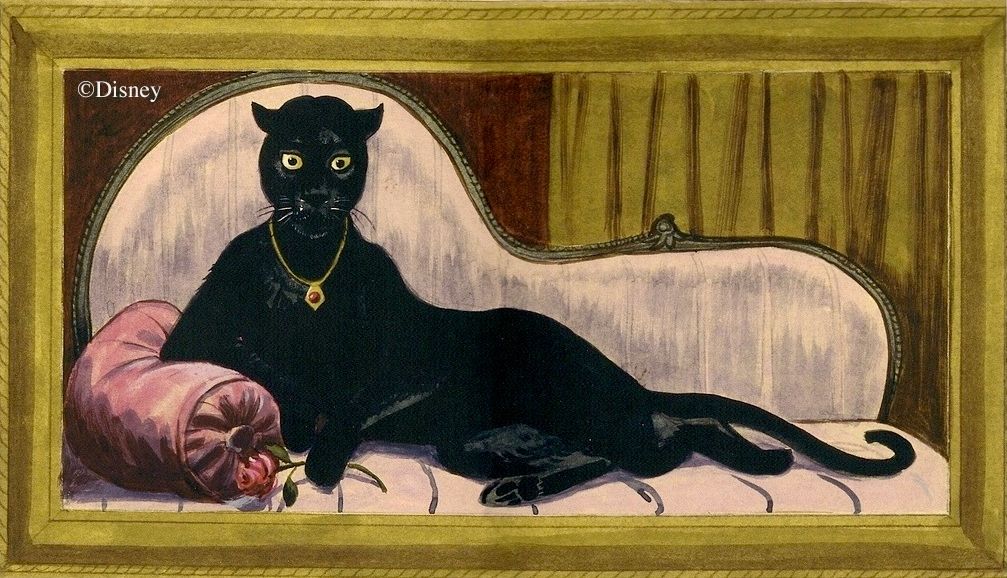
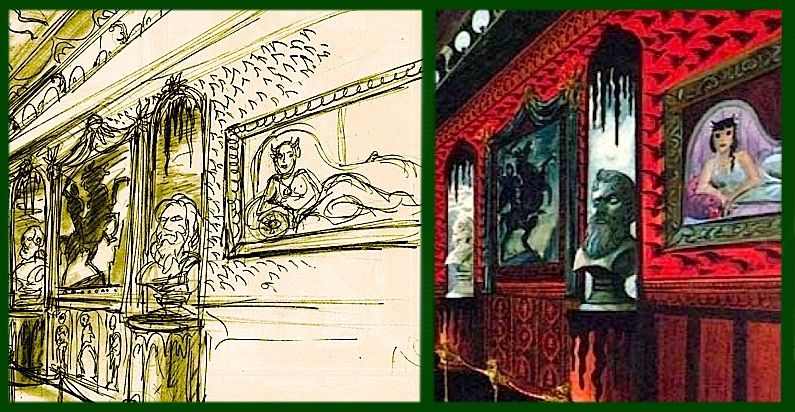
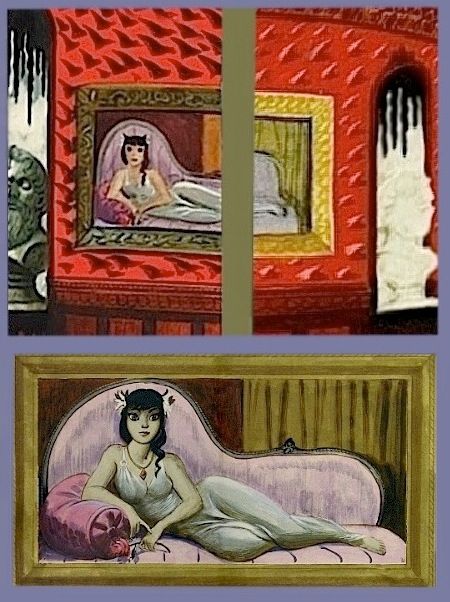
Ever since the day the Disneyland Mansion opened, the far right picture in the changing portrait gallery has been the Cat Lady (called "Cat Girl" and "Cat Woman" on the blueprints). I hadn't really planned on devoting an entire post to it, because (1) there are few surprises to be found in the cultural history of the image, so its background is not particularly intriguing. Not only that, but (2) the history of the development of this particular piece is pretty straightforward and unremarkable as well. But hold. There is a startling correspondence between this particular painting and a piece of then-contemporary pop culture that has never been explained, so I thought it might be worthwhile to do a Cat Lady post after all, in the hopes that someone out there may have a key to the mystery. Plus, she's bound to be somebody's favorite, so even if it's not Post of the Year material to the common herd, there will be those who bookmark it.

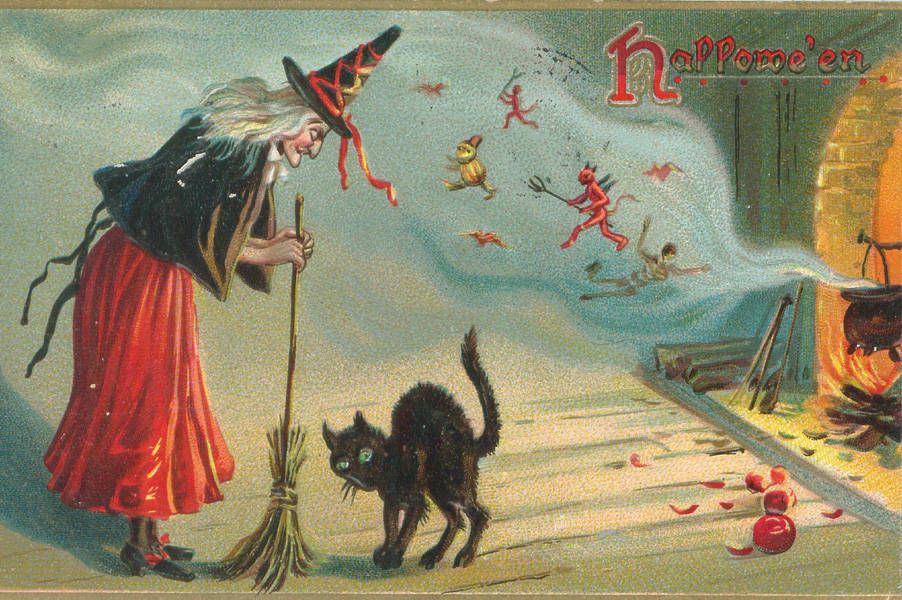
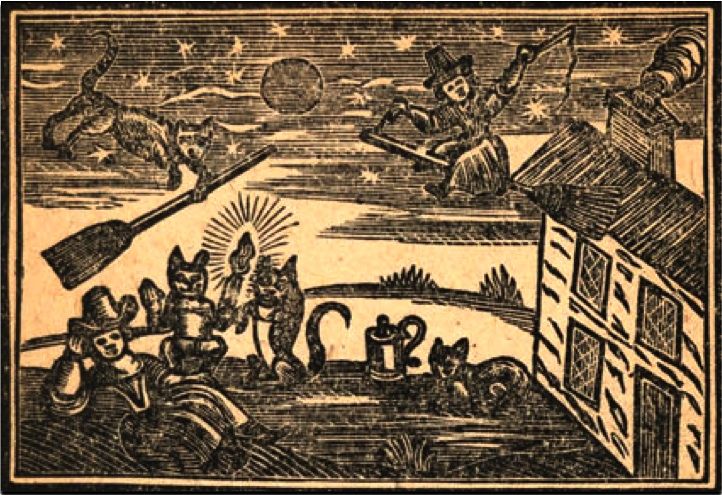
As Marc Davis originally conceived it, the Cat Lady was an attractive and somewhat exotic female flashing back and forth with a human-sized black panther, that is, a big black cat. I don't suppose anyone will be surprised to learn that the association of black felines and sinister females goes back a long way. Black cats are familiar to us as, well, familiars, animal manifestations of spirits who assist witches in their magical praxis. The association of black cats and witches is still running strong in common Halloween decor, of course.

1908 postcard

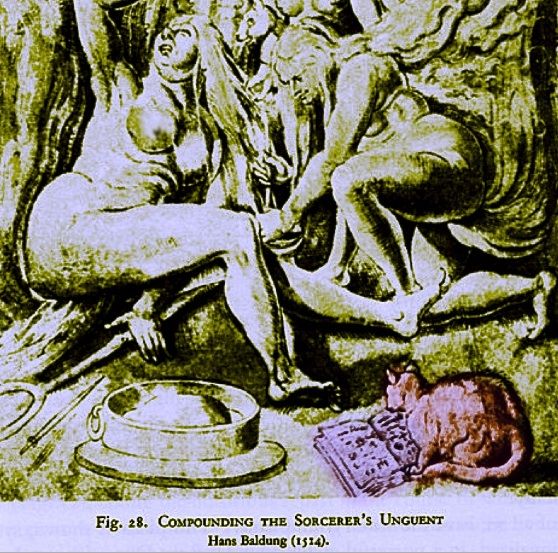
If any proof were needed for the antiquity of this motif, it could easily be demonstrated from a multitude of sources (although you soon discover that the blackness of the cat was optional until relatively recent times). We'll limit ourselves to two good, fun examples, and move on. In this first one, the cat is reading a recipe book for the "sorcerer's unguent," which will, if liberally applied, enable you to fly.

Think of it as the pixie dust of the Dark Side.

"Meow.  Okay, one of you has to swing over to Trader Joe's and pick up some
newt's eyes. And this time try to remember to get the organic kind, please?"


This cat looks like it's having a little trouble getting used to broom
travel.  I suppose it's harder than it looks, like riding a unicycle.


Curiously enough, in modern culture the black cat is associated with bad luck, but according to Émile Grillot de Givry, in the olden days the good luck charms we call talismans could sometimes be living animals, and "black cats especially had a talismanic repute for bringing good luck" (de Givry, 337). I can testify that my own black cat is ambiguous in this regard.  Cleo is just too, too cute, and affectionate as she can be, but she blupps out hairballs like a Gatling gun.

If we want to trace the idea of a cat woman into modern pop culture beyond the boundaries of Halloween decoration, we can hardly do better than Batman's foe bearing exactly that name. I could post some artwork from Batman comics at this point, but I'll probably get more traffic if I put up Julie Newmar:


I could continue in this vein with pictures of Halle Berry and Michelle Pfeiffer, but Batman the TV show puts us smack dab in the middle of mid-sixties pop culture (1966-68); or just the time when the Haunted Mansion project was moving off the back burner. In those days, visions of Julie were dancing in more than a few heads, one supposes. (Yes, yes, I know that the Cat Woman was also played on the show by Lee Meriwether and Eartha Kitt, but Julie is the one people remember.)

So much for background.  In his concept sketches, Marc Davis had the lady turn into a solid black panther, like I said.


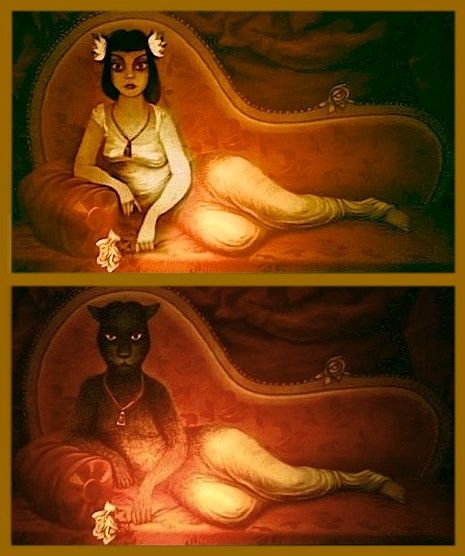
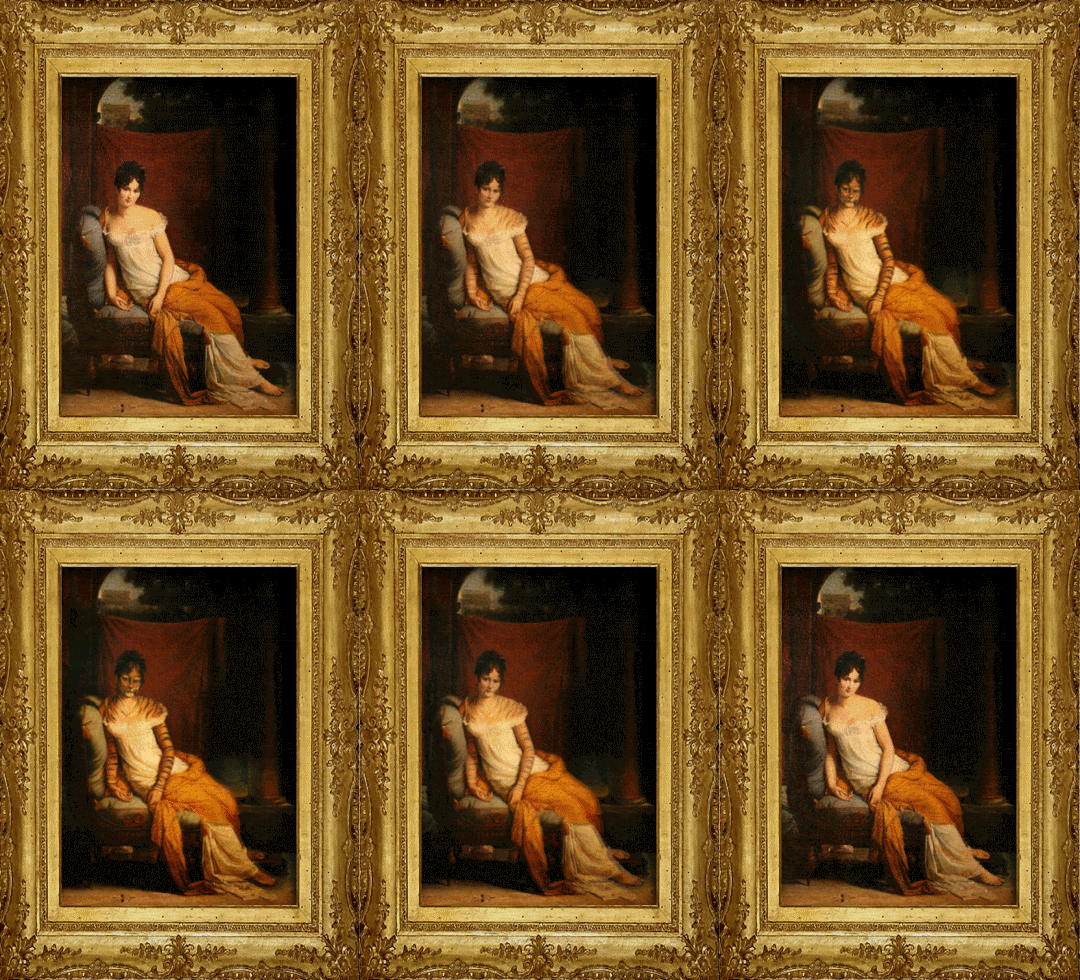
But for the paintings used in the attraction, they decided to limit the transformation
to the lady's upper half. I don't know what you would call such a hybrid.  A purrmaid?


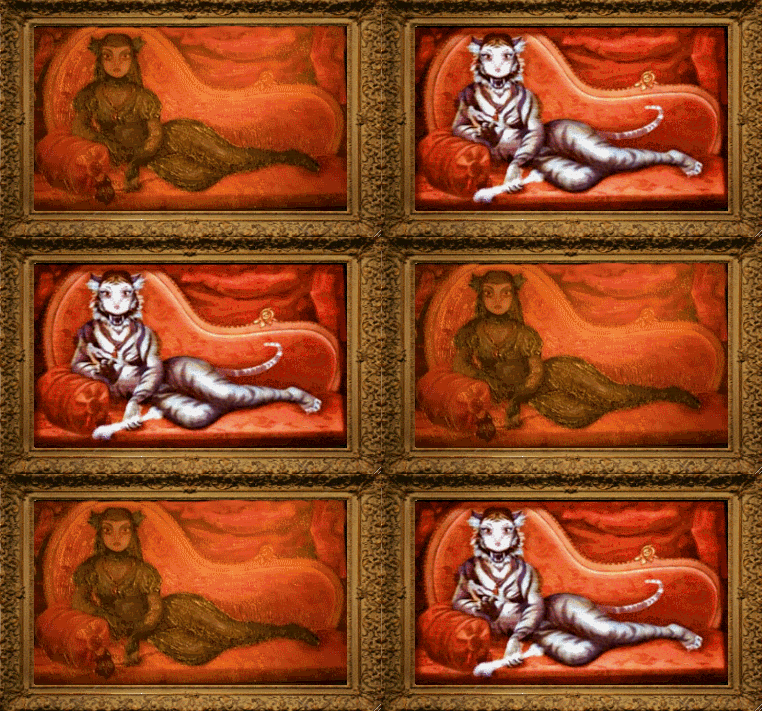
As you know, all of these portraits originally transformed with the
lightning flashes, going to a slow morph effect sometime later.


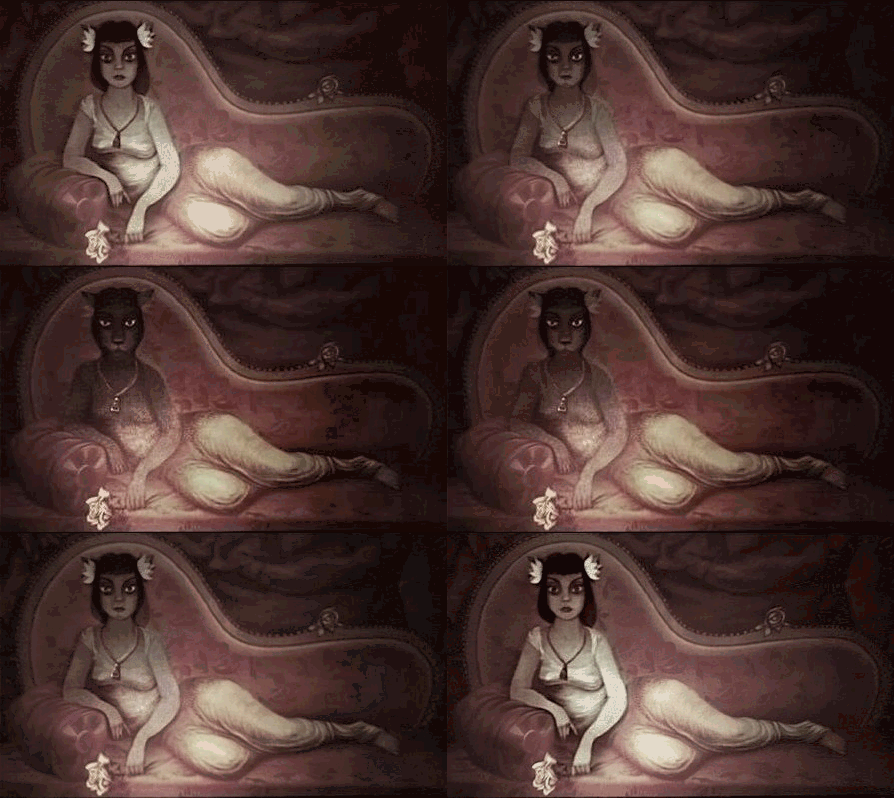
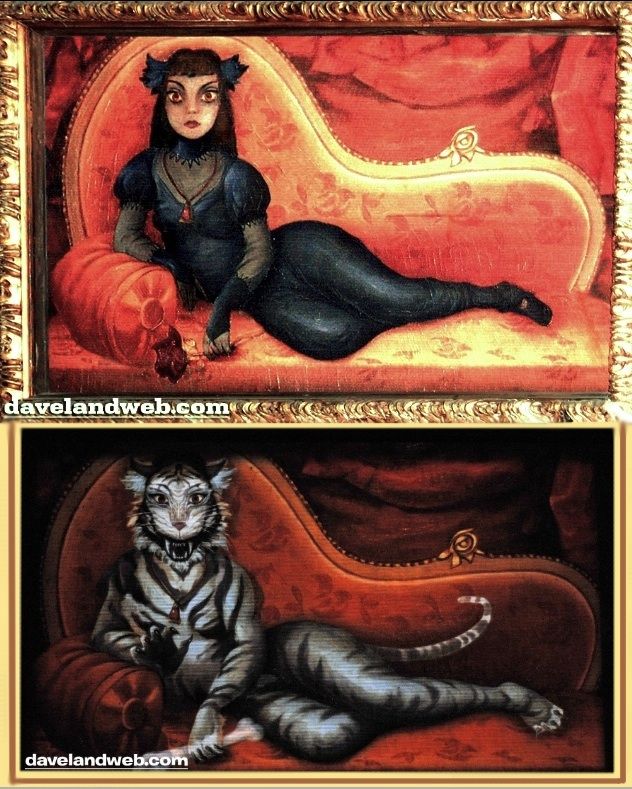
When the new-style portraits debuted in January 2005, following the seasonal HMH overlay, the Cat Lady had undergone a color
reversal.  She was now dressed in black, not white, and the black panther was now a white tigress.  She also had a bone to pick with us.


The color reversal was necessary for the new technology to work.  The secondary
picture is all white, and for contrast purposes the primary picture must be fairly dark.

And of course, we're back to the lightning flash.


Incidentally, it may be possible to trace plans for turning the panther into a tigress back to 2002 at least, since
the Cat Lady portrait used in the Haunted Mansion movie (then in production) was a tigress, not a panther.


Unlike many other denizens of the manse, Cat Lady has never to my knowledge picked up a nickname—
nothing, at any rate, that has successfully filtered into common usage. Now that she transforms into a tigress,
allow me to suggest she be named Euphrates (yoo-FRAY-deez).  Some of you will get that.  Some of you won't.


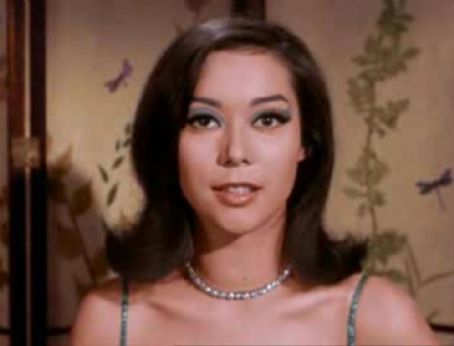
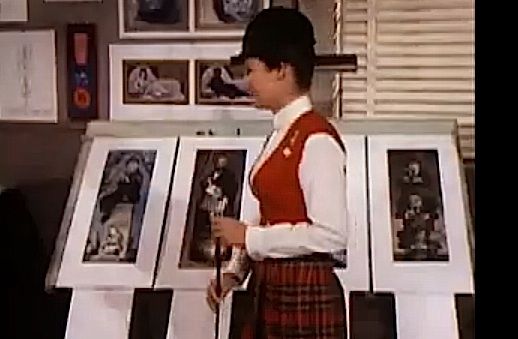
And now for our mystery. Return with us to the first season of Bewitched, the famous sixties sitcom. In the 21st episode, Darren (Dick York) is having difficulty finding the right kind of model for an advertising campaign. He needs a beautiful, exotic-looking, Asian girl. Wanting to help, Samantha (Elizabeth Montgomery) turns a stray cat into just such a model (Greta Chi), but forgets to take into account the persistently feline nature of "Ling Ling." As they like to say, "hilarity ensues" as Ling Ling dazzles everyone with her mysterious beauty but also exhibits embarrassingly feline behavior like lapping milk and gobbling down sardine hors d'oeuvres.


For the main photo shoot, she reclines on a sofa, and I'll be danged if the
Bewitched cat woman doesn't look a lot like the Marc Davis cat woman.


This could simply be a remarkable coincidence, of course, and at the moment, I think the smart money's on that option. If there is a connection, however, the problem is to figure out not only how, but which way the influence ran. "Ling Ling" aired February 11, 1965 and was filmed December 16, 1964, according to the list of episodes at Wikipedia. When did Marc execute his sketch? That's hard to say, but it was up on the wall at the WED studios when they filmed the Disneyland "Tencennial" special, which aired January 3, 1965.


Cat Lady can also be seen in a concept painting for the "Grand Hall" which appeared in the 1965
Disneyland souvenir guide and in the concept sketch that preceded it, but these may be later than the TV special.


The January 3rd date is our firmest point of reference. Work on the Mansion really got going again in the latter half of 1964, after the hectic World's Fair projects were over. That's when Marc was enlisted. So "sometime in the latter half of 1964" is a safe bet. That is well before the Bewitched episode aired, so it is not possible for Marc to have seen the program on TV and to have gotten the idea from there. By the same token, how could the Bewitched producers have seen Marc's unpublished sketches before December of 1964, when "Ling Ling" was filmed? Was Marc chummy with someone involved in the production of Bewitched?  

We may never know what connection there was, if any, between Ling
Ling and the Mansion's Cat Lady.  It remains an unsolved meowstery.


Digging Deeper in the Lost Graveyards

$
0
0
.
.     
.                                                                           Got your shovel?
*Chik.  Shing. Chik.  Shing.*                                                        

This month Long Forgotten celebrates three years of digging 'em up and dissecting 'em, otherwise known as revelations and ruminations about the history and artistry of the Haunted Mansion.  This is also the 100th post I've written, by which I mean that it's the 100th post if you count the ones that are already written and currently in the can and ready to go.  So I'm cheating, but this way I can celebrate #100 and the third bloggiversary in a single post and help keep these annoying horn toots to a minimum.  Seems like we just had one.

Three years and a hundred posts.  Gee.
And yet there are still people who think that what I choose to say or not to say at Long Forgotten does or does not matter. What do they know?

Okay, that's done.

Back to business.  Let's lay out some fresh Mansionalia, recently unearthed.  Oh, and speaking of still people, that reminds me.  Two things:
First, remember to show some respect for the dead.  Still people are still people, you know.* Second, always wear a tie clip to an autopsy.

Ordinarily, when I come across new material relevant to an existing post, I just add it to the post and then note in the Refurbished Posts list on the right that something has been added to the old post, but in this case the material is plentiful and interesting enough to warrant a separate sequel, so I thought I'd append it to the celebratory notice above and call that a post.  Again, you could think of it as a snack to hold you over until dinner rather than as a full meal.  Just so you know, I've got some upcoming posts that should be a lot of fun.


New Old Information

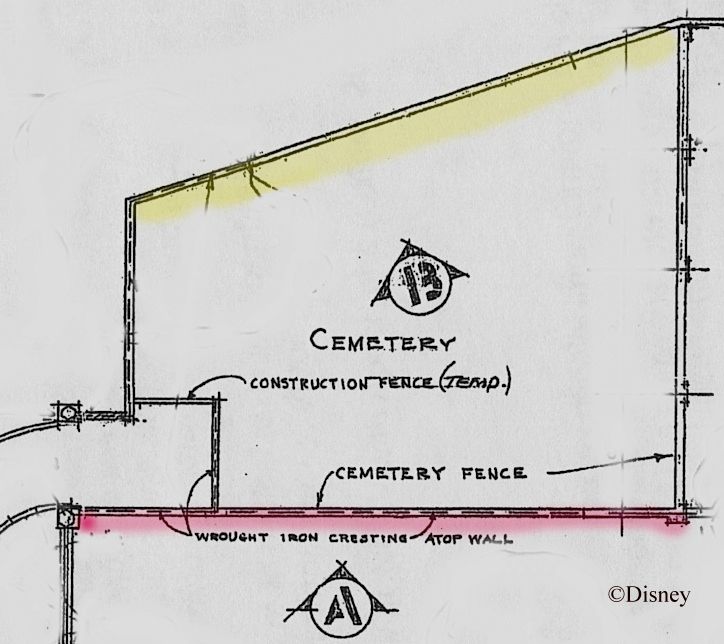
I've recently come upon some more 1962-63 blueprints that are new to me, and they augment both the Lost Graveyard post and the more recent To Find a Way Out post.  Those are, you will recall, the posts dealing with the two graveyards on either side of the Disneyland Haunted Mansion that were the final destinations for the twin walk-thrus originally planned for the attraction.  The one on the north (to the right of the HM) remained a cemetery and became the exit courtyard for the ride, albeit much altered from the original plans, and the one on the south (left) became a queue area. The new old blueprints give us more information.  For clarity, I've added color in many places.

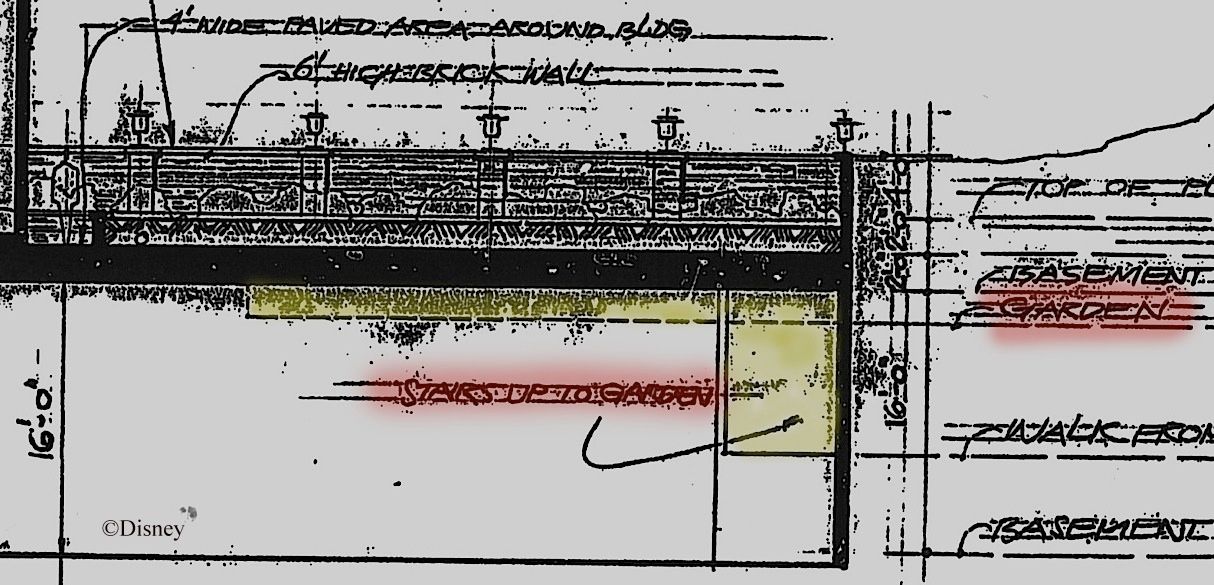
In this one, you're looking straight at the front of the house.  I don't think you should attach any significance to the human figures on the balcony. I think they're only to show scale. One of the two elevators is depicted, and to the extreme left and right of the lower level one finds the two exits, confirming our analysis inTo Find a Way Out.


If you're wondering what that dark band is, the one above the thin black band,
that's the brick wall that goes behind the building, up against the berm.


On the left in the blueprint, the staircase that would eventually be the "chicken exit" from the changing portrait hall is
plain, as well as part of the courtyard originally planned as an ornate cemetery, with its distinctive, stepped wall top:


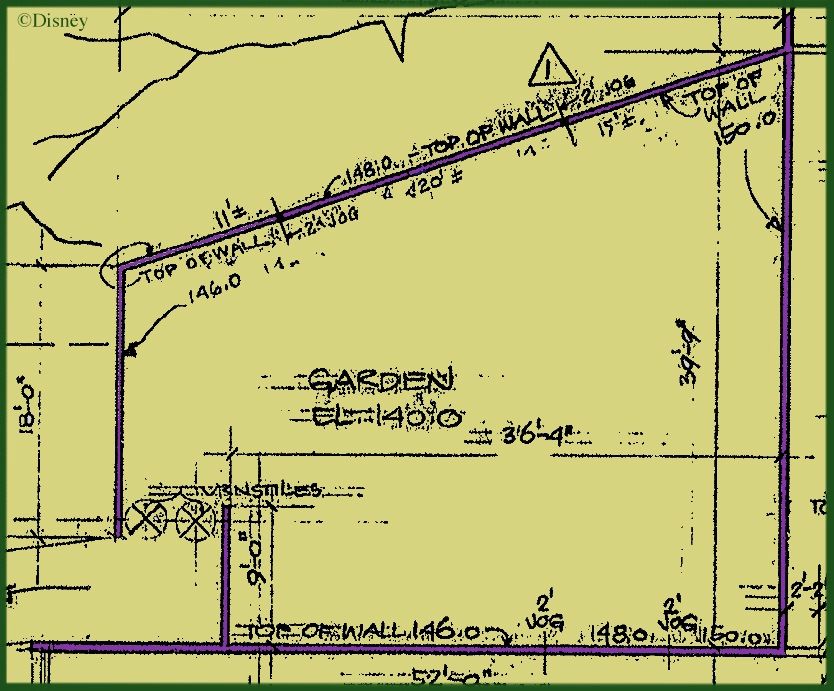
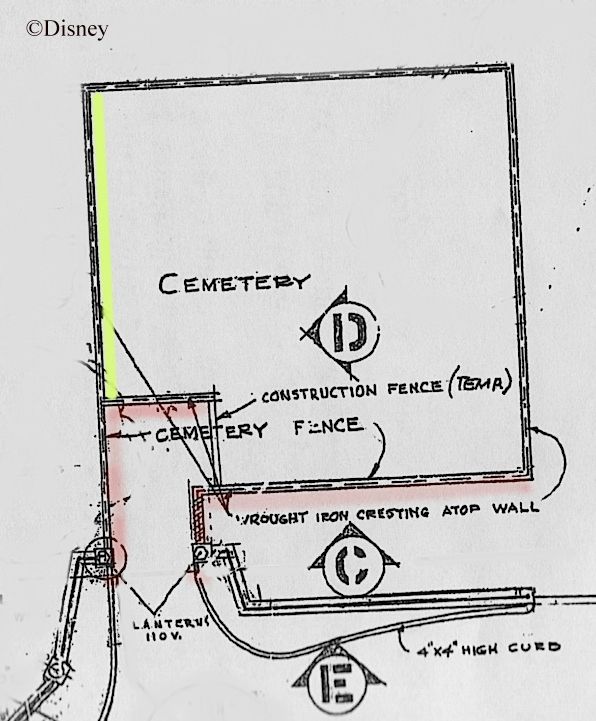
It says "Garden," but as we know, it was indeed a cemetery they were planning.  Here's another new old blueprint.


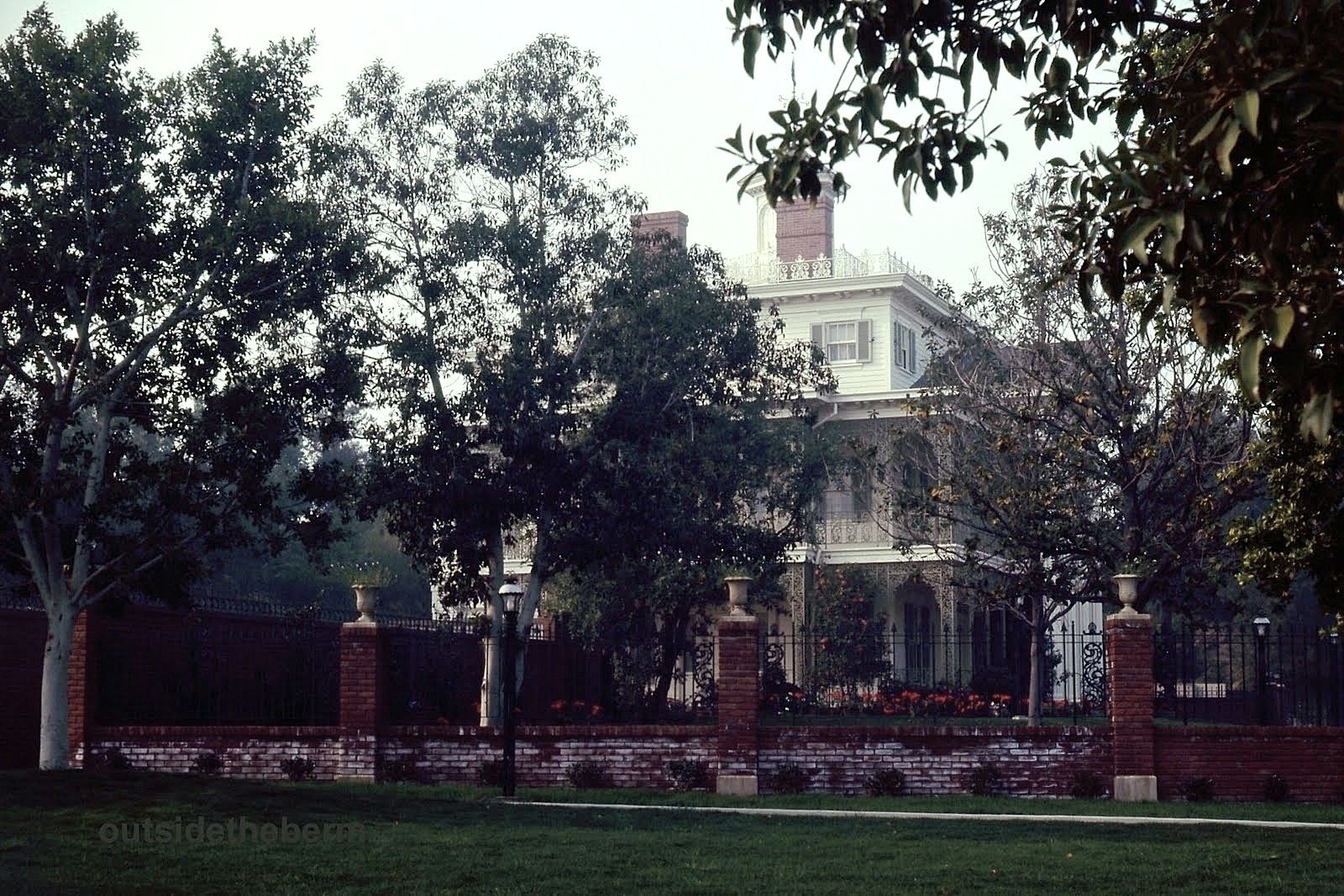
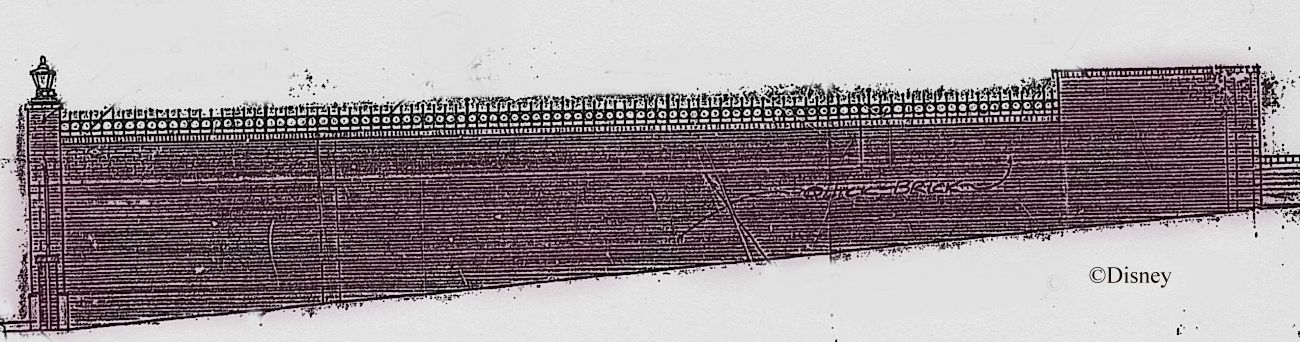
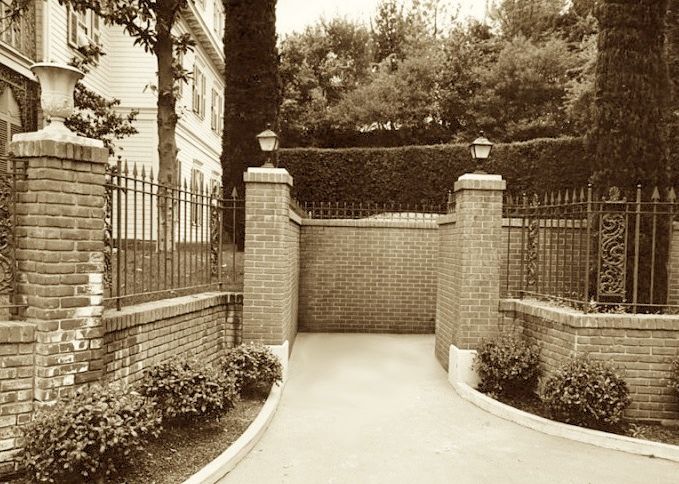
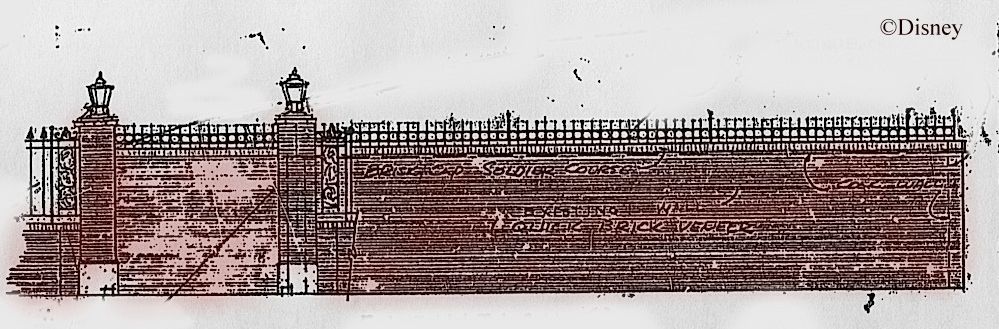
As we have seen in previous posts, there was no opening in the front wall (red) originally.  It was simply a massive brick wall.

(1964 pic from Outside the Berm)

Here's a new blueprint view of that wall.  For some reason it makes me think of a sinking oil tanker or something.


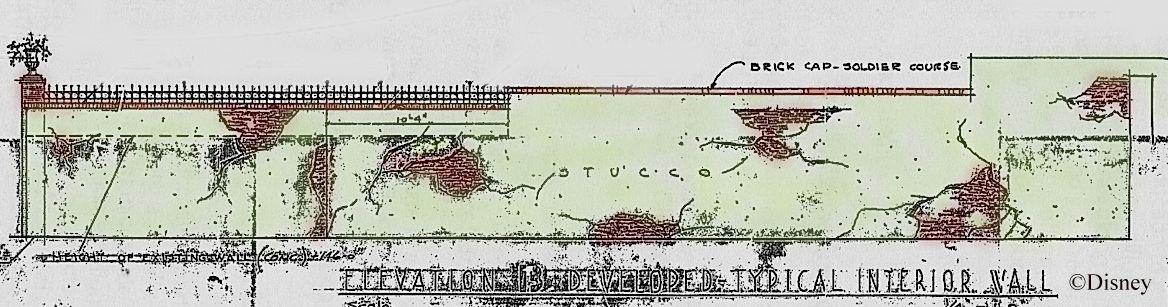
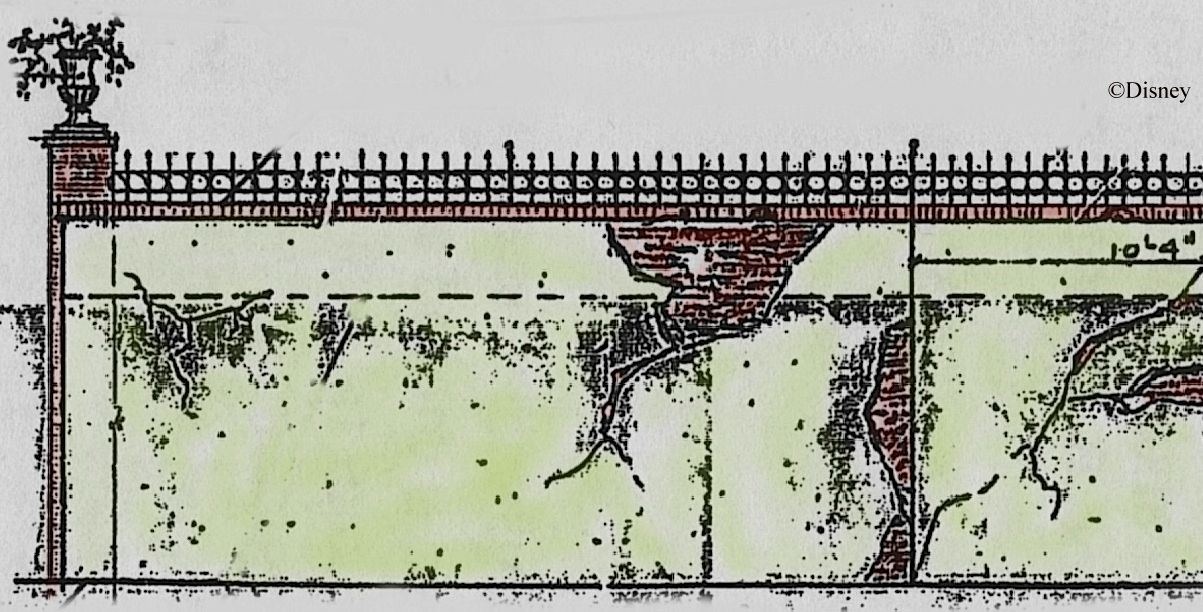
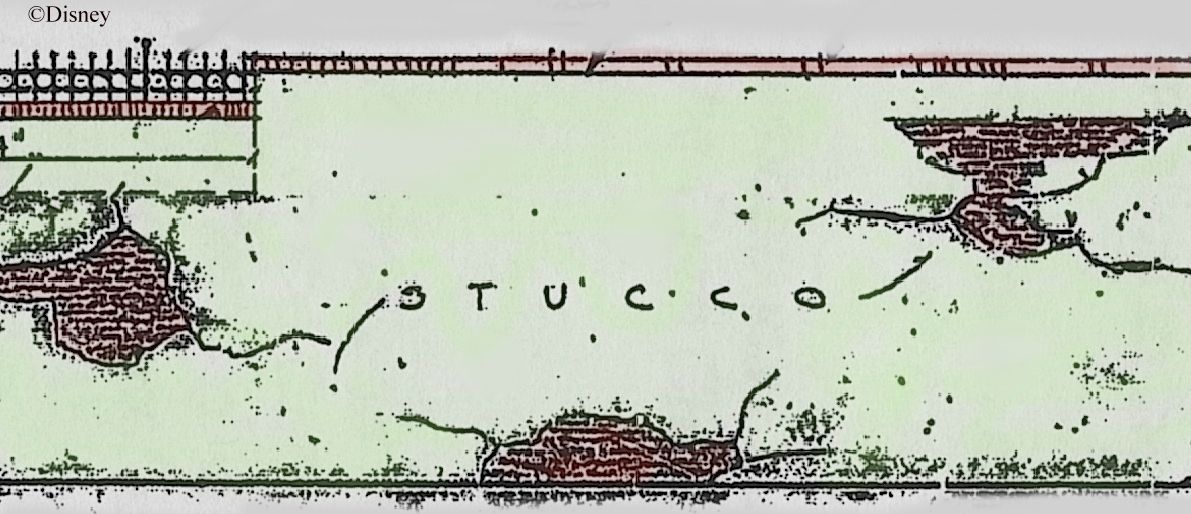
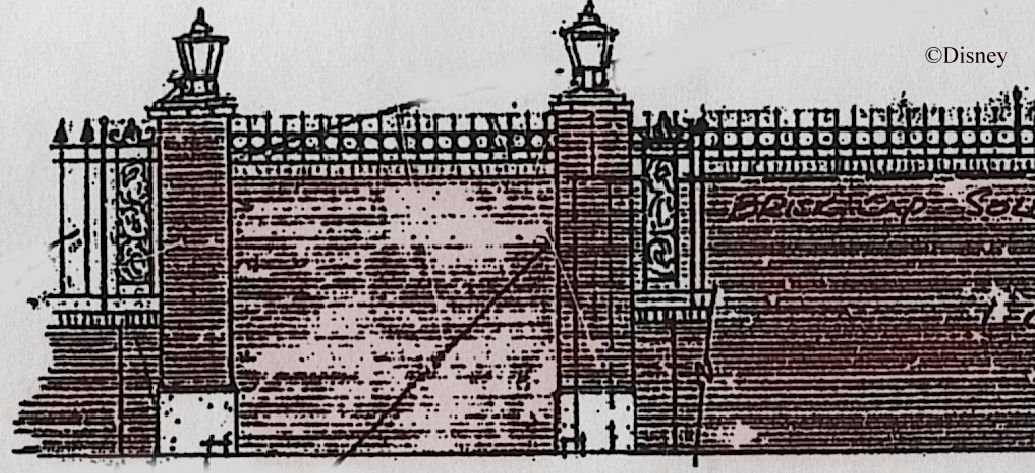
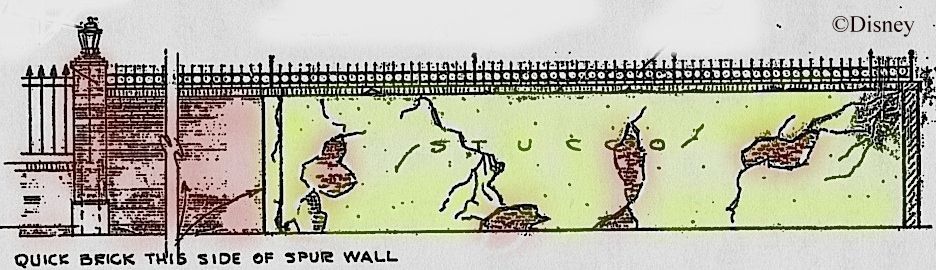
But more fun is this one, which shows a "typical interior wall" (yellow on the drawing above).


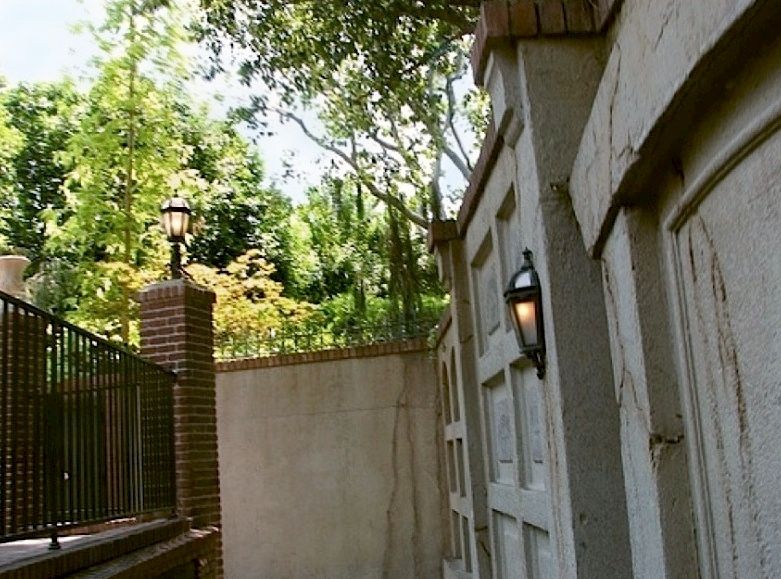
That is, once again, the back wall with its two jogs, but the surface design is obviously different from what
we see today. When it was actually built, we got that row of trim and tidy mausoleums, not falling plaster.


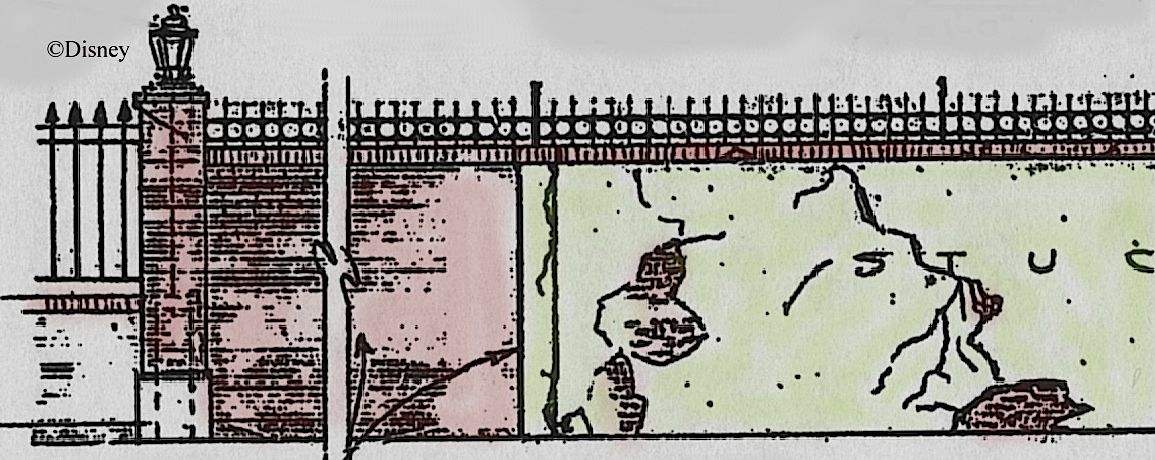
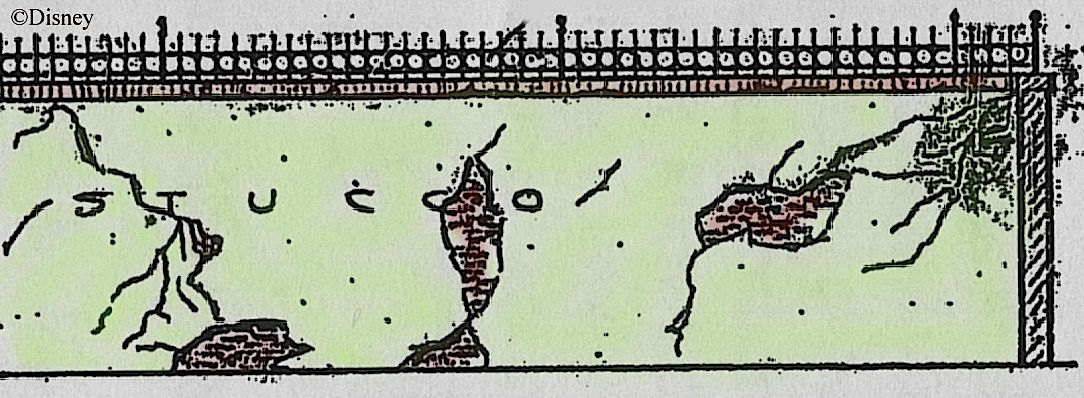
Ah, but the crumbling wall in the blueprint matches what we see in that concept sketch we've posted so many times before:


One supposes that Walt's insistence that the exterior of the house look clean and well-kept was seen to apply as well to the interior of these cemetery courtyards, which is logical enough.  Still, I think it's great fun to find what amounts to a second sketch of the original concept.

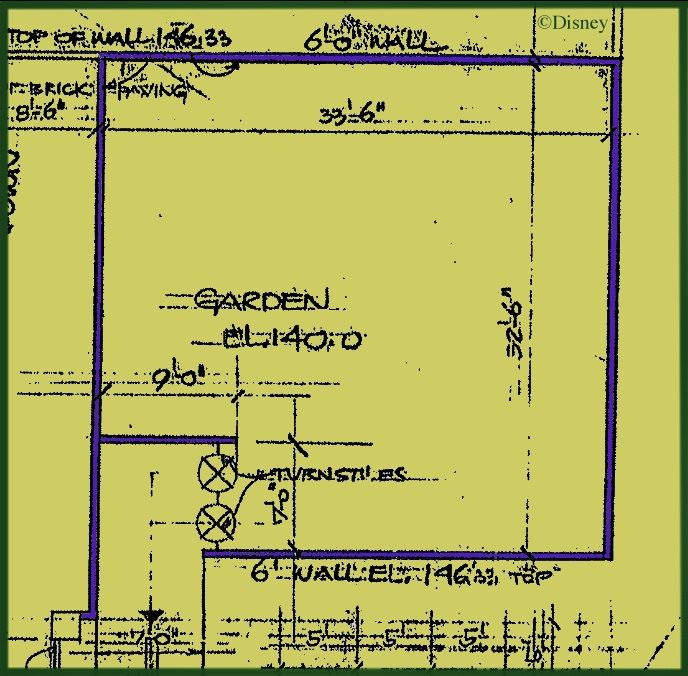
On the right side of the first blueprint at the top of this post, there is less to be found.  That's still the brick wall going across the back of the lot you see.  The ground slopes slightly down toward the viewer from there (rainwater drainage considerations), so the "Garden" is a little lower than that back wall, and because of that we can see a strip of the bottom-most portion of it depicted.  The exit staircase on this side (now an emergency exit) runs east-west, not north-south like the other side, so there are no cute stairs drawn in profile in this rendering.


The other new old blueprint gives us a rare interior view of the north cemetery courtyard as it was originally planned.


The red is what you see from the front and resembles what was actually
built but eventually modified into the exit crypt complex we have today.

1966
(modified fromthisoriginal Daveland photo)


The yellow represents the left hand interior wall, as per the diagram above.  Thus we have at least
one piece of artwork which reveals something about the original planning for the north cemetery.


Presumably, the crumbling plaster look on this side was scrapped too, so all we really learn is
that the interior walls of this cemetery were going to look just like those in the other cemetery.


***************


*The dearly departed was a bootlegger, you say? a maker of moonshine in the
mountains? It matters not. Still people who were still people are still people.


Weird Glows Gleam Where Spirits Dwell

$
0
0
.
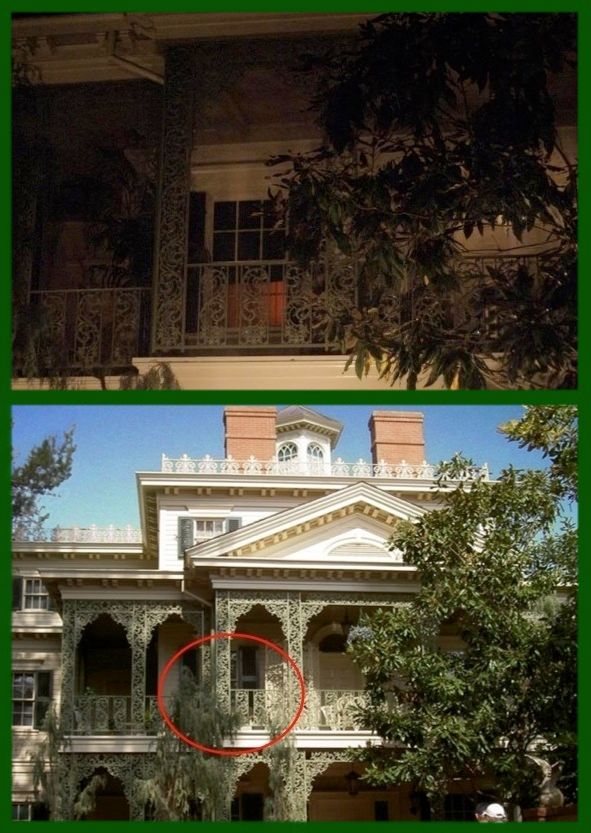
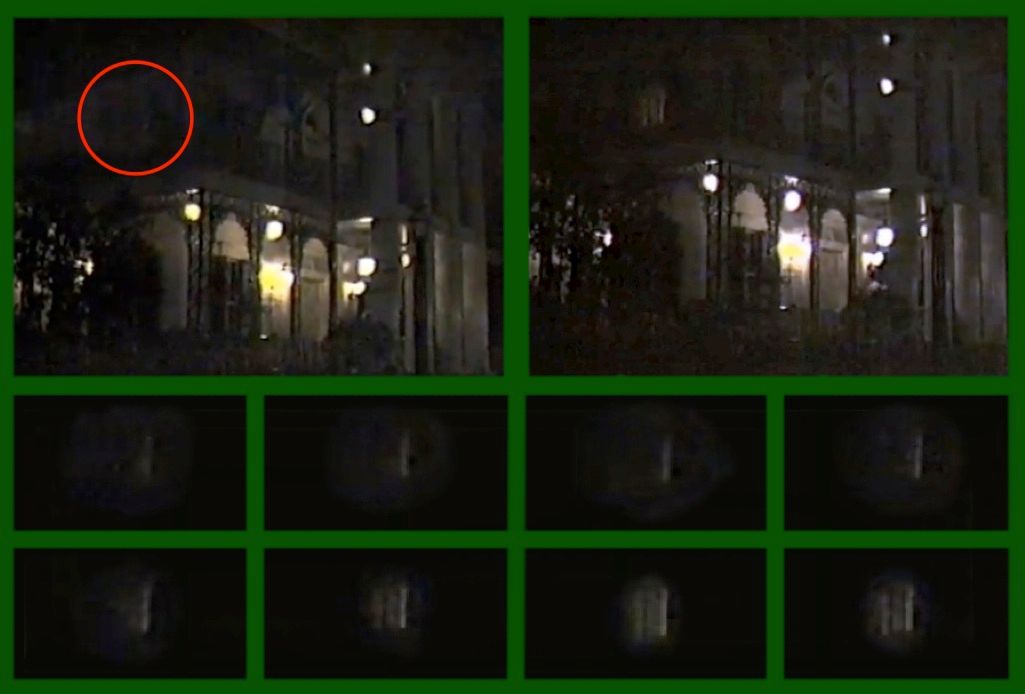
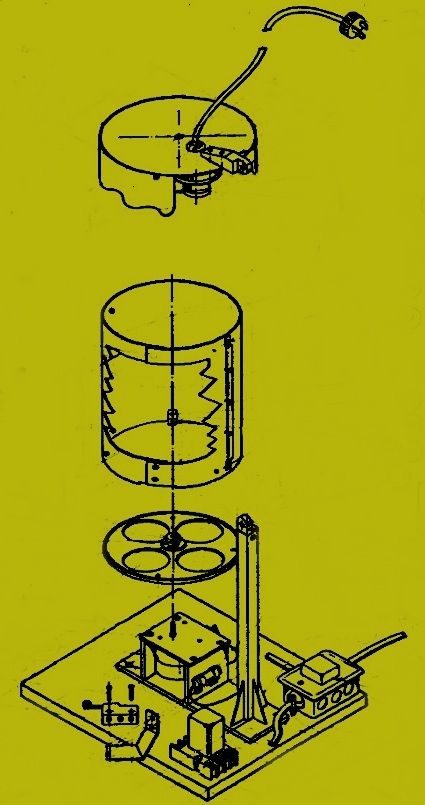
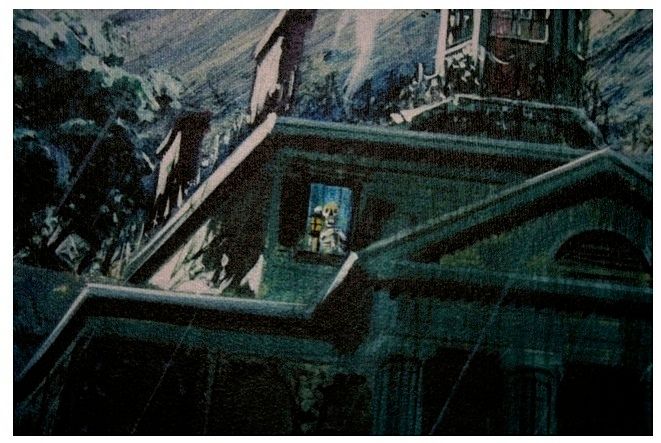
Many of you will recognize this quotation from the "Story and Song from the Haunted Mansion" souvenir album:  "Strange sounds come from within the walls, and it's said that eerie lights have been seen, both in the attic windows, and in the graveyard at the side of the house."  I've actually been asked to do a post on the eerie light effect, and I think it deserves one.

Wait, there's an eerie light effect? Yes, there's an eerie light effect.  Furthermore, it is in my opinion one of the most beautifully economical effects in the Haunted Mansion, and yet it's also the least noted, or darn close.  So modest it is, that even people who know about it tend to forget that they know about it.  Not a word about it can be found at Doombuggies.com or in Surrell's Haunted Mansion book, or anywhere else in print that I can recall at the moment.  I guess it's not thought aught worth commenting about.

It's known as the Traveling Light effect.  I love it.  It's probably been there since the ride opened, and it's still there now; nevertheless, even among Mansion fans, it's surprising how many have never seen it or even heard of it.  If that sounds like you, know that there is a mysterious light which appears in an upper-floor Mansion window and moves across to other windows before disappearing.  After a short interval, it does it again. That sure doesn't sound like much, does it?  But this seemingly feckless effect effectively affects folks, and that's a fact.


Walt Disney World

WDW has the Traveling Light, but the context there is not like Disneyland.  The façade of the HM, by its very design, spreads out its wings and forms a sort of IMAX screen for the effect.  Consequently, the Traveling Light is far more conspicuous in Orlando than it is in Anaheim, and it consists of seven separate lights in coordination so that the light travels quite a distance and even moves through the Conservatory, where you can hardly miss it.  I don't know for sure, but I think that the Tokyo Haunted Mansion has the same set-up.

A video from 1992 showing the light in the upper left window can be seen HERE
A second video from 2012 showing the effect can be seen THERE

Good old Foxxy (she of Passport to Dreams Old and New fame) has published a long-exposure photo showing most of the path of the WDW Traveling Light.  When it's firing on all cylinders, the light begins in the upper window on the left side of the building (around the corner, on the end), it moves across the face of the house through upper left and right windows, goes through the conservatory, and moves across the face again in the lower windows, right to left, ending in the lower window on the left side.  A big loop.  Runs every four minutes or so.


As I said, by design the WDW light is not and cannot be very shy.  You can even see it during daylight hours, although it's possible the light was dimmer originally. The only element of real-world mystery stems from the fact that the light was non-functional for many years.  The motors and bulbs burned out and the effect was largely forgotten.  By the early 90's only one window light was still working.  Older guests would sometimes wonder if their recollection of the traveling light was accurate, and younger ones were either skeptical or envious.  Happily, during either the 2007 "Rehaunting" refurbishment or the 2011 interactive queue installation, the effect was repaired and restored to its original glory.  (Our thanks to Foxxy for much of this information.)


Disneyland

I much prefer the Disneyland version, because it's harder to see, which means it's easy to miss, which means it's more mysterious.  It's only visible at night, as it moves across the windows of the second floor on the south side.  Not only that, but from most vantage points, the view is partially obscured by trees.  The light is orange, mimicking a candle flame or an oil lamp.  I've seen only one photo of it, taken by Jack Wixom in 2007.

(The lower photo is just to show which window is in Wixom's shot.)


For some people, so many years pass before they finally notice it, that they assume it's a new effect, when in fact it goes back to 1969, if the date on the schematic means anything. Furthermore, like its WDW counterpart, the Anaheim Traveling Light has often been out of commission for long periods.  The story I'm told is that it's a low priority item, so when it breaks, it can take a long time for maintenance to get around to fixing it. Unlike other effects, no one lodges complaints about its absence. And after it's gone missing for awhile, it's easy for both guests and staff to forget that it ever existed. Such, my friends, is the humble profile of our Traveling Light effect.

The only video of the DL Traveling Light that I've ever seen is THIS ONE from 1990.  It can be seen near the beginning, from 00.32 to 00.38.


Why am I so fond of the Traveling Light?  Because it scares people.  It preys upon jittery imaginations and sparks rumors. Best of all...

EYEWITNESSES REPORT IT IN MUCH THE SAME WAY AS THEY MIGHT REPORT SEEING A REAL GHOST.

Pardon my shouting, but that, friends, is a mighty fine thing.  Pull up a chair and listen to a strange tale or two.

I was a Sweeper in 1985.  Late one summer night I was assigned to Haunted Mansion on a closing shift.  This meant I was responsible for a final sweep of the queue and to clean out its bordering flower beds. [....] It was dark.  The other sweepers in New Orleans/Bear Country were far off doing their own closing routine.  I was alone.  There I stood in the large bullpen near the east side of the Mansion, with my ever-present pan and broom in one hand and my trust black flashlight in the other.

A breeze lifted the branch of a nearby tree as I stooped over a flower bed in search of old napkins, cigarette butts, guidebooks, cups and other such castaways. The tiny leaves of the branch ran along the back of my neck like fine fingers. I started and stood up straight. Then I saw it. I had been going to Disneyland for umpty years and had been working there for almost two. I had never seen it before.

My eye caught what looked like a yellowish ball of light bobbing gently past the inside of one of the upper story windows of the Mansion. As soon as I saw it, it was gone. I blinked, looked away, then glanced back up. Nothing. Well...I decided I'd better finish up my flower bed, sweep the queue and get out of there. I didn't even have a radio with me. Nope. Just me. And the Mansion.

I directed the beam of my flashlight back into the dark flower bed and gingerly picked out more debris with my pan and broom. I was pretty sure I had seen something, but tried to push it away as the reflection of an airplane in the window panes, or maybe one of my fellow cast members had shined their flashlight up there. Needless to say, I picked up the pace of my work. I looked forward to heading back to the area locker. I was working near the brick wall of the queue and meandering along the bullpen (that's what we lovingly call the area where guests line up) toward the porch of the Haunted Mansion. As I dumped my pan into one of the trash cans of the queue, my eye wandered up the facade toward those upper windows again.

There it was. The ghost. A flickering light moved across the inside of one of the windows again. There was NO mistaking it this time! Then...it moved on to the NEXT window! When it proceeded to pass in front of the NEXT window, then I knew. Darn Imagineers! This special effect was clearly an intended part of the attraction and could only be seen in the dark of night. What appeared to be the ghostly light of a candle moved along inside each of the windows, as though the widowed bride were marching around inside her home, waiting for the return of her captain.

The effect was well done, with a slowly bouncing, flickering light moving past the opaque curtains of the windows. It moved slowly from window to window, with a slight pause in between. When I had first glanced up, the light had reached one of the corner windows, so that it proceeded around the corner to the next window (where I couldn't see it). That is why I caught a glimpse and then it had appeared to vanish. Another smart part of the illusion was that the "walking light" paused for some time between cycles, so that the windows would return to their darkened state and, if you didn't stare up at them for a few moments, you might not notice the light when it began moving again.

Now I'm not saying that there aren't ghosts in the Mansion, but I almost became a believer on that summer evening! I kept that little effect under my hat, sharing it only with a few family members on evening trips to the Park. I have not been out there after dark at any time in the recent past. I wonder if the haunted candle is still pacing around the old house's windows...

.                                                                                                                                 Mike Kelly, "Jungle is 101" blog post, 9-16-08


When I was a kid...I thought I remembered something like [the traveling light] at Disneyland's mansion.  But I'm never sure if it's an actual memory, something that I made up, or maybe a memory of one of the many dreams I've had about the Haunted Mansion throughout my life.

I do know that for years, whenever I was at Disneyland, I would look for a moving light in the windows of the Haunted Mansion, and over the course of those years I never (again?) saw it.  I have never seen it mentioned anywhere, though, so I have no idea if I'm remembering it correctly.

.                                                                                                                                 Kenny Vee, "The Disney Files" blog post, 9-12


How Do They Do That?
The Traveling Light effect has inspired some elaborate explanations, like this one from a chatboard post at a popular Disney website several years ago:
Actually, it's more than just a wandering candelabra.  The effect is this:  A harsh, reddish orange glow begins to flicker brightly in the window, the flicker glow growing brighter, filling up the window.  Then, as the glow reaches the height of its brightness, a shadowy figure moves from the right side of the window towards the light, putting out the light.  The effect repeats itself every several minutes and is quite unnerving when you see it.  The way the figure moves across the window - it's not like it's walking past the window - it's gliding past it. 
Not bad for a light bulb inside a revolving coffee can.  Really, there isn't much more to it than that.  The tear-away portion of the drawing below is actually there on the can, and the bulb (not shown) is a flickering bulb, with a mirror behind it (also not shown). They hang black material on the framing behind the whole thing so that when the hole is facing that way you don't see anything.

It's probably a Yale Gracey creation.  You look at that schematic, and you read accounts like
those above, and you shake your head in disbelief.  Bloody freakin' genius that is, and no mistake.


Somebody's Home
What can one say about a mysterious light in the window of an abandoned house?  It's a horror cliché, of course.  Sometimes there is something visible in the window.  In one of Ken Anderson's earliest Ghost House scripts, he describes an effect seen by guests as they look at the exterior of the house: "First at one upstairs window and then another, a girl's face appears momentarily, screams and is throttled by a large hairy hand which draws her back into the darkness."  One decade later, Dick Irvine, then the executive VP and Chief Operations Officer at WED (=WDI), came up with a rude sketch based on Anderson's idea.


"An annual pass is now HOW much?  Tell Mickey he can kiss my mmmphh..."

Even though they didn't use this, creepy figures sometimes appeared
in the windows of later concept art, like this Collin Campbell painting.


These Andersonian spooks are suitable for a shutter-flapping, dilapidated house of horrors, but they are obviously out of place in the pristine, innocent-looking mansion Walt insisted on.  On the other hand, how about a fleeting, mysterious light in the windows, leaving you in doubt as to whether you saw anything at all? Now you're talking.

To say the motif is well known would be a whopping understatement.  Just by way of illustration, it's hard to count how many books, short stories and poems are titled or subtitled "A/The Light in the Window," and a lot of them seem to use the image to raise goosebumps.


Same goes for artwork.  It's as much of a fixture in
haunted house illustrations as bats or thunderstorms.


Disney uses it in Mansion-inspired artwork, perhaps consciously referencing the actual
effect, but I would think more likely by pure coincidence, so pervasive is the cliché.


On the most mundane level, the unexpected light in the window is evidence of occupation.  Someone or something has taken up residence, here where no one supposedly resides.  Storywise, it creates a tension.  On a dark and stormy night, the light welcomes you to come in and find shelter, and yet it scares you away at the same time.  The situation calls for discretion: Would it be bravery or stupidity to go in?  Would it be prudence or cowardice to keep away?  At this point in the story, it is always the case that you can still choose which path you will take.

There IS turning back now.  Later, not so much.

That point of tension is so pivotal in so many scary tales that it is no wonder that the light in the window cliché continues to be heavily used, since it introduces that moment so well.  "Drawn like a moth to a flame..."

**************

It's appropriate that we find ourselves here on the second floor at the Anaheim Mansion, because in the next two posts we'll be running all around the front yard, and before we're finished we will spend quite a lot of time on this upper balcony, the place where the weird glows gleam.


Stroll Around the Grounds Until You Feel at Home, Part One

$
0
0
.
I've got about eight separate and yet loosely-related mini-topics that I'm going to present in a couple of posts. I suppose they're analogous to Disney "package" films, more like, say, The Three Caballeros than Pinocchio. The collections are not random: all of these topics have to do with things seen in the front yard of the Disneyland Mansion.  Today there are three mini-posts, and the common theme among them is color.

Oooooooo   Color -r-r-r-r


The Imagineers who built Disneyland came out of the animation studios, and that means they were sensitive colorists, among other things.  People who admire the end product have noted again and again how subtle and suitable is the use of color throughout the park. It's all quite deliberate and meticulously maintained (for the most part). (Hit that button again, would you?  Thanks.) The last time I was at Disneyland I noticed for the first time that the stone "blocks" of Sleeping Beauty castle come in six different colors.  When you look at older photos, you find that they've been multicolored like that for a long time, maybe from the beginning. Some of the variations are so subtle that it's hard to pick up on them with the camera.  Why so many? especially since some are so similar?  Because it looks right.(Hit it one more time?  Thanks, you're awesome.) 


Off White

Nobody at Disney was more sensitive to the use of color in the parks than John Hench. He worked at Disney for 65 years, up until a few weeks before he died in 2004. My friends, whatever John Hench tells you about Disney design you can take to the bank.

"Because I said so."

According to Hench, the Disneyland Haunted Mansion is painted "off white." Strange name for a color, isn't it?  I mean, aren't red and blue "off white" too?  Well, nobody asked me.  As Hench explains it, the colors for the house are more psychologically complex than people realize.  

Sometime between 1972 and 1987.

“For Disneyland’s Haunted Mansion, we wanted to create an imposing Southern-style house that would look old, but not in ruins.  So we painted it a cool off-white with dark, cold blue-gray accents in shadowed areas such as the porch ceilings and wrought-iron details.  To accentuate the eerie, deserted feeling, I had the underside of exterior details painted the same dark color, creating exaggerated, unnaturally deep cast shadows.  Since we associate dark shadows with things hidden, or half hidden, the shadow treatment enhanced the structure’s otherworldliness.  The park maintenance painters like the haunted effect.  I even received calls from guests who wanted to know the brand and swatch number of the paints so that they could use them on their own homes.”
 .                                                                                                                —John Hench, Designing Disney (NY: Disney Editions, 2003) 116.


These painting tricks are an example of signals sent from the Imagineers that are received unaware.  It's extremely unlikely that guests consciously notice the artificial shadowing, but very likely that it affects them psychologically, be it ever so slightly.  It's an interesting sort of interaction between artist and audience:  An expression fully intentional, very carefully thought out, and yet by design much too subtle for the conscious mind to engage.  I don't know.  Sounds illegal to me.

What Hench does not mention is that a radically different color scheme for the Mansion exterior was being contemplated practically from the moment it was first built.  You never hear about it, and were it not for the fact that a mysterious and unique document from those days survived and surfaced, it truly would be long forgotten.

That the house would be white (or off-white) seems clear enough from Sam McKim's iconic concept painting in 1958, which you will recall was a paint-over of a Ken Anderson sketch which was based in turn on the Shipley-Lydecker house in Baltimore.


For what it's worth, the Shipley house itself was white:

1945  (The house had been remodeled by then, and the side porches are gone.)

McKim's painting was put to immediate use in brochures and souvenir guides published over the next several
years, so public expectations about the house, long before it was even built, were that it would be a white building.


Sure enough, when the building went up in 1962, it was white.  Here it is in mid-1963, just
months after the last major landscaping around the brand-new building had been completed.


Everything indicates a straight, uninterrupted line from start to finish, a line that is painted off-white.  So where in the
grand scheme of things does this oft-published artifact belong?  It's a 1962 or 63 color guide for the Haunted Mansion.


Huh? No one seems to know anything about this rival color scheme.  Strange.  But we had better not lag behind
and puzzle over it today; we've got two more mini-topics to cover.  Mustn't dawdle.  Scroll on, scroll on.


Garden Variety Imagineering

Applied color theory doesn't end with the building itself.  Let's turn around and look at the front yard.  What a pleasant place it is!  Other, newer rides may have more exciting and entertaining queues (Star Tours, Indiana Jones, Tower of Terror), but for my money the Anaheim Mansion still takes the prize for most beautiful queue.


This is still true even though it used to be even more lovely.  Originally there were flower beds around the light posts.
For most of their history, they were warm, bright patches of yellow. They were taken out in 1991, give or take a year.

1980

 1973                                                                                    Today

1974

It's a pity they're gone, but even without the
flower beds, it's still beautiful out there.


While I miss the flowers, I can't get too worked up about their absence.  Perhaps they were a little too
cheery. It does seem a wee bit more serious and somber without them, and I can't complain about that.

And now, a question:  What are Halloween colors?  Black and Orange, right?


Are there any other good color schemes for Halloween?  How about Green and  Purple
(or Magenta)?  Just google "green purple Halloween," and brother, it's all you can eat.


Okay, fine.  Now what are the differences between the orange-black strategy and the green-purple one?  I can think of two:  (1) orange-black is inescapably juvenile, and (2) it's joined at the hip to Halloween.  It's difficult to use orange-black anywhere else, because it "looks Halloweeny" no matter what you do, and it's never adult-scary.  It's for kids.  Green-Purple, on the other hand, is not so tightly constrained.  Oh sure, it can go as cute and tricks-or-treatsy as anything orange-and-black (witness the above), but it can also be used for more adult scares, although it always seems to do so with tongue-in-cheek, never too far away from the campy side of horror.  I mean, no one uses the purple-green palette if the intent is to truly scare the crap out of you, but it can certainly be used for the gruesome and grim.  And green-purple is not tied down to Halloween.  It can be used to evoke spooks and spirits and ugly old creeps far beyond the October horizon.


No clearer example of putting this color combination to gleefully ghoulish use can be found
than Collin Campbell's artwork for the "Story and Song" Haunted Mansion souvenir album.


Just flip through those familiar eleven pages.  Sometimes it's green and purple,
but at other times it's purple and green.  For variety's sake, one supposes.
(The only exception is the Hat Box Ghost illustration: blue and purple.)

Is this a recent development, this perception of purple (or magenta) and green as a creepy combo?  No.


Do Disney artists use this palette elsewhere, for the same purposes?  Yes.
We've already cited Madame Mim, but that's barely the tip of the iceberg.

The "Hatchet Man" portrait in the Corridor of Doors at WDW

From The Princess and the Frog, a tribute to the animated "Leota" headstone at WDW

You see how it works.  Purple (or magenta) and green conjure up goblins and ghoulies, but not necessarily from last Halloween, and even though it's not a seriously horrific palette, it isn't particularly kid-friendly either (witness the Grand Guignol posters above).  All and all, it feels like a perfect fit for the Haunted Mansion, does it not?

1979 paper bag design

They used purple-green for the silver anniversary celebration in 1994:

Left to right that's John Hench, Bill Justice, Sam McKim, X Atencio, Disney archivist
Dave Smith, Disney historians David Mumford and Bruce Gordon, and Russell Brower.


No wonder Campbell went straight there and stayed there, and no
wonder everyone agrees that he hit the nail right on the head.

But you know, he wasn't the only one.


It remains only to show you some random pictures from the front yard gardens, taken during
the last 15 years or so.  The evidence is undeniable, the case is closed, 'nuff said, and Q.E.D.


(pic by PirateTinkerbell)


The plants get changed and moved around.  One year they may have a green-purple thing around the sundial,
and the next year it may be yellow there.  Green-purple coloration is always prominent somewhere, however.


Not surprisingly, they make good use of hardy plants
that give you both colors, like this Wandering Jew.


I've said it in other places, and now I'll say it here:  There is NO DEPARTMENT at Disneyland that produces more consistentlyexcellent work than the landscape and groundskeeping crew, the gardeners, the flower and tree guys—whatever it is they most like to call themselves.  They know exactly what they're doing and they always do it well.  Gentlemen and women, I salute you.  You're the best in the business.


Plaque Build-up

There's another item out here in front of the Mansion where color more or less tells the story, but it doesn't redound to anyone's credit quite so much.  In fact, it may be more an example of blundering to a happy conclusion than brilliant theory expertly applied.


Those handsome plaques that grace the posts of the entrance gate tell an amusing tale.  They're made of brass, which means they're an alloy of mostly copper and some zinc.  If you think of them as big pennies, their metallurgical metamorphoses may seem a bit less mysterious, for copper pennies also contain zinc (but also enough tin to classify them as bronze, not brass). You will recall that copper oxidizes to green.  (As many of you know, that's why the Statue of Liberty is green: her "skin" is copper.)


The plaques didn't go up until the Mansion opened, and they began as beautiful, brilliant, golden shields.  I remember
them when they were like that, and there are enough photos around to give you an idea of how impressive they were.


The golden age didn't last even one full year.  They quickly turned brown.  Like a penny.

(bottom pic: Gorillas Don't Blog)

By 1975, the brown was already beginning to oxidize to green...


...and by the early 80's, they were very nearly as green as they are today.


After a few more years, they were.


Now here's the really dumb part.  In 1989 or 1990, someone was apparently horrified that the plaques had been so badly neglected, and so it was decreed that they should be restored to their original glory.  Down they came for a good polishing.  However, it seems that the best they could achieve was a nice caramel color.  (I am reminded by my readers that I could be wrong about all of this, and every step we see may have been consciously engineered.  Nevertheless, it's hard to see why someone would be so dissatisfied with the green that they went to this kind of trouble to change the color.)


Afterwards, someone must have realized how stupid it was to try to make what was supposed to be an old house look like it was still bright and shiny new.  Why not rejoice over the natural greening, the fact that the house really was beginning to show its age so authentically?  Here was Nature freely supplying something they normally have to fake, and they were trying to fight it!  True, the house is supposed to be kept up, not dilapidated, but this is different.  Even in carefully manicured environments, outdoor brass and bronze fixtures are often allowed to oxidize.

Anyway, they wised up and let them go back to green, and green they remain today.  I don't know if they gave them any chemical help to speed the process.  I would like to think they did not, but I must admit that the lettering and evenness point to some degree of artificial guidance, lending Nature a hand.  You can see them darkening up and starting to oxidize again in that 1994 25th anniversary shot earlier.


Several posts back we discussed how the authentic age and the checkered history of the building serve to enhance the pleasant
impression of an old and mysterious place.  In their own way, those sombre green plaques contribute to this phenomenon, I think.


This is the history of the plaques at Anaheim, but with a little effort you can find
plenty of photography documenting a similar story with the plaques at the WDW Mansion,
although in Orlando they seem to have resisted the green and clung to the brown more stubbornly.

*******************************

There are many more curiosities waiting for us in the front yard,
some that you know about and some that you don't.  Next time.


Stroll Around the Grounds Until You Feel at Home, Part Two

$
0
0
.
We're still strolling around
that magnificent front yard
at  the  Disneyland Mansion,
and I've put together another
potpourri  of  mini-posts,  a
bunch  of  things interesting
enough  to  share,  but  not
necessarily  worth  in  each
case an entire post to itself.

This time out the common
theme   is   intentionality,
and furthermore, all of the
items  to  be  discussed are
props that have been seen
out on the upper  balcony
of the Mansion (with one 
exception).

What   exactly   did   the
Imagineers intend for you
to  take  away  from  these
details?  In some cases, did
they intend anything at all,
or  is  it  your  imagination,
hmm?  And how much does
it matter what they intended,
anyway?  All  this  and  more,
coming right up.

The Mansion
1990-1992


.     Did Something Die in Here?

.       In 1993 a funeral wreath with some modest, old-fashioned bunting sprouted among the columns out in front, but it didn't stay there
.       very long. This brief appearance is today little remembered, being overshadowed at the time by the debut of the pet cemetery.


Maybe they were testing the waters or something.  It came down and stayed down for 1994 and the first part of 1995 and then went back up,
this time with more conspicuous bunting.  A few years later, sometime in the latter part of 1997, a telescope appeared on the railing, with a barometer on the wall behind it.


These were pretty overt offerings from WDI, and guests were expected to engage with them at some level.  I liked them just fine, because they gave you no help at all, just like real life.  With regard to the wreath and bunting, a host of questions come to mind.  Does someone still live here, and did a relative of that someone just die?  Or did the owner die, and the staff were instructed to put up the wreath and bunting in the will, perhaps?  Or did the staff do this on their own, for one of their own?  And why the old-fashioned, 19th-century bunting and wreath display? Are we seeing someone's antiquarian or eccentric tastes at work?  Or if we're willing to countenance a more supernatural explanation, since ghosts do exist in the world of the Mansion (its sole fantasy feature), is it possible that these items are (gulp) apportations from the past?

This is exactly as it should be.  You don't have to think about this stuff at all, of course.  The show is not diminished in any way if you don't.  But if you do, you can come up with four or five possible explanations for the wreath and bunting, none of which require you to leave this world for a fantasy world.  There isn't enough information to decide among the options.  As I said, it's just like real life.  You may have noticed that the world is not especially eager to explain itself to you as you pass by.  You have to figure it out yourself, boys and girls, and often you don't have sufficient data, and that's just how it is.  Now finish your sandwich and stop that whining.

Yes, and what about that staff, anyway?  I've come to accept the Butlers and Maids as part of the show rather than theme park noise to be screened out.  After all, the house is well-kept, the candles are lit, the yard is immaculate.  Someone must attend to the place, unless you're prepared to put all this down to supernatural activity.  I'll concede that the latter option is possible in the world of the Haunted Mansion, but for me, lawn-mowing ghosts just don't cut it.  Barring that, how do we square the presence of this staff with a house given over to ghosts, operating a retirement home?  You don't get the impression that any mortal actually lives there.  Who would want to do that?  It's a haunted freakin' house.

A 1969 photo of seven of the original 43 Butlers and Maids

Again, we're given very few clues.  You never see any of the staff on the second floor, and there is evidence of complete neglect up there. Cobwebs are everywhere.  It's easy to imagine a staff willing to keep up the grounds and the first floor but refusing to go upstairs.  Too creepy, too scary, perhaps.  It's bad luck.  There's a curse.  Whatever.  No one goes up there unless it's absolutely necessary.

But where does this staff come from?  Your guess is as good as mine, but it's perfectly possible to account for them.  Maybe one of the last owners created an endowment that pays a lot of money in interest, funding a trust managed by a steward who hires enough staff to keep the place up, as per the trust fund agreement.  Perhaps there is also a cozy relationship with the city (something to do with the endowment) so that an alderman keeps the stewardship position filled, which is in the city's interest anyway since they don't want the house to become a crumbling eyesore.  The nearest relative, the actual owner of the building, is presently unknown.  That's a mess no one wants to bother with until they really have to. They'd rather wait until the legal owner just shows up some day and claims the place, seeing as how the endowment has been paying handsome dividends, and the current arrangement has been increasingly lucrative for both the steward and the city.  So the unoccupied house is kept up nicely (or nicely enough) in perpetuity.  There is no "evidence" for any of this, but it shows that what you see is entirely explicable within this real world.  They give you no help in figuring this out, and why should they?  What business of yours is any of that?  Go away.

The bunting and wreath far outlasted the other second-story exterior additions.  We can cover this ground quickly.  (Just enjoy the purdy pictures.) Wreath and bunting were both still there in the first part of 2004...


...but the bunting came off later in the year.


I've got a photo dated "January 2005" showing the bunting hanging out again, while other early 2005 pix don't show it.  Either the photo is misdated, or they were putting it up and taking it down more casually and more frequently than I would have expected.  At any rate, in 2005 the wreath was removed to make room for a big spider web to mark Disneyland's 50th anniversary:


The web was just a cute, temporary decoration, of course, and after it came
down in 2006, the wreath went back up and lasted for a few more years:


It was finally removed in 2009, when the HM celebrated its 40th anniversary, and so far it has not returned.
All and all, it was a nice long run for an intriguing prop with a deliberately ambiguous message.


.           Keeping a Weather Eye Open

.                     The telescope and barometer that debuted in 1997 did not survive the first Haunted Mansion Holiday in 2001.
.                     What a shame.  I think the telescope added something special and was the best of these second-floor additions.


(pics by Allen Huffman)

Every Mansion fan knows about the original "Sea Captain" backstory nowadays, but in 1997 very few did, so the fact that these relics point back enigmatically to that old concept was tantamount to an inside joke among Imagineers at that time.  I suppose that 10,000 guests noticed the telescope for every one who noticed the barometer on the wall behind it.  The fact that WDI didn't care about that discrepancy is, again, to their credit.  Reality is that way.  The telescope was a great prop, genuinely intriguing, inspiring questions without answers and suggesting that there were stories to this old place that you just didn't know.  And don't you wish you did!  Also, it was hard to look at it and not imagine someone looking through it, but of course no one was there.  See?  Those cunning Imagineers practically had you creating ghosts in your own mind.


Lemonade in the Shade

Not all of these quaint and curious upper balcony mysteries are relics from the distant past.  Since opening day they have always kept a set of white wicker furniture up there.  It speaks nicely of the southern plantation house setting.  You can imagine folks sitting out there on a sultry day, fanning themselves, hoping to catch the early evening breeze, lazily waving away flies.  It's a little mysterious because you wonder who put that furniture there, and as if to underscore that mystery, a lemonade set appeared one day.

(pic by RegionsBeyond May 2009)

(pic by SilentDante Feb 2013)

I'm not sure when it made its debut.  That 2009 photo above is the oldest clear picture of it I've seen, but it may have been there much
longer.  However, it's not in any of my 1990s photos, and in the 1980s something else sat on that table, something I can't identify.


I don't know if the lemonade set is "official."  (Sometimes Cast Members and maintenance staff get a little happy when no one's looking.) Whatever its origin, it's perfect.  Not splashy enough for most people to even notice, and yet baffling for anyone who does.  It certainly goes well with the ambiance of the southern plantation house, but who is it for?  Who left it there, and why?  As usual, you are given no help at all in answering such questions.  This is a little random, but it sorta reminds me of those ghost stories where unless you leave a rose in this vase or that place setting at the head of the table or this lemonade set out on the porch, there will be problems with the ghosts.  You know, one of those George the Welder things.

Oh, you don't know about George?  George the Welder doesn't come from some Victorian ghost tale but actually exists as part of a current legend that some people take seriously.  According to the story, a welder named George died in the construction of the POTC ride at WDW, and unless the Cast Members greet George in the morning over the PA when they turn it on and say goodnight to him before they turn it off, the ride will supposedly break down.  I don't know whether the story of George is true, but I'm told that it IS true that some WDW Cast Members diligently observe this ritual.  Valid or not, the idea behind it is a well-known phenomenon.

Anyway, I'm glad to see the lemonade set is still there, and I hope they intend to keep it there.  It would be the last survivor of a series of upper porch props, most of them short-lived, that added a layer of intrigue for those paying close enough attention.

They were things odd and unexplained but not unexplainable,

...and in my book that strikes just the right note. Now, as soon as you've finished your lemonade, there remains one more upper porch mystery that I think is worth knowing about.  This one is the oldest of the whole lot, and it's about as long forgotten as they come.


The Birdcage

When the Mansion first opened, there was a green birdcage hanging on the southern porch, close to where the lemonade set would be seen many years later.  I've only found one half-way decent photo of it, from early 1970:


As you can see, I wasn't kidding about the "half-way" part.
Bad as this next one is, it's my second-best photo of it.


It was there on opening day:


Once you know about it, you can sometimes detect its presence in other old photos——barely. 


Then, poof, it disappeared, sometime between September of 1971 and June of 1972, to be precise, and to my knowledge it has never
returned.  Oh, and before someone asks, no, this is not the birdcage that's been kicking around in the attic from time immemorial.


The bottom has a different design.

In my opinion, what qualifies this thing as something more than micro-trivia is the possibility that an empty birdcage in this kind of context automatically functions as a metaphor.  Did it "feel right" to some Imagineer because it calls up notions larger than itself?  (Here you're
supposed to say,"Why, whatever do you mean, professor?"  It's right there in the script.  Didn't you bring your copy?)

Let's see . . . my pipe, where did I put my pipe?  Ah. *puff*  Sit, do sit down.  Please.  Get comfortable.  Yes, right there is fine. *puff*

At least as far back as Plato, it has been a commonplace in many philosophies and religions that the body is a prison for the soul.  Starting from there, we are told that freedom from the prison is to be found either (1) in this life through some transcendent spiritual experience or philosophical enlightenment, or else (2) only in death.  With regard to the latter, grimmer outlook, one of the favorite metaphors for this idea among writers of the past few centuries has been . . . wait for it . . . a bird in a cage, waiting for Death to open the door and allow the spirit to go free. It really is a widespread cliché.  It didn't take long to collect oodles of quotes to prove that this is so, but don't feel obligated to read every last one of them; just read until you have reached the point where you are ready to concede that once again your blog administrator is correct, at which point you may skip to the next paragraph.  It shouldn't take long. *puff*  There's no need to weary yourself.


I'm not bothering to provide references, since frankly, they're a bunch of authors you've never heard of (except for Keats: "Most souls, 'tis true..." ).  Oh, and there's also this from Victor Hugo in Les Miserables, although it doesn't mention death:  "The soul helps the body, and at certain moments raises it.  It is the only bird that sustains its cage."  If it matters to you, google any line in any of those other quotes and the original context will pop right up.

(Incidentally, the chief nay-sayers to this common outlook have been traditional Jews and Christians who believe in bodily resurrection.  We detect a denigration of the physical body in there and a bifurcation of the human being that have never set well with us.  Just so you know.)

So here's the big question:  Does an empty birdcage, hanging on the porch of a reputedly haunted house, spontaneously function as a metaphor and call to mind this clichéd image for a significant number of viewers, if only vaguely or subconsciously?  Or is your blog administrator foolishly chasing phantoms and trying to stuff them into what is just a random, long forgotten prop, placed there by an Imagineer entertaining no such thoughts, not even vaguely or subconsciously?  You can tell I'm leaning toward the former, or I wouldn't have wasted so much time on this.  This is different from the attic, where a birdcage is covered with cobwebs and thrown in with a lot of other junk; this birdcage is hanging right where it presumably hung when it had a bird in it, and isn't it true that the first thing anyone does upon noticing a birdcage hanging in place is look to see if there's a bird in it?  So inevitably it's not just the cage but its emptiness that strikes the viewer.

Some will disagree, but I think that if one sees a conspicuously empty bird cage in situ on the porch of a suspect haunted house, it whispers of death.  "The bird is gone.  The cage is empty.  Another spirit has shuffled off this mortal coil." It may whisper it very low, I'll grant you, but whisper it does. As for what the Imagineer was thinking, that may matter less than we usually assume.  We'll take up that question presently.
But first . . . and last . . .


The Sundial


This item could have been part of the previous post, which you will recall dealt with the front yard gardens; and furthermore it's the odd man out in this post, since it's not a porch prop, but the sundial brings up once again the question of intentionality, so I've included it here.

Everybody likes the sundial.  It was among the last things added to the grounds before opening day, but it was indeed there, and it has stood undisturbed ever since.  Here it is in 1969, not long after the Mansion first opened.  If you look closely, it appears that the gnomon is glittering gold, like the gate plaques did at that time.  Too bad I don't have a picture of the dial surface itself.

(pic from Mousetalgia)

This grab from a wretched 1974 video shows that it still had some of its golden gleam even then.


With the house painting psychological stratagems we talked about in the previous post, we have something clearly intentional that you are NOT supposed to notice.  With the balcony props, we have things that are equally intentional and that you ARE supposed to notice, but they are also intentionally ambiguous, so as to stimulate your curiosity without satisfying it.  When we turn to the sundial we encounter something different. The degree of intentionality here is impossible to determine.  It's not just a question of what they're trying to communicate, but if they're trying to communicate.  Either way, strangely enough, there is undeniably something there that is communicated, because it has writing on it.


As with the gate plaques, the metal is aging naturally, steadily adding to the sense of antiquity of the house without any effort from anyone. There's a "time flies" symbol on it, and as many have noticed, there is also a motto:  GROW OLD ALONG WITH ME, THE BEST IS YET TO BE.  After the passage of nearly 44 years, I suppose I could say that yes, I have grown old along with it, as per its request.  No wonder it feels like an old friend. All of this is very odd, because I'm not old. (I live by the rule that says "old" is always 15 years older than you are now.)

The cheerful motto has always seemed appropriate, since we're going to find out presently that it's one big party in the afterlife.  "The best is yet to be," get it?  Nice comic irony at work, since out here in this tranquil, sunny garden, who could possibly anticipate that "the best is yet to be" is soon to be justified in such a brash and boozy, lampshade-on-the-head manner?

But here's the thing.  If you do even that much with that motto, you don't know if you've gone beyond the Imagineers' actual intentions when they put the sundial there.  As a result, you may conclude in despair that you cannot tell when you've started to "make something out of nothing," and you may then decide to give it all up rather than risk making a fool of yourself.  Just stick with me here; it'll get clearer.

Robert Browning

The motto is from the opening stanza of Robert Browning's poem, Rabbi Ben Ezra.  Ben Ezra was something of a Renaissance man back in the medieval period, and Browning evidently admired his spirit as someone who knew how to live his life rather than hang back and play it safe, like so many of us do.  "Seize the Day" is okay, but ol' Bob here thinks it's too narrow: embrace the whole sweep of your life, the good and the bad. The full stanza is actually a pretty well-known snippet of Victorian verse:

Grow old along with me!
The best is yet to be,
The last of life, for which the first was made:
Our times are in His hand
Who saith "A whole I planned,
Youth shows but half; trust God: see all, nor be afraid!"

That really is a fine piece of poetry right there, and it's often reprinted just like that, as if it were the entire poem.  Unfortunately, it isn't.  Rabbi Ben Ezra goes on in dense, didactic fashion for another 31 stanzas that don't really add much to what has already been said (in my opinion; apologies to Browning lovers).  There's nothing biographical about Ben Ezra himself in there to provide relief; he's just a symbolic title for a topic Browning wishes to expound——and expound and expound.  I suspect that Rabbi Ben Ezra in its entirety is little read these days.

So when you're reading the sundial in front of the Haunted Mansion, you're actually reading an excerpt from an excerpt, which introduces our first ambiguity.  Is that motto supposed to evoke the whole first stanza in the reader's mind?  Is it an allusion, in other words?  Probably; that first stanza is a famous poem.  Okay, but was the sundial designer pointing us to the whole 32 stanza poem?  Is it legitimate, for example, to find in his sundial a possible allusion to "Time's wheel" in stanza 28 or perhaps to "earth's wheel" in stanza 30?  Uh...well...that's harder to say.

And the murk only gets murkier.  The Mansion's Imagineers did not create this sundial.  It's an off-the-shelf design.  In the comments, reader EvilRocketeer identified it as a Virginia Metalworkers model 23-1 sundial. Here's one of those alongside the Disneyland specimen.


Now the options for intentionality really get blown wide open.  At one end of the scale, maybe someone in charge of the HM landscaping, in a desperate hurry at the beginning of August '69, flipped through a catalogue and said, "Okay, here.  That one.  That'll do," handed the catalogue to an assistant, and never even noticed that there was something written on it.  At the other end of the scale, we may imagine an Imagineer who is vice president of the Robert Browning Appreciation Society and can recite all 32 verses of Rabbi Ben Ezra by heart, and this is a moment he's been eagerly anticipating from the beginning of the project.  Or let's go for something in between: Imagineer Joe notes that the motto on this particular sundial is vindicated in an unexpectedly comic manner in the HM and says, "Perfect!  Get it."  Or maybe Imagineer Jack thinks that the gnomon design goes nicely with the "bird of paradise" wrought iron design that decorates the house, and so this sundial gets the nod.


I realize that I may be the only person on earth who can make a problem out of looking at the sundial in front of the Haunted Mansion,
but admit it, you're sucked in now.  Don't worry, your blog administrator is not going to leave you out there like orphans in the snow.


Intentionality: Who Needs It?

*puff*

*puff*

The running assumption throughout these analyses has been that if WDI did not intend it, it doesn't exist.  It's a make-believe world, and what is and is not "real" in that world is determined by its creators (and owners, not quite incidentally).  When it comes to Disneyland, everything you see is whatever Walt Disney Imagineering says it is, period.  Right?

Having spent more time than I care to admit in the world of academia, I can tell you that there is another view of these things, quite the rage at present, and often linked with the term "post-modern" (which doesn't clarify things much, IMO).  The discussions are usually with regard to authors, texts, and readers, but the ideas are easily transferable to artists and musicians and Imagineers and their audiences.  According to this other view, inquiring after an author's intention is a fool's errand.  In many cases, the author is dead and cannot be consulted, and his/her intention is unavoidably a question of interpretation—by the readers.  The text (or artwork, or song, or sundial) is released into the world, and baby, it's on its own.  The author doesn't own it anymore (with regard to meaning, presumably, not royalties!).  "Meaning," we are told, is created in the viewers' minds as they look at the work; it isn't in the text itself (which is just black squiggles on paper) or the artwork itself (just dabs of paint).  Authors and artists cannot control how people are going to react to their creations——self-evidently so if they are dead and a lot of time and cultural change has flowed under the bridge.

In its more radical forms, this line of thought gives birth to declarations like, "One interpretation of a text must be presumed as valid as any other," and "There is no fixed 'meaning' in any text," and "There is no objective 'truth'; only my truth or your truth or their truth."  It is explained that we each read texts from different social locations, and it is this that determines the meaning of the text for each of us, and furthermore, that's exactly the way it should be.

I had several professors who were enthusiastic passengers on this train.  In a small group discussion one time, I was foolish enough to ask one of them if instead of Deuteronomy or the Gospel of Matthew I might apply my personal notions of truth and meaning to the text known as "Teaching Contract," seeing as how it too was a text, and my reading of it should be as valid as anyone else's, and I had been given to understand that there was no need to concern myself with the author's intent.  I got a dirty look and was told that obviously, that was a completely different thing.

Having said that...

Just because I don't buy into this view in its entirety and in its most radical expression doesn't mean I don't think there are some valid points to it. Remember this, from Fantasia?

You know, it's funny

There are other examples of this kind of "funny."  Artist Georgia O'Keeffe did a series of large canvases consisting of realistic close-ups of flowers. Everyone in the world thinks they have an erotic quality to them.  Everyone, that is, but Georgia O'Keeffe, who always insisted that she had no such intentions.


Stop staring, you perv.  Have you no shame?  If you're still not convinced, this should do it:  Reportedly, Elvis Presley thought "It's Now or Never" was his best song.  No, seriously.  The point is, artworks do have an objective, independent existence, and whether by luck, ineptitude, stupidity, subconscious impulse, or the influence of the Muses, they can give an impression shared by a large number of people that the artist never consciously intended, a perception in some cases so compelling and widespread that resistance is futile.  "Everybody knows" that painting X means Y.  It's a fact on the ground, and there's not a damn thing the artist can do about it now.

There are at least two cases where something similar to this has occurred at the Haunted Mansions:  the "bride's ring" at WDW that was nothing but a cut-off pipe, and the identification of the man in the Dorian Gray-like painting as "Master Gracey."  So strong was the popular presumption that those two interpretations were correct that WDI eventually caved and gave its blessing to both.  So once in awhile it can happen that authorial intent is sidelined or superseded.  In the case of the ring, meaning was created where no one had intended to say anything at all. People "made something out of nothing," and that Thing eventually prevailed over the naysayers.

"It's . . . ALIVE!"


.
                        
.                         

My beef with the "post-modern" view is not that it's utterly wrong but that they're taking something that is exceptional and trying to make it the norm, something universally applicable or very nearly so.  Not only does that go against common sense, but in their heart of hearts even its proponents don't quite believe it when it seriously matters, when things get real, as they say, like with teaching contracts.

I think that THE BEST IS YET TO BE on the sundial at Anaheim's Mansion would strike enough people as amusingly ironic and wittily appropriate that such a reading has a pretty good claim to validity regardless of WDI's intent, which is unknown in this case and probably always will be.  I won't insist quite so strongly for the empty birdcage as a metaphor of death, but I believe that this too would have a decent claim if the cage were still around.  Too bad it isn't.  It was a cool prop.

Whoops, there's the bell.


The Shadow Man

$
0
0
.
We've explored the cultural/mythical backgrounds of so many supernatural manifestations encountered in the Haunted Mansion that you'd think by now we must have covered them all, but not so.  Here's one we have not discussed at all:


What we have here is not a ghost so much as a paranormal being, variously classified. If you Google "Shadow People," you'll be inundated with sites discussing this phenomenon. You'll read of demons, or you'll read of aliens, and nowadays "interdimensional beings" is a pretty popular explanation too.  Belief in Shadow People seems to run independently of belief in ghosts. There are people who have never seen a ghost and even have doubts about their existence who swear that they have had creepy encounters with Shadow People.

These beings are no strangers to popular entertainment culture.  A recent example is the 2012 horror film Shadow People, which claims to be "based on a true phenomenon."  Gosh.  (I'm sitting here trying to think what it would take to falsify the claim, "based on a true phenomenon.")


The Hat Man

The "Hat Man" is one particular variety of Shadow folk who shows up over and over, and I have to say that I find the hatted figure at least ten times scarier than the hatless types, and I don't even know why.


People rarely get a good look at him.  It's usually an "out of the corner
of your eye" manifestation, which only makes him that much scarier.


Merchandizers of horror haven't let this opportunity slide by, of course.
The Jeepers Creepers film series cashes in on it with their villain:


One of the better episodes of the new Twilight Zone series in the 80's was a Joe Dante directed piece called "The Shadow Man," about one of these dark fellows who lived under a 13-year-old boy's bed and was definitely up to no good.  I remember that when I first saw it back in '85, it was just about the scariest thing I had ever seen on a regular TV program.  It's up on youtube as of this writing, and if you haven't seen it, you should. Terrible music and utterly unconvincing performances by the young actors, but forget all that.  It's got one of the best twist endings evah.


I am the Shadow Man...


In pop culture, the basic Hat Man image goes back at least to the early 1930's and the creepy anti-hero, "The Shadow," famous from pulp novels, comics, and an immortal radio program, where he was sometimes portrayed by Orson Welles.  (That seems right; in later years Welles did indeed cast quite a shadow, as I recall.)  The Shadow bears a remarkable resemblance to our Hat Man.

The Shadow Knows


As the first "dark knight" avenger and anti-hero, The Shadow may have served
as a prototype for Batman, although in this one he looks more like Bela Legosi:


We could chase this guy around all day. People continue to report sightings in the Santa Lucia mountains along the central California coast of what have come to be known as "Dark Watchers," black robed and broad-rimmed hatted specters.  They're always in the distance, either staring at the visitors or off into nowhere in particular.  If you approach them they vanish.  They say.  No one knows how long they've been reported, but they're mentioned in a John Steinbeck short story, so they've been around since the 1930's at least.  There are supposed to be old stories about them among the local Native Americans, taking us back into the mists of antiquity, but *yawn* that's de rigueur with these kinds of things.  It seems like any time any weird thing like this is reported anywhere in North America, it isn't long before someone makes confident claims about old Indian traditions in connection with said Weird Thing. (For the record, in this case, responsible anthropologists who have learned everything they can about Native Americans in the Santa Lucia area—those would be the Chumash Indians—haven't found anything there about the Dark Watchers.)


Nevertheless, I do suspect that the essential image here goes back a lot further than the 1930's.  No doubt you've heard of the artist Edvard Munch? You know, the guy who did "The Scream"?  Yeah, him. Well, here's an equally cheerful Munch piece from 1890, innocently called "Night in St. Cloud."  Would you sit next to this guy?  Hey . . . where's his shadow, anyway?


Yeesh.  I'm tellin' ya, it's that damn hat.

(pic byerix!)

Shadow People in the Mansion

So now that we're a little more familiar with the territory, we may ask whether the Haunted Mansion Imagineers put any Shadow People into the house.  And of course the answer is yes. Some of the early concept art definitely tries to tap into those vague, amorphous, SP atmospherics. Here are two sketches, most likely by Ken Anderson.  Feast your eyes; they're extremely rare.

This first one was on display in the Disney Gallery for awhile in 2003, but I don't think it's ever been published.


And I don't think this second one has ever been officially displayed or published anywhere.


Incidentally, that second one is a superb example of Mansion cross-pollination with other Disney attractions.  It's obviously
inspired by a piece of Eyvand Earle concept art for the Sleeping Beauty walk-thru, especially if you reverse it like I do here:


Anderson was working on the Sleeping Beauty attraction at about the same time that he was also working on the Ghost House project.  We really don't need evidence in order to suppose that Anderson knew this particular piece—he must have—but as a matter of fact we happen to have such evidence anyway, in this photo which we've run before showing Ken and Claude Coats working on the Sleeping Beauty project:


Speaking of Coats...


These ominous figures recall the more amorphous, unhatted variety of Shadow People, but in the
80's and 90's the Imagineers went full-on Hat Man, starting with Phantom Manor concept artwork...


(Hat tip DHI)

...and ending with the introduction of a new character at Disneyland, the attic pianist of 1995.

(pic by K447)

Some people think the pianist is supposed to be the Hatbox Ghost, or at least a tribute
to the Hatbox Ghost.  It's possible, but I doubt it.  The style of hat isn't quite right.


But if it's wrong for him, it's right for the Hat Man, with its slightly droopy, downward-sloping brim, quite noticeable in this crisp Daveland shot:


According to some interpretations of the Shadow People, the shadow is all there is. These aren't shadows OF someone or something; the shadow is itself the being. The attic piano player seems to be precisely this kind of apparition.  The shadow demons in The Princess and the Frog are also good examples of this type of manifestion.


This makes me wonder whether there are other specters in the Mansion that could or should be regarded
as Shadow People rather than the cast shadow of some sort of unidentified spook.  How about this one?

(pic by Jeff Filmore -LifebytheDrop)

Probably not.  Notice that unlike the attic pianist at Disneyland, the shadow is not itself in the position of the player.  We're supposed to
take this as the cast shadow of a not-quite-yet materialized spirit, similar to what you find in this gag from Mickey's Christmas Carol:


How about this one?


This is a better candidate.  Have you ever considered the possibility that there may not be anyone behind you at all, casting that shadow?

As it happens, one of the most celebrated ghosts in the Mansion may be drawing inspiration from these same murky wells.  Besides the Hat Man,
a few other "species" of Shadow People have been identified, including a hooded figure with glowing eyes.  Kind of a tall, dark Jawa, I guess.


Look familiar?  Lots of people, including myself, think that the creepiest, scariest attic bride was the dark-faced, round-eyed, Beating Heart
version.  Could that be because she seems vaguely like something more or other than your garden variety ghost?  I don't know, but I wonder.


Come to think of it, that illustration of the two most often reported varieties of shadow people is eerily reminiscent of the attic occupants in general.  I don't know if this a matter of sheer coincidence or another example of well-tuned artistic instinct. On the other hand, this particular incarnation of the bride was taken out at the same time that the pianist went in, so they've never been seen there together. Perhaps I'm making something out of nothing (again).  I don't know what's going on here, if anything, but I wonder.


I don't know, but I  wonder.
Sometimes I think that's my life motto right there.
And sometimes it doesn't bother me if it is.

It's a Joke...

It would probably be a huge mistake to assume that the Imagineers thought they were dealing with a wholly other type of critter when they threw Shadow People into the mix.  One of the ground rules in the world of the Haunted Mansion is that no real lines are drawn between one netherworldish being and another.  "Ghosts" includes not only spirits of the dead, but banshees, wraiths, demons, phantoms, poltergeists, goblins——you name it. Shadow men are just another part of the ghoulish goulash presented under the catch-all rubric of "ghosts" or "spirits."  You are further given to understand that almost all of them are "happy haunts" and "silly spooks," and since no one actually believes in fun-loving ghosts, the attraction declaims any and all attempts to tell you anything serious about what populates The Unknown.  There's wisdom in that.  Marc Davis ain't no theologian and he ain't no paranormal investigator.

But for sure Davis does know what he's doing.  He's going after Disney's biggest target audience: the Average Joe.  To be sure, you and I know exactly what a banshee is.  "She's not quite a ghost, but a spirit of the fairy folk." Demons are quite another thing, and poltergeists yet another. But we Forgottenistas are a little peculiar in our intellectual pursuits.  Average Joe just sort of smiles and says, "Whatever.  A spook's a spook." He's skeptical about whether they exist at all, but even if they do, he's still skeptical that we can know anything about them with certainty.

That seems to be the premise of the Haunted Mansion as well, but curiously enough, this ghostly homogenization for purely comic purposes is agreeable to not one but two decidedly uncomical schools of thought on the subject.


...And Therefore It Should Be Taken Seriously


First of all, on the Christian side, the Church has always held that undisciplined curiosity about the occult world is unhealthy, for the simple reason that you don't know who or what it is you're pursuing.  Yes, there are beings over there, says the Church.  No, you have no way of judging which are good and which are bad, especially since the bad are going to try to look like they're good, and they seem to have such skills as are necessary to do it convincingly. Between their shape-shifting abilities and their suspect motives, how are you supposed to know who or what you're dealing with?  Spiritually speaking, it just isn't safe to travel through that forest alone at night.

Second, some of the most respected secular paranormal investigators have come to much the same conclusion.  I'm thinking in particular of Jacques Vallée and John Keel.  Many sane and serious people believe that there is sufficient evidence to conclude that there are non-human intelligences cohabiting the planet with us who are normally imperceptible by us.  Beyond that general observation, you've got your angels, demons, gods, fairies, ghosts, sprites, kelpies, gnomes, aliens, extra/intra-terrestrials, reptilians, elves, Care Bears, Men in Black, Shadow People——there's simply no way to know how many of these are actually separate "species" or even if they're all the same thing, wearing different masks for God knows what reasons.  The Care Bears, at least, have been revealed for what they really are (*shudder*).

(right: Vallée; left: Keel)

Vallée and Keel do think these critters are generally untrustworthy, whatever they are.  When they choose to communicate with us, they frequently turn out to be liars, and sometimes malicious ones.  Hence, Vallée and Keel, neither of them religious, end up giving you advice similar to that of the Pope or your local Baptist pastor: You don't know and can't know what you're pursuing, and it is probably not wise to actively seek such contact.  Even if you're skeptical and regard this whole mess as a human psychological phenomenon, it's still the case that that way lies madness.

Of course, we don't get anything posing as an ET from Venus at the Mansion.  Here, the only interest is in the sort of "goblins and ghoulies" that can reasonably be said to have come "from last Halloween." Still, when the show jumbles these all together and presents them to us in a comic venue, it may, if we let it, have the healthy effect of reminding us that Average Joe has a point: We know a lot less than perhaps we like to think we do when it comes to sorting out what lies in regions beyond, and that's the kind of attitude that can keep you out of trouble.  There's a reason it's called The Unknown.


The Black Prince

$
0
0

.                         
.                                            The first thing to be said is that there is no doubt that this changing portrait
.                                            is called "The Black Prince." It's labeled that way on Marc Davis's concept art.

(Hat tip to GRD)

But no one uses that name.  Everyone calls him something more generic, like "The Knight," or "The Black Knight," or "That guy on the horse."  Even on the blueprints, he's just "Horseman."  But Davis says he is "The Black Prince," and that name refers quite specifically to Edward of Woodstock, Prince of Wales, Duke of Cornwall, Prince of Aquitaine, sire of King Edward III, warrior of renown (1330-1376).  We mentioned him briefly in a former post, but we did not go into any detail.  Very good at slaughtering the French, he was.  For his portrait, Davis probably drew inspiration from a late 19th c. sketch by Walter Paget showing Edward at one of his most celebrated triumphs, the Battle of Crecy.

There was bludddd in the saddle...


The pose is rather conventional, of course.


Tracing the artwork for this one isn't very difficult (or interesting), since it's another case of Davis nailing
it the first time out.  There isn't a lot of difference, for example, between his preliminary sketch . . .


. . . and his finished concept paintings, just as there aren't any important differences between those paintings . . . 


. . . and the paintings actually used in the attraction, which were done by Ed Kohn.  There is one amusing difference, however.


Mr. Kohn has discreetly moved Edward's scabbard over to the correct side (actually, you
can't even see it). Edward was a righty, and his scabbard therefore belongs on the left.

As long as we're tittering over mere trifles, here's another tidbit of trivia you might find amusing. Disney artist Collin Campbell was never one to let an unused piece of Marc Davis artwork go to waste. Take for example these nightmarish Davis ghosties. They were never used, but I would point to them as further evidence that Marc wasn't just a jokemeister but was committed to making the Mansion a scary place as well, as I've argued elsewhere.


Anyway, if they seem familiar, that's because Campbell used them in his artwork for the "Story
and Song" souvenir album. I don't know what those things are, but funny is what they are not.


Well, in the case of the Black Prince portrait, Campbell lifted the skeletal horseman from Davis's
original concept painting and this time found a completely different use for one of Marc's creations.


Busted!

Okay, let's get back to the portrait.  Unlike the case with so many of the other changing portraits, there is no evidence that Davis planned anything for the Prince other than what we got: a two-stage lightning shift from living horse and rider to skeletal figures.  In other words, there are no surprises to report at this stage of the game either.  (*yawn* Is it any wonder I haven't done a post on this guy before?)


What Are You Doing Here, Ed?

The only real mystery with Edward the Black Prince is this:  Why is he in a haunted house at all?  There are no ghost stories or anything else supernatural connected with him, so far as I know.  We can, if we wish, visit his impressive tomb in Canterbury Cathedral in search of clues.


.  There we find this epitaph:

.         Such as thou art, sometime was I.
.         Such as I am, such shalt thou be.
.         I thought little on th'our of Death
.         So long as I enjoyed breath.
.         But now a wretched captive am I,
.         Deep in the ground, lo here I lie.
.         My beauty great, is all quite gone,
.         My flesh is wasted to the bone.

Sober, yes, even grim, but there's nothing there that would give you goosebumps.

If Edward isn't a ghost, neither is he generally included with "famous villains of history," which was another admission ticket to the Mansion during this period of its development.  Quite the contrary, Edward is regarded as a legendary warrior from Britain's past, a mighty hero . . . more or less. The "less" comes with acknowledging that Edward did have a dark side.  Something about slaughtering women and children now and then, but sheesh, who hasn't done that?  It's so unfair.  One or two massacres and right away you're the bad guy.  But seriously folks, could it be that this less palatable dimension of his story, plus the "Black Prince" title itself (allegedly because he wore black armor), have gradually pushed him over into ambiguous territory, making him villainous and scary?

Probably not.  The problem is, this sort of historical revisionism doesn't seem to have destroyed Edward's reputation (yet?), and it certainly had not done so during the time period we are dealing with.  Ten years before Marc's portrait of the Black Prince, Hollywood had put Edward's story on film in The Dark Avenger (1955), with Errol Flynn in the title role.  Edward looks pretty mean and nasty in the movie poster, but the Black Prince is still very much the swashbuckling good guy in the film.  It's Errol Flynn, remember?


As a matter of fact, if we're looking for possible artistic influences on Davis beyond
the Paget print, could that movie poster right there be a candidate?  Um...maybe.


For Some Reason, Beauty is Deceptive

With no obvious justification for his inclusion, Edward the Black Prince is an intriguing and puzzling member of the Mansion family.  Not surprisingly, this complicates our attempts at interpreting the painting.  All of the other changing portraits present us with something pleasant that transforms into something horrifying. In doing so, every one of them demonstrates the truth that beauty is deceptive, but curiously enough, they offer two distinct arguments in support of that claim.

"Beauty is deceptive because it does not last" (April-December, Master Gracey, the "Flying Dutchman" as a handsome ship destroyed by a storm).

"Beauty is deceptive because it can mask something evil" (Medusa, Cat Lady).

Furthermore, a lot of unused changing portraits could also be cited which fall neatly into one or the other category.  The wilting bouquet of flowers is obviously part of the first group.  So is this unused concept, a terrestrial counterpart to the Flying Dutchman painting.  Call it "Dustbowl," or "The Little Farmhouse that Couldn't."


Several unused "femme fatale" portraits featuring charming young women
taking a homicidal turn just as obviously belong in the second category.

Scroll if you must.

Taking it a step further, one could argue that the two responses can be reconciled as essentially one by recognizing Death as our enemy and never our friend, whether he comes softly with the creeping decrepitude of age and disease or suddenly and violently at the hands of another while we are still in the bloom of youth.  The cold-hearted spirit who animates the homicidal maniac is the same one who patiently takes you apart piece by piece until you can't go another step, even if it takes 99 years. That is a distinctly Christian view of Death. There are many attempts in many religions and philosophies to appease the Reaper, or to ignore him, or to negotiate with him, or to soften him, or to stoicly accept him, or to outright embrace him.  Many attempts.

Screw 'em all. Death must die. In the Eastern Church, and curiously enough also in the writings of the Puritan American Jonathan Edwards, "beauty" is a theological category, a fundamental dimension in spiritual reality.  Consider this: We cannot help mourning over the transitive nature of earthly beauty.  We're always a little sad when our flower does what all flowers do, always a little shocked and disappointed when we see old photos of our various heroes in their youth and compare them with their grayed and brittle-boned present.  But if it has always and ever been thus, why do we stubbornly continue to feel this sense of loss, almost a betrayal?  It's because we know something, instinctively.

Divine beauty never can and never shall deceive. It is Beauty who whispers to us that Death is an alien presence, a mocker, an enemy.

Okay, is he done?  I think he's done.


Part of the Team, or an Outlier?

Is the Black Prince portrait also a commentary on the deceptiveness of beauty?  If it is, which of the two statements does it make?  This is the most interesting thing about the portrait for me.  You can make a case that this changing portrait is like all the others, but to do so you have to claim that (1) the first phase of the painting presents a form of beauty, and that (2) the second phase either foreshadows Edward's tragic mortality ("beauty doesn't last") or reveals Edward as a fiend in human form ("beauty can mask evil").

It's a stretch no matter which way you go.  With regard to the first point, it's true that those scowls don't necessarily mean he's a bad guy.  Witness that movie poster.  And you can claim that what you're seeing is the handsome image of a tough, brave and determined warrior.  And it's true enough that Edward the Black Prince has always been presented as a fearsome fighter but basically a good guy, so why should this be any different?  

Against all this is the fact that we are given no clues whatsoever to help us identify the figure as Edward in the first place, and you have to admit that he looks not just brave but pretty scary with those orange, madman eyes and those bad teeth.


If we're supposed to like him, why not give us something a little more cuddly, like the guy in
the Paget print?  He looks like he could be the lead singer in the latest boy band sensation.


As for the second point, only the fiendish interpretation is really defensible.
No way can this be taken as just another wistful example of memento mori.


If it's ridiculous to look at that and see only a sober reminder that beauty is destroyed in death, it's just as hard to see a shocking, vivid contrast between it and the first phase of the painting, where one is pleasant and positive and the other unexpectedly horrific.

Let's face it; the Black Prince is not like all of the other changing portraits.  I suspect that Davis used extant portraits of Edward only as artistic models for a ferocious horseman and wrote "The Black Prince" on his sketch without giving it much thought, knowing that it didn't matter, because no one would have enough clues to identify the knight with a specific historical character anyway.  If that's the case, we should ignore the title and just concentrate on the portrait itself.

I don't think we're seeing any sort of commentary on beauty at all.  It's something else.  It's a BGGB.


The BGGB Portrait

The Black Prince is hard to place because it represents the only surviving example of something that currently lacks a name.  I do hereby dub this genre, "BGGB changing portrait." That stands for "bad guy gets badder." A portrait of someone who is sinister but nevertheless human transforms into something far worse.  Most BGGB's start out with a recognizable historical or literary villain, soon to be revealed as a strange and diabolical creature in human guise.

Originally, there were lots of BGGB's.  Some were never used, and some ended up among the "Sinister 11," following you with their eyes but not transforming.  Among these would be Dracula, the Witch of Walpurgis, Rasputin, and the Wolfman.  (These are all discussed HERE and HERE.)  All look human, and all change into something inhuman.

These BGGBs will give you the Heebie Jeebies

There are other BGGB's, but those are the plainest examples.  The only one of them that starts out with a nameless, generic character is the Witch of Walpurgis, so she would be the closest parallel to the Black Prince if he's going to be read as simply "a fierce and frightening horseman."

That's my explanation, but who knows?  You may come up
with a different solution to the puzzle of the Black Prince.


Here in This Gallery

$
0
0
.
In 1964, Walt Disney spoke specifically about the hallway in the Haunted Mansion where we now see the changing portraits. He said that he...

.               "...wanted something nice for the hall, like werewolves,
.               a Medusa, marble busts that talk, and ordinary-appearing
.               pictures that will change into horrors before the visitors' eyes." *

That's a pretty accurate description of the "Great Hall" as Marc Davis envisioned it.  It's not likely that Walt came up with this detailed scheme and dictated it to his artists.  More likely he's describing—with obvious approval—the artwork that Marc had already shown him.

Marc Davis in 1968, with artwork for the "Great Hall"

We've posted and discussed that artwork on two separate occasions, once to show how receptive Marc Davis was at one point to Rolly Crump's notions of a surreal environment for the Haunted Mansion (A Weirder Haunted Mansion) and once to show how Davis and company planned for awhile to use massive scale to intimidate guests (Does Size Matter?).  So I better have a darn good reason for pulling out that same artwork a third time and placing it at center stage.  As it happens, I have three.  (1) Recently I acquired some fresh copies of those paintings that are better quality than what I had, one of them MUCH better quality, so even though you've seen them before, you may never have seen them this clear and sharp, especially the first one.  (2) Besides the cleaner copies, I've also got a handful of trivia about them that has been sitting patiently in my files, waiting for just such a moment, and I've decided to let them come out and play. One of them might even be charitably described as "serious history," nearly, almost.  After that we'll get to the real meat of the post: (3) an entirely fresh angle on the creative genius of Marc Davis that probably justifies a third go-round with this intriguing artwork.

So you don't mind if I post them again, do you?  Oh you do?  You do mind?  Well, as the poet says, that's just T.S., Eliot, because I'm posting them.


Triviality #1 is trivial indeed, but fun.  It has to do with the date of the two paintings. They were done in either 1964 or 1965. Since Walt seems to refer to them in 1964, you would think that would fix the date. The artwork also appeared in the 1965 Disneyland souvenir guidebook, so it obviously existed before that went to press.


Nevertheless, I'm inclined to assign the two paintings to early '65.  The paintings are nowhere in sight during Walt's tour of Marc's corner at WED during the January 1965 "Tencennial" television show, even though the walls are covered with Marc's and Rolly Crump's concept art, and it's possible that what Walt saw in 1964 were concept sketches of individual paintings and sculptures, along with preliminary sketches for the hall itself, like this:


But the real reason I date them to early '65 (and the only real reason this
trivial little discussion is interesting at all) is something I just recently noticed:


As for triviality #2, I noted in passing in one of the previous examinations of these paintings that they represent the two ends of the same room and should be taken together.  I didn't explain how we know that. Davis left no room for doubt on this point by showing half of the Cat Lady portrait in one painting and the other half in the other painting.


This naturally encourages us to look across the Hall to see if we can identify the painting
chopped in half on that side.  At first glance, the project doesn't look too promising.


But dry those eyes, and please, put down the gun.  I think
this too is a real painting that can be positively identified.


On to triviality #3, wherein I note the curious circumstance that all seven of the paintings shown in the Great Hall really did make it into the finished Mansions, either at Disneyland or Orlando, but none of the sculptures made it. The paintings are Dracula (in his wolven phase), the Cat Lady, the Black Prince, and Medusa along one wall, and what we now know is Jack the Ripper, the Flying Dutchman (in its original form) and the Witch of Walpurgis along the opposite wall.

We need to take a stroll down the Hall to get to triviality #4.  Guests would
have entered through those Crumpish doors at one end, off to the side...

(Look at how beautifully that armor is rendered.)

...with the portrait of Dracula right in front of them (Walt's "werewolves")...


...and a very large bust to the right.  It's hard to make
out any details without moving in closer.  It's creepy.


At the other end of the Hall is the fireplace.  As we have seen previously, Davis did more than one concept painting of that one.  Perhaps he felt that the room had enough talking marble busts and needed something different over the hearth.  We've got a battle axe and medieval mace crossed behind a shield, and from the looks of it, perhaps the face in the shield was going to talk.  Very Crumpish.  Also very Tiki-Roomish.


And this brings us to triviality #4. It has been suggested that the fireplace was actually going to serve as the exit from the room.  Weird, unexpected, and scary.  Perfect, in other words.  If you look at the guide ropes in the sketches, it is clear that guests either exited through the fireplace or had to return and go out the same door they came in, which seems unlikely.

The hearth opening is certainly tall and wide enough to be a doorway, and there are any number of ways the effect could have been achieved. Special effects whiz Yale Gracey could have designed something like that on his lunch hour.  Most interesting to me is that this would have been yet another case of borrowing a page directly from Ken Anderson's playbook. In the original 1957-58 blueprints for his Ghost House, the "Father of the Haunted Mansion" included two rooms from which the guests would exit via secret passages revealed by moving fireplaces.  In the case of the Trophy Hall, even the layout of the room resembles Marc's Great Hall, with animated animal-head trophies along each side wall (= Marc's marble busts) and the moving fireplace in the center of the end wall.


Marc the Lowbrow

More than once I've tried to debunk the stereotype of Marc Davis as a diehard jokester who had no interest in making the Mansion a scary place. Try to find anything funny in these Great Hall paintings.

There's another somewhat related stereotype that can use a little debunking as well, and that's Marc the slightly bawdy, lowbrow entertainer. Because so much of what we receive from Marc's hand in the Mansion is humorous, and so much of this humor is pretty lowbrow, it's easy to forget that he was more complex than this.

The unused "Great White Hunter" gag is a good example of the type of thing Davis is known for.  At one point he conceived of a "Ghost Men's Club" in one room of the HM, and the GWH would have gone there.  I've posted the concept painting before, but most of you have probably not seen Marc's sketches.  The basic gag was simple:  A tiger rug comes to life and bites the ghost of the man who shot him.  Did I say "simple?" The joke may be simple, but don't ask me to explain the metaphysics.


(David Witttakes the whole thing several steps further.)

It would seem that Marc toyed at one point with the idea of
having the tiger bite the man's boot rather than pants bottom.


Well forget that.  Biting the pants is much funnier. Marc knew and shared Walt's sense of humor, and that meant BUTT JOKES.  Lots of butt jokes. Once you notice it, they're all over the place, a favorite groove in the Disney oeuvre.  If you need proof, this will do as well as any:  Be it known that there are 14 butt jokes in Pinocchio.  That's four freakin' teen.  I haven't really done a detailed count for other films.  I've got other things to do, you know, and what do you think I am, anyway, some kind of PERVERT?  If you really doubt that this sort of humor rang the bell with Walt and Marc, I've got two words for you: Lost Safari.

Think too of the truckload of corn Davis delivers in the Country Bear Jamboree, and then there's my favorite example from the Mansion, a guy in his unnerwear on a keg o' TNT.  It's not for nothing that Marc has a reputation for lowbrow humor.

As for bawdiness and naughtiness, do we really need to go there?  Hmm?  Oh, we do?  Okay, well, there's the obvious example . . .


But in my humble opinion, Marc's wickedest double entendre is here:


You don't see it?  Oh come on, how can you not see it?  There's a rooster on his tippy-toes. You still
don't get it?  A rooster.  And he's standing erect.  NOW do you get it?  Okay, let's change the subject.


Marc the Highbrow

But don't forget that there is also Davis the serious artist, well trained, highly disciplined.  His knowledge of anatomy was excellent.  Reportedly, there was no one at Disney better at drawing realistic animals.  This Marc Davis would tell you that Mary Blair was as good a colorist as Matisse and just assume that you know enough about modern art to know what that means.  He was an expert in New Guinea primitive art.  In fact, he and wife Alice actually bought the house next door to their own so that he could display his impressive collection of New Guinean art there.  He also moonlighted as a "serious" artist, and some of his work from the 1950's, although not groundbreaking by any measure, isn't half bad.

Horses Seeing Red (1950)

Queequeg Pursuing Moby Dick (1956)

The point I wish to make is that sometimes Marc's work on the Haunted Mansion betrays the influence of this side of the man.  As a serious artist and student of the arts, Davis was certainly familiar with the great art collections of Europe, such as the Louvre, the Vatican museums, and the Hermitage in St. Petersburg (then Leningrad).  The Western European collection at the latter is among the finest in the world, and those galleries are considered the heart of the Hermitage.

So what?  Well, I strongly suspect that when Davis designed the Haunted Mansion's Great Hall in the form of a large art gallery, he had in mind not only Rolly Crump's surrealistic architectural environment, but also a real world art gallery: the Hermitage.  Judge for yourselves.

(top photo from Viking River Cruises)

A few additional observations.  You don't see it in the photo above, but
those distinctive red galleries also housed white marble statuary:


How about some purple draperies to go with those red walls?


And those toothsome wall coverings remind me somehow of the Hermitage Throne Room.


In "Does Size Matter?," I pointed out that the Great Hall was massively oversized, part of a scare strategy (subsequently abandoned) of intimidation through sheer bigness.  If you think that this was simply another element of surrealistic fantasy, think again. It's very much an element of real world museums like the Hermitage.  By happy accident, in our earlier photo there's a man standing in the same place as a man in Davis's painting, and the scale is not much different.


Davis was aware that real world museums sometimes overawed their guests with enormous canvases and statuary in monumental settings.  It's not hard to feel like a midget walking among giants.  (One could mention here that the great cathedrals evoke a strong sense of spirituality through sheer, breathtaking scale, as anyone who has ever been in one of them can testify.  Perhaps that's one reason why "Gothic" and "spooky" so easily came to be synonyms?)

So there you have one more example of the richness and depth these talented artists brought to the table from their own experience.  And now, we'll put these pieces to bed, unless and until such time as it seems appropriate to bring them out for a fourth discussion.  Wouldn't surprise me.

*Jeff Baham, Doombuggies.com Presents the Secrets of Disney's Haunted Mansion (2006) p. 14.


And Begin to Socialize

$
0
0
.
One of the points I keep making around here is that there is very little fantasy in the Haunted Mansion.  It's not like a movie or a show depicting a make-believe world or a world remote in time and/or place.  Nor is it a world that you are watching like God from some unseen vantage point. Quite the contrary; if you stipulate that ghosts exist, everything else about the attraction is presented as if it were a real-world location that you yourself are physically visiting.  As I've said before, I've said this before.


Another, related point that I have made now and then is that the notion that ghosts are real is presented in the HM as truly a fantasy element by anyone's measure, even by people who really do believe in ghosts, since these ghosts turn out to be fun-loving spooks intent on nothing more serious than having a big party.  Even true believers don't think that the spirits of the dead gather in retirement communities and are just itching to come out and boogie.  Without giving it sufficient thought, I have suggested elsewhere that this comic twist is original.  Um . . . not quite. I've changed my mind about that, and this post explains why.


Zest in Peace

Already in "The Skeleton Dance" (1929) you had a cartoon about the dead coming out at midnight for a musical romp, and of course "Lonesome Ghosts" (1937) has impish spirits who scare people for laughs.  Those are perhaps the most famous ones, but there are other early cartoons in the same vein.  They certainly contain elements of the HM formula, but in all cases the jolly spooks are simply characters in a comical fantasy world, so the frolicking doesn't come as any big surprise. By the time the dancing skeletons and jokester ghosts show up, we've already accepted anthropomorphic cats and talking mice the same size as ducks, so it isn't much of a leap.


Besides those, we have already seen (or heard, I should say) that before the Haunted Mansion came along, the basic "silly spook" idea was already there in comic songs about midnight jamborees and swingin' séances and the like.  In my original post on the topic, I overlooked what is perhaps the oldest example of such songs and only added it to the end of the post after it was brought to my attention by faithful Forgottenista Melissa. It's "When the Night Wind Howls," or Sir Roderick's song, from the Gilbert and Sullivan comic opera Ruddigore, or The Witch's Curse (1887).  After adding it to the post, I didn't give it any further thought, but I should have.

The opera was originally called Ruddygore, but after complaints that this was a bit too
gruesome, G & S changed the spelling to Ruddigore.  "Ruddy," of course, meansred.

Yep, I should have paid closer attention, because Ruddigore is an opera, which means it's a story, and it has a visual as well as musical presence. It's also a Gilbert and Sullivan opera, which means it's not obscure.  It isn't usually regarded as one of G & S's top tier efforts, but it's still performed regularly enough, and it's even been done as a cartoon (1966) and a TV movie (1982).


As far as I can tell at this point, Ruddigore is the earliest clear example of a popular entertainment presenting the audience with reasonably well-adjusted ghosts who carry on a social life in our world much like the living and materialize at midnight for the sole purpose of having a good time.  Importantly, they manifest themselves in a world that is supposed to mirror our own—within the conventions of comic opera, of course. Liberal as such conventions are, there are not and could not be talking animals or people blithely defying natural laws in Ruddigore. Furthermore, the ghosts are altogether frightening at first, and their predilection for merry-making comes as a surprising new revelation. We have something close to the whole formula here.

I think it not at all unlikely that the Disney Imagineers were familiar with Ruddigore and that it may well have been a seminal influence on people like X Atencio and Marc Davis.  At least in Long-Forgotten land, that qualifies as a big deal.

For those of you unfamiliar with Ruddigore, it's a comedy bordering on farce, burlesquing many of the conventions of stage melodramas.  For our purposes, all you need to know is that the plot involves a family curse that requires the head of a noble family to perform some dastardly deed every day or else die in agony.  The current baronet, Robin Murgatroyd, is too timid and too virtuous to fulfill his duty properly, and it falls to the ghosts of his ancestors to pay him a visit and see that he begins to take his destiny more seriously.  Apparently they can still suffer if the current baronet is negligent in committing his daily crime, and the spirits are prepared to torture him into compliance if necessary.

The critical scene opens with the ancestral ghosts making their appearance by stepping out of their portraits, and their spokesman is a certain Sir Roderick Murgatroyd, Robin's uncle.  After Roderick identifies himself, Robin exclaims, "Alas, poor ghost!" Roderick's reply is our money quote:

The pity you express for nothing goes;
We spectres are a jollier crew than you, perhaps, suppose!

"We spectres are a jollier crew than you, perhaps, suppose."
Isn't that the whole Haunted Mansion show in a nutshell?
I can't think of a more succinct or a more apt summary.

From The Illustrated London News, Jan. 29, 1887 (Robin is prostrate with terror.)

Roderick and his ghastly company then break into a song about lively spooks come out to socialize.  To the best of my knowledge, it's the granddaddy of them all.  You will recall from our earlier post that this was a popular genre, with exemplars stretching down through a heyday in the 30's and 40's to a last gasp in the 60's with "The Monster Mash" and "Grim Grinning Ghosts."  The lyrics to "Sir Roderick's Song" are strikingly similar to GGG in both form and content, so you might say the genre ends where it began.  As for the tune, I have to admit that it took awhile to grow on me, but I've come to like it.  (Yo, all you guitar heroes out there: it isn't hard to imagine a Metal arrangement. Get busy.)

Sir Roderick's Song (When the Night Wind Howls)


When the night wind howls in the chimney cowls, and the bat in the moonlight flies,
And inky clouds, like funeral shrouds, sail over the midnight skies--
When the footpads quail at the night-bird's wail, and black dogs bay at the moon,
Then is the spectres' holiday--then is the ghosts' high-noon!

CHORUS. Ha! ha!
Then is the ghosts' high-noon!

As the sob of the breeze sweeps over the trees, and the mists lie low on the fen,
From grey tomb-stones are gathered the bones that once were women and men,
And away they go, with a mop and a mow, to the revel that ends too soon,
For cockcrow limits our holiday--the dead of the night's high-noon!

CHORUS. Ha! ha!
The dead of the night's high-noon!

And then each ghost with his ladye-toast to their churchyard beds takes flight,
With a kiss, perhaps, on her lantern chaps, and a grisly grim "good-night";
Till the welcome knell of the midnight bell rings forth its jolliest tune,
And ushers in our next high holiday--the dead of the night's high-noon!

CHORUS. Ha! ha!
The dead of the night's high-noon!
Ha! ha! ha! ha!


As uncle Roderick strolls about onstage singing about "grisly grim" good-nights and "the welcome knell of the midnight bell" in a booming baritone, it's like seeing a more mobile version of "Uncle Theodore," Thurl Ravenscroft's singing bust.


There are clips of several different performances of this scene on Youtube as of this writing.  THIS ONE is particularly good and includes the entire ghost scene.  In productions like this one, it's difficult NOT to think of the graveyard jamboree in the Haunted Mansion.


For Ruddigore, Gilbert and Sullivan borrowed ideas from their own earlier work.  The device of having ancestors step out of their portraits had already been used in Ages Ago (1869), as we have seen elsewhere, and the lyrics of "When the Night Wind Howls" were inspired in part by a Gilbert poem published previously in Fun magazine:


The flowery, lovesick mood of the poem is unlike anything in the Mansion, but many of the concepts are similar, such as the idea that there are myriads of ghosts running around having a good time, and that they get a bang out of scaring people, and the idea that they greatly appreciate morbid, cold, and corrupted things that we mortals find appalling, which is milked for humorous purposes.  One recalls the Ghost Host's comments about how "delightfully unlivable" the place is, with "wall to wall creeps and hot and cold running chills."


As Puck Would Have It

Another remarkable precursor to the grim grinning premise of the Haunted Mansion can be found a few decades later.  Just as we have in the wake of Ruddigore a string of novelty songs about reveling revenants, so too we have a subsequent graphic presentation of the same basic joke, dating in this case to 1906.

(Credit for this discovery goes to Craig Conley)

We see a group of happy ghosts in 18th century attire, drinking punch and celebrating at the stroke of midnight on Christmas Eve.  Some old walrus in then-contemporary dress is looking on, unperturbed.  His artistic function in the cartoon is to represent us the readers, not terribly different from the sketchy figures Claude Coats put in his concept sketches to represent the Disneyland guests.


There he sits, looking on from his doombuggy, as it were.
Let's crop him out, leaving only ourselves as observers.


You know, that could almost pass for a Marc Davis concept sketch (and Conley is certainly justified in calling it a precursor to Davis's work).  You can easily imagine this little group at one end or the other of the Grand Ballroom.  Of course, the Mansion is up and operating all year round, so Christmas is a poor choice for a celebratory occasion, as it is tied to one spot on the calendar (Tim Burton notwithstanding).  Anonymous celebrations without predetermined dates, like weddings or birthdays, work better in a ride, so we make that simple substitution, and voilà.


The ghost sketch is by Louis M. Glackens and appeared in the November 28, 1906 edition of Puck.  Puck
(1871-1918) was America's first successful humor and satire magazine.  Here's an outrageous cover from 1912:


The magazine featured superb work by a stable of immensely talented
artists, including Glackens, who produced many full-color covers.

(A Glackens cover)

Puck is one of those sources concerning which it is safer to assume that the Disney artists knew it and consulted it than to assume that they did not.  As for L. M. Glackens, he is a very interesting fellow.  In addition to being a great graphic artist, he was an animator for awhile, back in the 'teens, back when the art form was truly in its infancy.  Furthermore, he will forever enjoy a unique and important 
connection to joy buzzers and whoopee cushions.  Immortality indeed.


Now that you're curious, you can read more about him HERE.


Direct Influence?

Gilbert and Sullivan, and L. M. Glackens, are among the earliest talents to present to the public fun-loving ghosts of the type we find in the Haunted Mansion, and some of the details of their work are close enough to the Disney project to raise suspicions about the possibility of direct influence.  I expect that readers out there will have varying opinions about the strength of that possibility.  I don't suppose we will ever know the truth, but in any event, I no longer think that the silly spooks of the Mansion are quite as unprecedented as I once did.


*Some may argue that 1984's "Ghostbusters" qualifies as the last major example of the genre, but I think the song lacks too many of the distinctive features that most comic ghost songs share in common.


Armor Gettin'

$
0
0
.
There is an old, unanswered question that will today be given a definitive answer, an unquiet spirit finally laid to rest after nearly half a century of restless haunting.  Don't misunderstand.  It's not what anyone would call an earthshaking discovery; frankly, it's more of an earth-yawned-rolled-over-and-went-back-to-sleep discovery.  But even though it's a minor mystery, it's a prominent mystery, so I suspect that a lot of you have wondered about it now and then, even if it isn't something that has kept you awake at night.  If it serves its purpose, this post performs the respectable if unheroic task of scratching a little itch you've always had.  Merry Christmas.

As it happens, solving this mystery only reveals another one.  In addition, the whole topic revolves around a familiar fixture found in most spooky old manor houses and haunted castles.  In fact, when it comes to haunted furnishings, that fixture is the cliché of all clichés, and yet it's rarely discussed.  So we will.  A little, anyway.


Suitable Suits

I am talking about that ubiquitous prop, your friend and mine, the suit of armor. With movies and TV shows, it seems like the cheaper the gothic horror story, the more likely it is that these guys are going to show up, since they're easily acquired from practically any prop house, probably don't cost much to rent, and they never fail to get the job done. If you're a set designer with a tight budget trying to create an old haunted house, one or two suits of armor are as indispensable as cobwebbing.

And when we go inside . . .

. . . it's just as I feared.

The 2003 Haunted Mansion movie wasn't low budget, so it went whole hog and gave us an entire armory, a suite of suits.  Set design is just about the only aspect of that film that everyone seems to agree was excellent, and the armory was no exception.  It was very menacing, very effective.

Nathan Schroeder's breathtaking concept art was the best thing about the entire movie, if you ask me.


Avoid a Void (especially if it carries a mace)

It isn't hard to explain why suits of armor are scary.  First of all, they're ancient and unfamiliar, from another time and place, and often they are holding wicked-looking weaponry.  Armor, after all, is supposed to look intimidating.  Second, they present you with a human-shaped vacuum that could easily be a hiding place for a prankster or a villain—you can't tell by looking.  Since you don't know for sure if anything is in there, when you see one your fight-or-flight instinct is automatically put on low level alert (otherwise known as the jitters).  Funny, but you can't help imagining them starting to move, however vague or backgrounded or foolish this anticipation might be. Third (and best of all in my book), despite any misgivings you may have, it is nevertheless presumed that suits of armor are likely to be empty, which is to say they contain nothing, they define a void, they create a something-that-isn't-there, and this "nothing" is in the shape of a human.  See?  You've practically molded for yourself a ghost, instantly and automatically!  With a suit of armor, it's all so easy that it's practically cheating.


Restraint

By including an armory, the Haunted Mansion movie actually made a radical departure from the attraction, which is surprisingly restrained in using this prop.  When Marc Davis did his concept artwork for the "Great Hall," he did put a pair of giant suits of armor at the entrance and another pair at the exit, but they were never used.

That didn't take long.  That's the fourth go-round for this artwork.

If you think about it, it would have been easy to put armor in both the changing portrait hall and in the limbo loading area at Disneyland or along the walls in the corridor and load area at WDW and Tokyo, and it wouldn't have looked half bad, but the Imagineers chose not to.  There are, of course, a few depictions of knights in armor—the Black Prince near the beginning and the Decapitated Knight near the end—and in the Disneyland Mansion there are a couple of suits in the background of the attic as random junk.  While we are at it, I suppose we should also mention the well-known experiment in 1985, when they put an actor in a suit of armor in the Corridor of Doors, frightening guests the easy way.


When yours truly saw him, he was like the above, unarmed, and he stayed well back from the buggies, mostly just striking poses.  That's because guests had reacted unpredictably and even violently at first, so the actor backed off and chilled out a bit.  Eventually they equipped him with a device like a garage-door opener so he could stop the ride when he saw guests engaged in chemical or zoological activity inappropriate to a Disney park.  According to the concept art, he was originally going to be armed with a huge axe.  One supposes that he could have put the kabosh on smokin' and pokin' just as efficiently with that, but legal issues and blah blah blah.


They discontinued this experiment after that one summer.


A Knight to Remember

But all of that is piddlesome trivia.  When most people speak of "the suit of armor in the Haunted Mansion," they mean the one standing to the right of the Endless Hallway.  He's really the only one that counts.  In true haunted house fashion, he's animated, just enough to cause a "what was that?" reaction.  Originally he was going to be on the left side, and one or the other of his arms was going to jiggle in conjunction with booming footsteps walking up and down the hallways, an effect never used (and discussed HERE).

(pix by Loren Javier, Old Grimm Guy, and of course Dave)

He was on display in the Disney Gallery in Disneyland during 2003, so there are lots of nice, clear photos of him in circulation.

(pic by Allen Huffmann)

How about an atmospheric 3D view, "magic eye" style as usual.

The WDW and Tokyo versions are not absolutely identical, but they are very similar.  What you've
got is a pretty standard-looking suit of armor except for that bizarre, bird-beaked helmet. Those
stars (or suns? flowers?? ) riveted to the sides are something I've seen before, but not on a helmet.

(hat tip CC)

Many Mansionites have wondered for a long time where on earth they got the
inspiration for that funny headgear.  Well, your days of wondering are over.


Armor for Albert

The Archbishop of Mainz from 1514-1545 was one Albrecht von Brandenburg (1490-1545).  He is mostly remembered today as an early foil to Martin Luther at the beginning of the Protestant Reformation.

Albrecht by Lucas Cranach the Elder

It was Albrecht who commissioned John Tetzel to sell indulgences for the Church. Famously, Tetzel went about this task in an exceptionally crass and mercantile manner ("when the coin in the coffer rings, the soul from purgatory springs").  This so infuriated Luther that he nailed his famous Ninety-Five Theses to a church door in Wittenberg.  Albrecht thought they looked a little heretical and forwarded them to the Pope, and bang, the Reformation had begun.  For a time Luther hoped that he might find an ally in the Archbishop, who was known for his broad education and generally liberal views, but in the end Albrecht came down firmly on the side of the Church and against Luther.

Anyway, in about 1526 Albrecht had a set of "costume armor" made (i.e. armor not for combat but for show).  Today it stands in the Kunsthistorisches Museum in Vienna.  One glance at the helmet (below right) and there is no doubt that we have found the model for
the one used in the Haunted Mansion (below left).

(pix by Allen Huffmann and by Fiona Moore at flickr)

(pic by Tomasz Wladarczyk at flickr)


So there it is.
Itch scratched.
Mystery solved.
Merry Christmas.
Good bye for now.


You're still here. You say you want
to see the rest of the armor? Why? It
was the helmet we were interested in,
and now you've seen it,  so we're done.
Don't you have some Christmas shopping
to do or something?    You shouldn't be
wasting the whole day on the Internet,
you know.   Now shoo, out with you.
Scoot. See you next time. Toodles.


Oh . . . all right.


Brace yourselves.


(pic by Jason Howse at flickr)

I tried to spare you, but oh no, you just had to look.  And what you've seen you can never unsee.  There
may be stupider looking suits of armor in existence, but there can't be many.  I feel like Ralphie's mom:

There.  I've said it.


Now that we've broached the subject, can you imagine what would have happened if they had copied the whole thing, not just the helmet?  I'll tell you what would have happened.  We would all be wasting time talking about an Endless Hallway with a Donald Duck chair on the left and what is obviously Donald Duck armor on the right.  We would wonder if we should start looking for "Hidden Donalds" around the Mansion.  And undoubtedly we would start finding them.  Someone would start a blog.


In fairness, the armor may not have looked quite so odd in Albrecht's day.  The "skirt" and the
Ronald McDonald shoes can be found elsewhere in the museum, although they're less extreme.

(right pic by cphoffmann42 at flickr)

But we're not in Albrecht's day, are we?  We're in our day, and in our day Albrecht's armor
looks simply ridiculous.  Maybe it would look better in a more haunted environment?


Okay, I guess not.  I wonder if Albrecht had an armored purse to complete the ensemble?

It's understandable that someone would take notice of this armor in a catalogue of photos in an old book somewhere.  No one can resist looking at a car wreck.  But why did they linger? Seriously, why did they spend the extra time and money duplicating this helmet when a standard issue could easily have been found in Disney prop storage somewhere?  I haven't a clue.


A New Mystery

So now the mystery is why they borrowed anything at all from this . . . thing.

I don't know who was responsible either.  Ken Anderson did a very cool sketch of a haunted suit of armor when he was working on the Haunted House in the 50's, but the armor itself is normal looking enough.


And even in his most surrealistic moments, Marc Davis gave us nothing but stereotypical armor in his artwork.


I wonder if Rolly Crump is responsible?  Was this his way of rebelling against the utilization of the hoariest cliché in the book? a way of turning it into something no one had ever seen before?  As we know, that was what he thought the Haunted Mansion should be: a place full of things no one had ever seen before.  Maybe.

Or is the helmet part of the Imagineers' efforts to emphasize the gryphon imagery in this part of the ride (discussed HERE and HERE)?  Maybe.


One thing we know for certain is that the helmet was like this from the very beginning.

( pic by Jeff Cook )

I note that they made the helmet look more masculine by flaring out the bottom into more of a bell shape, giving the look of a bull neck rather
than a bird neck.  In many other ways, however, the copy is quite slavish, like the careful duplication of the little  ~ shaped hole in the beak.

(pics by Old Grimm Guy and by Callie Giles at flickr)

Whatever the reason for it, I don't want to leave a false impression.  I actually do like the helmet.  The helmet's great.  It's intriguing, and
just as scary as any other kind.  The one place where the Mansion used the armor cliché, they gave it a mysterious twist, so I say good on 'em.

That's it for this outing, but make yourself nice and comfortable in this location, Forgottenistas, because we're going to be
exploring this room and the Corridor of Doors over the next couple of posts.  Some gooood stuff is comin' up, so stay tuned.

~~~~~~~~~~~~~~~~~~~~~~~~~~

Post Script:  This is not the only time Albrecht's helmet has been duplicated.  As of this writing, you can get one for
yourself from Outfit4Events for about 550 euros.  There is no hint at the site that they are aware of the Mansion version.


The Darkness at the Top of the Stairs, and Beyond

$
0
0
.
At Disneyland, after you board your doombuggy and ascend the stairs, do you ever notice a little rocking
and wobbling as you swing to the left?  I suspect this is done deliberately; if so, the intended effect is seldom
experienced nowadays, if ever.  Is this another long forgotten relic from Mansion history?  Or is it my imagination, hmm?


Discombobulating Bob

Here's a little experiment you can do with (1) a blindfold, (2) a chair or stool that spins freely and smoothly, and (3) your best friend Bob. Blindfold Bob well, and ask him to report his movements as he perceives them. Make sure you aren't too close to a wall or anything else that would give the ear telltale clues about the revolutions of the chair. Spin him to the left with a single push. He'll tell you he's turning to the left. Let the chair slow down on its own. If it's a good, free spinner (that is, it spins a long time when you push it), Bob will probably tell you he's come to a halt before he has stopped spinning. Now reach over and stop the chair before it has stopped on its own. Bob will tell you he is now turning to the right. He's sitting perfectly still right in front of you, convinced that he is spinning slowly to the right. He won't be dizzy either. Have him remove the blindfold. Now he's dizzy.

The very first time I rode the Haunted Mansion (August 14, 1969), the Limbo area was very dark indeed.  By the time I got to the top of the stairs it was pitch black, and I had no idea what was coming next.  When the little bump and wobble occurred, I picked up a sensation of spinning but wasn't 100% sure about it.  All I know is that at that moment I could not tell if I was moving or stationary, spinning or not spinning. "Now what happens?" I remember it well, because that was the first and only time I was ever genuinely frightened on the ride.  When the doorway of the first room began showing its pale rectangular opening in the darkness, I was your woozy friend Bob for a few long seconds.


Like I said, I'm not certain, but I suspect that the wobble was put there for the purpose of disorienting the rider in the darkness.  It might still work if (1) it's your maiden voyage and if (2) your eyes are still sufficiently unused to the dark by that point.  I can't tell, because once you know what the doombuggy does, the effect is gone forever, and if even the tiniest, dimmest light is visible (and that's usually the case), the effect will not work even the first time. If any of you Forgottenistas have ever experienced this effect, I'd be interested in hearing about it.


After passing through the darkness, you are mocked by being offered a choice, only to discover that you no longer have
the power to choose.  This is another long forgotten chapter from the tale that is "your journey through a haunted house."


The Two Corridors of Doors

This should have been obvious to all of us all along, but over-familiarity with the ride tends to obscure it.  According to the narrative logic of the ride, at this point you are offered a choice between two corridors of doors, one to the left, one to the right.  The one on the right is better known as the Endless Hallway, but it is just as much a "corridor of doors" as the one that goes by that name.  Since the choice between the two is actually made for you by your doombuggy, it is easy to overlook this element of the "plot." But take a look at the blueprint:


You swing out of what is supposed to be inky blackness at the top of the stairs into a dimly lit room,
and if the swing simply continued along the same arc, you would go right into the Endless Hallway:


While you are still looking in that direction, however, you are sucked into the
other hallway and dragged down it backwards, as if a vacuum were pulling you in.

At Disneyland and Tokyo, the pseudo-choice between the two halls is made from a room with yellow wallpaper that is discontinuous with the wallpaper in either hall, the red and black stripes of the EH or the demon-mask damask of the Conservatory and COD.  In other words, neither hall presents itself as the obvious continuation of the room you are in.  This is also true architecturally, thanks to the irregular shape of the room.

Note that we've got the three primary colors at work here.  " So what? " you ask.  Beats me, but note that we've got the three primary colors at work here.

Orlando, on the other hand, long ago replaced their yellow wallpaper with the demon-eye kind, making the whole room continuous with the Conservatory and COD.  In doing so, they conformed the area to what you see in the scale model from years earlier when the HM was being designed, but by doing so they also diminished the sense of choice between two equal options.  The Endless Hallway is now clearly perceived
as a departure branching away from the periwinkle path.  Phantom Manor has always been that way.

Walt DIsney World                                                                    Scale Model

(By the way, since people sometimes ask, yes, the wallpaper color is periwinkle.  The original paper at
Disneyland is mottled with a lighter and a darker shade, and it has never been replaced or redone.)


". . . putting the wink in periwinkle since 1969."

Getting back to Orlando, in 2007 WDW added the effect of eyes coming out of the darkness and fading into the walls, an excellent effect that more than atones for the replacement of the yellow paper years earlier.  There wasn't really any compelling reason to retain it, because after all, 99.9% of the riders at any of the Mansion locales have probably never noticed the "choice" motif anyway, discontinuous wallpaper or not.  You could argue that it was the original Imagineers themselves who nuked it, thanks to the last-minute inclusion of the floating candelabrum in the EH, which instantly made it a much more forbidding sight.  In a real haunted house, most people would not go in there if they had a choice, not with a ghost standing right there, so naturally they head for the other egress.  If this analysis is sound, then the sense of two equally attractive
(or unattractive) options was seriously compromised before the Mansion even opened.

If you're skeptical about this notion of making a choice between two halls, note how similar the two entrances are,
both of them square openings framed with nearly identical wooden beams and bases, and both adorned with looping
drapery. Have you ever noticed how alike they are?  No?  And you call yourself a Mansionologist!  You make me ashamed.


Obviously, the two hallways are also similar in that both of them are lined
on each side with identical doors, and the same design is used in both halls.

The halls are both "endless" too.  The EH is almost literally so, by dark ride standards anyway.  Believe it or not, it's the same length as the Grand Ballroom, and there are 12 doors, six on each side, before you get to the mirror that multiplies them still further.  As for the Corridor of Doors proper (that is the official name), it has a limitless and otherworldly feel to it, and this, my friends, is imagineering magic at its finest.  Magic I say, and I'm feeling inspired.  Even as I write, I can feel the left brain fading and the right brain taking over.  Feebly I resist, but all for naught.

The Corridor of Doors!  Ah, the beloved COD!  Let us cast a hopeful spell, a charm against destructive Imagimeddling.

"Within this hallowed hallway, where normally noisome noises annoy not, may every entrance ever entrance.
May the present perfection of every way out outweigh every impulse to improvise.  Leave it alone, damn it."

∞∞∞∞∞∞∞∞∞∞∞∞∞∞∞∞∞∞∞∞∞∞∞∞∞∞∞∞∞∞

I'm not saying that the Corridor is my favorite part of the ride (I'm not denying it either), but I will
tell you this: when someone says that it's their favorite part, I know I am going to like that person.

Every ingress is outré

The COD may evoke a sense of endlessness, but how many doors are there, really?  If you don't already know the answer, take a guess right now. Yes, now.  Before you move on.  You'll need to decide if you want to include the Conservatory as part of the COD.  If you do, that'll add one more door to the DL tally, and two more to the WDW/Tokyo (remember the Missing Door?).  Those are the doors on the wall opposite the coffin.

Now guess.


dee dee dum . . . Done yet?  Don't overthink this; just take a guess.


Oh come on.  Okay, look, I didn't mean that thing about being ashamed.


And the answer:

Without the Conservatory, there are only two doors on one side and four on the other before you reach the Clock Hall, and one of those is an emergency exit.  You thought there were more than six, didn't you?  I suppose it's possible that some among you who honestly did not know the answer to begin with may have guessed correctly.  Some.  But I'd be willing to bet that none of you underguessed and most of you overguessed. Thanks to crazy angles and clever twisting and turning, the COD seems longer than it is, and the doors seem more numerous than they are. With inspired architectural imagineering like that, who needs a mirror?

Don't get all excited about the "wild wall." That just means, "removable wall."

How exactly is this pseudo-labyrinthian illusion accomplished?  And don't say "imagineering magic."
We are men of science.  The artsy-fartsy right side has had its fun; now show the left brain some respect.

You have a presumption of rectangularity born of lifelong experience with buildings that you bring with you into any room.  You expect right angles at the corners and opposing walls to be parallel with each other.  Stop looking at that animated gif.  I'm talking to you. This presumption makes it quick and easy for your subconscious to give you a nice feel for the size of the room you enter.  But if you are going down a hallway backwards, and the walls are set at crazy angles, and even the width of the hallway varies unpredictably (something easily overlooked—see the blueprint), your poor little subconscious never gets the data it needs in order to comfort you with even a rough sense of the limits of your environment.  Ordinarily that job is done in an instant.  I don't know this for sure, but what I suspect is that the frustration of this automatic process translates into an exaggerated sense of the length of the hallway.  Perhaps this is because experience has shown that when it takes your subconscious an overly long time to give you a report, it's often because the place is huge.  Okay, now you can look all you want.


This may explain why a good, twisty dark ride can seem long and uncramped, even in a small area.  The original Disneyland
dark rides (Snow White, Peter Pan, Mr. Toad) were smushed into surprisingly small rooms, and yet you scarcely notice it.


That presumption of rectangularity is also why a lot of "forced perspective" tricks work.  They take
advantage of your long-trained subconscious expectations about normal architecture.  It really isn't fair.


Going Forward Backwards

Scooting the doombuggies down this hallway facing backwards was a stroke of genius, for at least two reasons:

First, you experience a hitherto unknown feeling of being taken against your will, or at least without regard for your will.  No one would walk down an unfamiliar path backwards.  You are being dragged by some force, a "perpetual levitation" presumably supplied by the Ghost Host. Earlier, your doombuggy's ascent of the staircase and entry into the yellow room merely mimicked what would be your own perspective and pace if you were walking voluntarily.  At WDW and Tokyo, this leisurely stroll also includes the portrait hall, library, and music rooms.  But an alien force took you over as you were faced with the choice of two hallways, and before you could choose, it sucked you into one of them and is now pulling you along. The "choice" was a mockery, you see. Its purpose was to demonstrate to you that your decisions no longer matter at this point: You are captive.  A new sense of absolute helplessness sets in for the first time, horrible and sickening, and how cool is that?


Second, by going backwards you notice the animated doors and hear the sounds coming from them as you pass them, which leaves open the possibility that it is you who are getting the ghosts so riled up.  If all this commotion were in front of you as you moved along, you would see that they were already upset before you got there. You would know that it wasn't something you triggered and that therefore they aren't specifically mad at you. And that wouldn't be nearly as scary, would it?  These guys are good.


So there you have it, at least one and maybe two more plot elements in the Haunted Mansion experience that somehow
slipped into the realm of the long forgotten.  Just when we think there can't possibly be any more, there are possibly more.

That's all for now.  Please step out to your left.

This post serves as a warm-up for the next post, a humdinger and a barn burner telling some untold
history about the Corridor of Doors and featuring some delightful artwork never before seen.


Unseen Twists and Turns in the Corridor of Doors

$
0
0
.

If you know anything about the Haunted Mansion's developmental history, you know about the Imagineers' difficulties in finding exactly the right mix of the frightening and the funny, but no one seems to notice that there was another, equally important balance that needed to be struck: the balance between Scary A and Scary B.  After all, there is more than one kind of fear.  When our guests aren't giggling, should the Mansion slowly give rise to an overwhelming sense of horror through the use of suggestion and eerie atmospherics, or should it pop things right into your face and scare the bleeding crap out of you?  The choice is between (1) driving them slowly insane and (2) giving them heart attacks.  Between two such worthy objectives there can be no easy decision.

Choices, choices...

The tug-of-war between fear and fun has been given several clever names (Scary vs. Silly, Light vs. Fright, Kooky vs. Spooky).  What should we call this other dichotomy?  Nameless Dread vs. Severed Head?   Too long.  Chills vs. Thrills?  Better.  Hey, how about Brr vs. Boo?  All in favor of that one, raise your hand.  All opposed?  I saw only one hand, and it was a yea, so I guess that means Brr vs. Boo wins.  Isn't democracy great?


Brr and Boo

The distinction between Brr and Boo is clear enough in theory but not always obvious in practice.  There is a kind of gray scale between them. For example, you can create a tense situation with loud noises that brings the victim almost to the point of panic (Brr or Boo?), and you can have ghostly manifestations that are so distant and detached that they aren't particularly alarming (Boo or Brr?). Nevertheless, gray scales do not disprove the reality and distinguishability of black and white.  We all know the difference between the kind of fear caused by a sudden shock and the skin-crawling kind you get from a creepy environment. It's the difference between heart thumps and goose bumps, between mouths wide open in terror and eyes wide open in terror.

It is also true that the two can coexist rather cozily.  You can have a heavy atmosphere of foreboding providing the environment for a sudden scare, going from Brr to Boo in a flash.  Think of the Attic scene before Constance moved in, when it was a dark and sinister place violently punctuated by that most quintessential Boo, the screaming pop-up spook.

(Oooooo...pop-ups!  May I digress for a moment? Yes I may; I graciously grant me permission. Why, thank me very much. I'm quite welcome. The blast-up types are the best pop-ups.  DL had two in its attic from 1969 until 2005.  There is some scant evidence that WDW also had some blast-ups in its attic at the beginning; if so, they were removed very early.  Tokyo and Paris have never had them. DL alone had a blast-up at the midnight jamboree, and it's still there today, the only surviving blast-up ghost in the entire Disney universe. Good ol' Blasty. Long may he rave, o'er the land of the freak and the moan of the grave.)


This whole preamble (less the digression) was necessary because I think we need something like the Brr vs. Boo tool in order to facilitate discussion of an unknown chapter in the development of the Corridor of Doors.  The COD is a Brr masterpiece.*  It's intense, and yet it's all about atmosphere.  There are no visible threats.  Nothing jumps at you.  But did you know that the Imagineers at one point thought about scrapping this approach in favor of Boo?  We'll get to all that, but if we're going to delve into the development history of the Corridor, it might be helpful to take another look at the original inspiration.


Once Again, The Haunting

What, again? Yes, again. Because believe it or not, folks, there's still a lot of juice left in that old lemon; and furthermore, we need to go past the details and get to lofty concepts and all that neat, heady stuff. Let's quickly review, and then start squeezin' anew. To begin, it is common knowledge that the bulging door gag in the COD was inspired by a scene in Robert Wise's 1963 supernatural thriller, The Haunting.


In an earlier post, I took the comparisons further, arguing first of all that it isn't just the gag itself: the design of the COD door was clearly
inspired by the Hill House door, and the jambs of the doorway seem to be inspired by the distinctive door jambs seen in hallways of Hill House.


I haven't mentioned this one before.  It's in Orlando/Tokyo, but not Anaheim:

(top left pic by Foxxfur)

Going a step further, there are the pounding footfalls heard in the film, which probably inspired the very similar sound effects originally planned for the Endless Hallway and Corridor of Doors but were never used.

There has also been speculation now and then about the mysterious wallpaper in The Haunting, which may or may not have influenced the famous demon-eye wallpaper in the COD.


 So far the review. To date, that's as far as I've gone with The Haunting.

Foxxfur over at Passport to Dreams has also explored the Haunting connection and took it several steps further in a January 2013 essay. For her, the second floor of the Haunted Mansion presents us with something like a "comprehensive catalogue of frightening images from the Wise film."

I'm not equally convinced by all of her parallels, which you can read for yourself, but I agree that the look of the Endless Hallway may owe something to sets in the film like this one:


And Foxxy is certainly on solid ground in pointing out a rather obvious inspiration that has somehow
managed to escape earlier commentary: the jiggling doorknob gag. It happens twice in the film, actually.


Okay, I'll add something here, but I admit up front that it's a bit of a stretch. See the Medusa design?  Well,
that makes it a pretty SNAKEY doorknob, doncha think?  Take that for whatever you decide it's worth.

The second time the gag shows up, it's on the very door that will soon begin to bulge, which is of course the door
that was more or less cloned for all the COD doors, including the doorknob jiggler type as well as the bulgarians.


So the connection between the jiggling doorknobs in The Haunting
and the COD may go a wee bit beyond the naked gag itself.

Just out of curiosity, how many of these do you think there are in the COD?  Answer: One


Fresh Juice From the Old Lemon

There is still more to be said about the influence of The Haunting. With our first new squeeze, we get this: the first time in the movie that the loud banging on a door occurs, the two female principals are inside the room, huddled in terror.  At one point one of them perceives that the Noisy Presence is actually up at the transom, and the camera dutifully directs our attention there.  The banging eventually stops and is succeeded by distant ghostly laughter, drenched in reverb.


It's against the top of the door!


It hardly needs to be pointed out that the COD also features loud banging and ghostly laughter (likewise drenched in reverb) . . .

The Corridor of Noise


. . . but it may not be quite as obvious that many of the individual sounds emanate from the tops of the doors; and furthermore, the transoms seem to have been chosen not simply as good, practical locations for the speakers but as a deliberate effect. The "effects" blueprints are careful to note this feature right alongside all the other effects.  The locations of sounds elsewhere in the Mansion are not indicated.

There is very much an "it" at the top of these doors


Lost in Spaces

Squeeze it again, and lo!  What have we here?  At an even earlier point in the movie, the females find themselves lost in the confusing
corridors of Hill House, unable to find the main dining room.


Shortly thereafter, the leader of the group, Dr. Marquack, (excuse me, Marquay), explains why the house is so confusing, with what is supposed to be a profound rejoinder from ElluvaBoreEleanor.  Sorry for the snark, but I absolutely can not stand the characters in this movie.

There isn't a square corner in the place.


The Corridor of Doors is just this way, of course, all crazy angles and inexplicable juttings in the walls, with doors facing in all sorts of improbable directions.  We talked about this in the previous post.  You are left with the impression that this area, like the hallways of Hill House, would be an easy place in which to get lost, and for the same reasons.


One More Squeeze

I've saved this one for last, because I think it's the biggest and in some ways the best.  The female characters in the film are "sensitives," and they're fond of saying things like "the house is alive" and "the house wants you." There is no attempt anywhere in Wise's film to draw a clear distinction between the house itself and the unseen presence haunting the house.  The malevolent spirit may be spoken of as a more-or-less conventional ghost, a distinguishable entity named Hugh Crane, or one may dispense with such niceties and simply speak of the actual house as the malevolent presence—it's all the same, and logic be damned.  It's not even completely clear whether or not there is only one spirit involved, although that seems to be implied most of the time.  All of this ambiguity only cranks up the Brr factor that much more.

The house, it's alive!

The bulging doors in the COD have sometimes been referred to as "breathing doors," as if the house were alive.  In fact, pre-opening press releases for the Haunted Mansion speak of the COD as a "hallway of demonized doors."  Note that it doesn't say demons behind doors but demonized doors. I have argued elsewhere that the house itself acts as a surrogate body for the imprisoned spirits, and that's why it can appear to stretch and breathe and watch us like a living thing.  I made no mention at the time of The Haunting, but clearly the metaphysics on display in the film are congenial to this reading.


The above was all written in October and early November 2013, so it was quite the gratifying coincidence to hear a similar analysis of the resemblance between The Haunting and the Haunted Mansion from Jeff Baham in the November 15 podcast of his Doombuggies Spook Show.


Incidentally, this interpretation might make better sense of the door knockers.  The fact that the ghosts are "going the wrong way" with their door knocking seems somehow irrelevant if it isn't the spaces in the house so much as the house itself that is the sticking point for the frustrated spirits who want to materialize but can't.

Wise's film is widely admired for its convincing presentation of a truly scary and genuinely haunted house without ever showing the audience a single ghost or even a single indisputably supernatural event other than the one experience of a bulging door—which is probably why that particular scene grips the audience's imagination so vividly. It is all done through atmosphere, nothing but sound and lighting and camera angles. There's only one genuine Boo in the film, and it isn't even a supernatural event (you know the scene I mean: the attic trapdoor thingie).
In short, the film is celebrated precisely because it is such a pure and successful exemplar of the Brr approach to terror. 


Make It Boo

My purpose in returning to The Haunting was to underscore not only the breadth but the depth of the influence of that film on the Corridor of Doors. What I mean is that the COD is indebted to the film in both small details and grand concepts.  We have documentary proof that a number of HM Imagineers saw the film together in a private screening, so you might be tempted to conclude that here is a case where the source material went almost straight into the ride without a ripple of dissent.  But resist that temptation, because it's wrong.  Marc Davis was not sold on using The Haunting as a template.
Does this look like a Brr?


It's obviously a concept sketch for the COD.  What's interesting is that it was done after they had all seen The Haunting and after they had started pulling ideas from it for the ride. The design of the door gives that away. This is, of course, a Boo.  You're suddenly frightened by the sight of an immanent threat posed by a dangerous Thing you can see right in front of you. Other than the great strength of said Thing, there isn't even anything supernatural here.  It's impossible to imagine this door in The Haunting.  It looks more like something from the Addam's Family, albeit without the camp.

That sketch was only one in a series.   I don't suppose that many of you have ever seen these.   Until now.   Who loves ya, baby?


I know you haven't seen this one:


I thought it might be funstructive (fun + instructive) to try to visualize more
fully what a Corridor of Doors with these Davis gags would have looked like:


We're mighty close here to a traditional pop-and-boo spookhouse. Even that last one, I think, is a Boo gag, although in this case a little more effort has been made to blend it into the environment.  Despite that, the difference is huge.  Wallpaper that looks at you is supernatural and profoundly unnerving; a guy peeking at you from behind a sliding panel is neither; it's just frightening.  It's also a cliché.


Hold on, not so fast. Maybe this was just another set of images produced quickly and without a lot of conviction, just some of the many ideas flung against the wall to see if they would stick.  After all, Davis churned out dozens and dozens of sketches.  He couldn't have been ideologically committed to all of them.

That's a point, but I tend to think in this case that the sketches really do represent Marc's preferred approach, which means he wasn't sold on the Brr approach presented in The Haunting that eventually won the day, which means we may have uncovered here another little Imagineering tug-of-war.  The Corridor will be scary, yes, but which type of scary?  The thing that convinces me that the sketches aren't outliers and that Marc wanted Boo in the COD is this other well-known sketch:


Davis seems to have had a hard time sustaining a Brr atmosphere even in this creepy concept painting.  Go up the left side of that hallway, and you've got an endless series of floating doors, not exactly threatening but surreal and hallucinatory, stirring up vague anxieties about getting lost in the Unknown, and all that.  Brrcity.  But on the right side we see that Marc was unable to suppress his gag reflex, and we've got a padlocked door bending out of its frame and another door featuring a human-shaped hole in silly, cartoonish fashion.


Nope nope nope.  They don't work.  Not here.  Those doors belong with that other set we looked at, not here in this twilight zone.
(Tellingly, when this artwork was reproduced for an unused scene in the 2003 Haunted Mansion movie, they nixed the padlock and the hole.)


Marc's deliberate shift from Brr to Boo in the sketch is even clearer if we accept a proposal made by Mr. Fenwright over at Micechat suggesting that the COD may have been inspired in part by a popular television show.  I would bet my lunch money that many Forgottenistas are also part of that show's fan base.


Dark Shadows

The Gothic soap opera Dark Shadows (1966-1971) was all the rage in the late 60s, and during the 1968-69 season a long series of episodes (one hundred sixty-nine!) was dedicated to something called "the Dream Curse." All you really need to know is that the same nightmare was passed from one character to another, and it involved wandering in "endless corridors" full of doors, behind one of which lay the character's worst fear. Cue the dry ice, and check out the visuals:


Through Endless Corridors


I would be genuinely surprised if the Mansion Imagineers did NOT have some acquaintance with Dark Shadows, and the "Dream Curse" sequence lasted long enough to be seen even by someone only casually checking in on the show now and then.

I'm not so sure about influence on the final COD per se, but influence specifically on that Davis concept sketch seems like a distinct possibility. Note that like "The Dream Curse," Marc's sketch features a hallway of floating doors with only the blackness of nothingness between them, lit by hanging chandeliers. 


I don't want to push this thing too hard, but
even the design of those chandeliers is similar.


It falls well short of proof, but there is enough to at least be suspicious.  If the sketch was inspired in any way by "The Dream Curse," it simply means we see Marc doing the same thing twice.  He takes the door from The Haunting and draws a green goon smashing through it.  He takes the floating doors from Dark Shadows and puts a rattling padlock on one and a Looney Tunes hole in another.


A Couple of Guys Who Really Like Their Boo's

Don't get me wrong.  There's nothing wrong with Boo.  Marc's doors would have been scary, and what Davis is here doing is nothing more than developing Ken Anderson's ideas.  He and Marc were on the same page in this area.  We recall that Anderson conceived of a hallway of "locked doors, too dangerous to enter" in his Ghost House, and when he actually got around to painting that sort of door for the Sleeping Beauty Diorama, he created something that comes from the same imaginative world as Davis's chained-up door.


This was actually built. You have no zombie breaking through, but if you were around back then and got up close and looked through the peephole, you saw some of Malificent's goons in there staring back at you, thanks to a neat trick using a bunch of tiny mirrors to reflect
back your own eye in pairs as the "eyes" of the goons!  That gag and Davis's sliding panel and peeping eyes are two chips off the same block.

Anderson was fond of grabby hands, too.  He was going to exploit this gag quite a bit in his Ghost House, even naming a recurring character after it, "Hairy the Arm." You will recall that Hairy was going to give your tour guide some difficulty.


Anderson also gave some thought to grabbing at the guests themselves.


Brr Fer Sure

Rolly Crump was one Imagineer who didn't think much of this Anderson/Davis approach.

"The concept of a haunted house was there from the beginning. Some favored the 'old dark house' tradition of sliding panels, clutching hands,
and so forth. Others saw it as a spoof, with lots of gags instead of scary stuff. I wanted to do something entirely different, something with a
tremendous amount of fantasy."                                                      —Jason Surrell, The Haunted Mansion: From the Magic Kingdom to the Movies (NY: Disney, 2009) 26.
                                                                                                             
We know that part of that fantasy involved making the house itself seem to be alive, as in Cocteau's Belle et la Bête (1946).  I would argue that at least that part of Rolly's fantasy was partially realized, even if the concept was adapted from the soberly conservative Haunting rather than from the phantasmagorical Belle. For all their differences, both films showcase a house that is supernaturally alive.  One suspects that Rolly reacted positively to at least this aspect of Wise's film.  You have to think that Mr. Spooky Atmosphere himself, Claude Coats, did too, although he's not on the list of Imagineers who saw it at the private showing.


Gurr and Brr

The Brr vs. Boo issue may have been exacerbated by the decision to use a conveyance for the guests rather than leaving the attraction a walk-thru. As we all know, Bob Gurr's brilliant omnimover system solved the ride's logistics problem, but the doombuggies left no time for guests to soak up a story, room to room, and the elaborate effects so carefully worked out by Rolly and Yale Gracey had to go.  I wonder if the Imagineers also worried that Gurr and Brr might not mix, that the system moved people too quickly for subtle atmospherics (or should I say, "atmosfearics"?  No, I guess I shouldn't).  The omnimover system is obviously perfect for a Boo approach, but could people get creeped out by ambiance alone while being shuttled from scene to scene in a pod vehicle?  We know the answer is "yes," but I doubt it was self-evident beforehand.  It is true that Adventure Thru Inner Space did a good job sustaining a sense of awe and wonder throughout, but omnimovers seem like a natural fit for a science fiction setting.  You would need some kind of pod vehicle to shrink down and enter a snowflake.  In the Haunted Mansion, on the other hand, these pods would be passed off as some sort of "perpetual levitation" supplied by the ghosts, an iffier proposition to begin with.  Whether omnimovers would cooperate in sustaining a tone of traditional supernatural terror in a haunted house environment remained to be seen.
In any event, the Boo approach would probably have seemed the safer choice.


Marc Wins, Mansion Loses?

Another reason I think Marc Davis was a convinced Boo man is that by the time they built the Orlando Mansion, they knew that Brr worked well enough in the COD, and yet Marc finally got his way there with one of the doors.


(The fingers are gone now in Florida, but that's another discussion, a
rare example of WDI taking a hands-off approach to classic attractions.)

The moment you notice the hands you're startled and frightened.  A desperate guy with superhuman strength is merely a few feet away and is likely to get through to you any second.  Those are his hands, dude.  Fear of the Known.  Disneyland never had anything like this, and obviously there is nothing like this in The Haunting.


Damage

I realize this may not sit well with some WDW purists, but I've never liked the hands.  They're an unnecessary Boo in an otherwise flawless and seamless performance of Brr.  In an earlier post, I compared them with the hands on the Conservatory coffin, noting that it all implies that the house itself is a coffin from which the spirits wish to escape.  But the two gags are also different.  If a corpse came to life, everything you see in the Conservatory scene would make sense.  No additional miracles are needed.  An ordinary man might very well be able to push up the casket lid in his desperate efforts to switch to decoffinated.  And obviously his frustrations are with that, not you.  But who or rather what is this thing that is able to bend a solid wooden door?  And what is motivating him to do it?  Your presence?  This is much more threatening.

But it's not just the hands themselves. Precisely because of this effect, the other bulging door (there are two in the COD) has to be done differently than the ones in Anaheim if both doors are supposed to exist in the same reality.  In the COD at DL the doors bulge out unnaturally but do not separate from the frames (they're latex).  In WDW, Tokyo, and Paris, the bulging doors clearly do bend out of the frames.  There's a green light back there to make sure you notice.

top: WDW by MasterGracey, lower left: Phantom Manor; lower right: Tokyo

That's a rather trivial variation, no?   No.  For me, the difference is immense.  In the real world, a door this thick and solid could never bulge out like they do in Anaheim without some separation from the frame, but the others look the way you would expect them to look if an ox, say, or a rhinoceros were on the other side giving it his all.  One is a miracle; the other tells you that something enormously strong is pushing on the door, which is remarkable but falls short of the miraculous. The effect of the effect is therefore quite different. The DL doors are like the stretching room, eerie and impossible, a disquieting metamorphosis; the others are merely alarming.  With them you're waiting for a snap and a crash as the door falls down flat before you. Very little resemblance to the door in The Haunting remains, in my opinion.

As I see it, the damage this does to the whole COD is not inconsiderable. The cacophony of threatening sound effects in the WDW HM translates into scary creatures trying to smash down the doors; the same sound effects at DL are only possibly that.  The saving grace for WDW/Tokyo/Paris is that the hands door is positioned at the very end of the COD, so you don't know until then what is back there.  At DL, you are never given any clues whatsoever as to what is behind those doors. The sounds might even be emanating from the house itself, a building possessed by spirits. Demonized doors, remember?  "Breathing doors" is a phrase that can only be used at Disneyland, and that's a pity.  Look, I'll just say it:

The original Corridor of Doors in Anaheim is in a
class by itself, and it is far and away the best one.


A Shadow of His Former Self

It would appear that Davis either changed his mind or had his mind changed for him by an opposing consensus among the Imagineers, who wanted to stick close to The Haunting.  Ken Anderson would probably have been in Marc's corner, but Ken had been off the Mansion project for a decade. Marc didn't walk away from the table absolutely empty-handed, however.  In addition to the unfortunate concession at WDW et al, shades of Davis's grabbing hand are still to be found in all of the Haunted Mansions, even at Disneyland.  I mean literal shades: the shadow hand in the clock room.  In earlier posts, I have argued that (1) the shadow hand was probably inspired by old horror movies like Nosferatu, and that (2) there isn't necessarily a creature behind you casting the shadow, because the shadowcould be all there is.  I'm not abandoning either claim, but it now seems undeniable that the more immediate inspiration for the shadow hand is to be found in Marc's sketches. Just take away the actual hand.


This effect can be read as a compromise; if so, it was a happy one. In fact, if you want an illustration
of the gray area exactly half way between Brr and Boo, I can't think of a better one than this.


* The COD is indubitably a Brr,  but it's so good,  perhaps we should call it a Brrrr.   See how beautifully versatile this terminology is?
If it's an exceptionally good Brr,  dub it a Brrr or even a Brrrr.   Likewise,  if something suddenly scares you so badly that you wet your
pants,  that's no ordinary Boo;  that's a Booo.   Four o's if you also soiled yourself.   Five, they had to call 911.   Six, you're now #1000.


Moonlight Picnic

$
0
0
.
Sometime back, I identified the royal playground scene in the graveyard as the Haunted Mansion tableau that has attracted the least interest. Scratch that.  It's only second to least.  The picnic couple next to the hearse tea party holds that dubious distinction.  It's not in any official synopsis of the ride that I have seen, it's not mentioned in the "Story and Song" narration, and you won't find it in any of the photos used for postcards, slides, souvenir guides, etc.

No love for picnicking ghosts.

For a long time I lumped them in with the tea party.  You have three couples interacting with each other over there.  Right to left: (1) the diminutive coffin occupant and his medieval conversation partner, (2) the coachman and lady, and (3) the picnic couple.  I just assumed that the picnickers were a third pair in the same group.


And why would anyone think otherwise?  There is even documentary support for the classification: a daily
checklist of animated effects used by ride operators refers to them as "T/PTY. MAN" and "T/PTY. LADY."


Notwithstanding this (semi)official document, I no longer think they belong to that group. The hearse tea party is exactly that, a tea party. They're drinking tea, with cups and saucers and a floating tea pot to make it as obvious as possible.  The picnic couple, however, are drinking wine, and I don't see anything suggesting that they arrived with the hearse.  They are a tiny tableau unto themselves. Officially, they are simply "Man at Table" and "Woman at Table." Note that Marc Davis's concept artwork for the hearse tea party does not include them.


There is little to go by in tracing the development of the picnic couple, but it is clear even from that little that they were originally supposed to be humorous.  I have never seen any Marc Davis concept art for them,* but we know that the scale model maquettes stick pretty close to the Davis sketches upon which they are based, and we do have a photo of the maquettes.  We'll have to squeeze it for every drop we can get.


He's very well dressed and appears to be making fine progress through the champagne bottle. He's proposing a toast. "To us, my dear." He comes across as an extroverted, well-heeled, boozy, woozy ghost, yet another comical Davis drunk.  He's supposed to make you smile, and he does.

As for her, unfortunately we can't see her face, but judging by what we can see, I'd say she's an unassuming, cheerful type. She's got a nice spring bonnet with a gay pink bow. Appropriate clothing for an outing, nothing special. She's got her hair back, out of the way, sensibly enough for a picnic. One supposes that she's about his age, and that her hair is gray, but boost the color and we see that it still has some blonde in it.


She's of a mature age, but I get an impression of health and
vitality matching his.  Not bad for a dead person, you agree?

Overall, it looks like Marc Davis envisioned a sort of "Thurston Howell III and lady friend" tableau.  Naturally, such a man is going to dominate the scene.  He's bombastic and overbearing, but he's also jovial and harmless.  She's his happy companion, and to all appearance her contribution is not much more than that.


Heads Will Role Play

When some long forgotten maquettes of the band members came to light about a year ago, we traced the creative process that gave us the harpist, working from two sketches and two maquettes as well as what we already knew about the development of the band tableau.  You will recall that the discussion ended on a bittersweet note, since most of Marc Davis's meticulous attention to the character went for nothing.  In an economy move (time? money? manpower?), they just put an existing Pirate head onto the harpist's shoulders. Not all of the original Davis character was lost, however.  Owing to his height and positioning, the harpist still comes across as band leader, and owing to his quaint and curious, old-fashioned uniform and the whacked out music they're playing, he's still an amusing, mildly comic figure.


Ah, but when they made the same sort of economizing move with our male picnicker, alas, they gutted the scene.  Look at the maquettes.  The man's face is 90% of the show, and I think this would still be true even if we could see her face.  But when they built the figure for the ride, he was stuck with a bland, serious countenance, lacking in individual personality. Sure, he's still dressed nicely, but not so much as to distinguish him from a lot of the other ghosts.  Why oh why did they choose this particular head? There are other Pirate heads with expressions not far from the one on the maquette.  Was the selection due to desperate hurry and current availability?  It better be a darn good excuse, whatever it was.

"To us, I guess. Whatever."


You could say that they had planned for a Dick Martin, but they settled for a Dan Rowan.

Here's a LINK for the L.I.N.K.'s among you (Laugh-in? No knowledge).

There's less to say about the woman's personality, since we can't see the maquette's face. For that matter, it isn't
easy to make out her face in the ride either, but once again Long-Forgotten rides to the rescue.  Let's take a look.


She too is sporting a standard-issue head, and she's got at least
one HM twin, back in the ballroom.  (The difference is all paint.)


Despite this, it seems to me that they were still able to preserve the
personality of the maquette pretty well, so far as it can be determined.

•       Youthful face            check
•      Happy mood             check
•      Cheerfully dressed   check
 
ride pic by maggotprince

In ride photos, the couple generally comes across as . . . subdued, shall we say?  Especially when
they're compared to what's going on all about them.  The picnic is not unpleasant, but it's a little dull.

(pic by K447)

What is that they're drinking, anyway?  Did they mistake the
ketchup bottle for the wine bottle?  Neverpicnicinthedark.
(pic by photomatt)

A Hit and a Miss

Since a pirate made off with the man's personality, the Imagineers had to find a way to inject some character into what was now a rather faceless tableau, so they apparently decided to reinvent the couple as veddy uppuh clawss Brits by means of their vocal soundtrack (which inspired an unofficial nickname, "The Duke and Dutchess").

The Picnickers


Okay, I admit that she's fun to listen to.  How can you not love the improvised "oh yes they do" at the end?  Hats off to Betty Wand. As for him, it sounds to me like Bill Lee is trying to pull off a Boris Karloff impression.  If so, it leaves something to be desired, but hey, it's certainly no worse than Dick Van Dyke's cockney.  I notice that his vocal sounds a lot less snooty than hers.  There's very little caricature in it.  You could just as easily argue that it's a mild, middle-of-the-road British accent, with no particular social pretensions projecting through it.

Overall, how successful was the reinvention?  In a word, meh.  There's a reason why no one ever talks about this tableau.  In their efforts here, I think the Imagineers scored one hit and one miss, but the hit was rather dull, and the miss was totally unnecessary and a damn shame.  As we have seen, there's a disconnect between the lively male maquette and his bland AA realization, but at least you can say that the vocal track seems to fit the ride figure.  It's humorless and lacking in personality, like him. I guess we have to call that a successful match, but big whoop.


Then there's the lady.  Like I said, despite her recycled head it seems to me that they preserved a nice continuity between the female maquette and her AA.  But then that achievement was inexplicably squandered by a poor vocal match.

By voicing her as they did, the Imagineers were apparently aiming for a comic effect along these lines:  A stuffy, self-important Grand Dame and her consort are seen enjoying a quaint old-fashioned picnic! How droll.  Even if you think the gag succeeds, it's still an awfully lame version of the same joke you see in King and Queen playing on a see-saw.  But I don't think it does succeed.  The lady looks nothing like what you would expect, based on the voice.  I don't see anything proud or snobbish or even comic about her.  Look at that unassuming smile, that perky little sunbonnet. She's got that quality the French call joie de vivre (although in this case we would more properly call it joie de mourir). Anyway, there's no irony here; she's exactly the type of gal who would really go for a picnic.  As amusing as the vocal track is by itself, I don't think it matches the figure.

(top right: Jeff Cook; bottom right: maggotprince)

So that's it.  Bummer.  But don't slash those wrists quite yet.  We've got a few
miscellaneous items to deal with, and after that Captain Negative promises to
come back to our overall evaluation and end the post on a more positive note.


A Loaf of Bread, a Jug of Wine, and Thou

I keep calling it a picnic.  It is.  In the photo of the maquettes, the picnic basket is conspicuously placed in front of the couple, alongside the wine chiller.  In the actual ride, the chiller is there, and so is the basket, but it's been known to migrate over to the tea party.  I guess the teapot isn't the only thing that floats around.  

(pic by Brett Garrett)

Even without the basket, there's no doubt that it's supposed to be a picnic.  The tablecloth has that familiar checkered design
that says PICNIC as clearly as if it were written on it.  It doesn't show up in most photos, but you can see it in this picnic pic, Nick:


It's more obvious in this shot of the Tokyo tableau:

pic by Tom Bricker

Incidentally, the table is ALL there is.  Thanks to the HMH, we know that they're sitting on invisible chairs.  It's strictly a table tableau,
you might say.  (Well, some of you might.)  Anyway, they look constipated. One more reason to dislike the holiday overlay, I suppose.


Some of you may have another picnic nitpick:  the maquettes are drinking champagne, but the
ride gives them red wine, and yet it keeps the wine chiller.  Chilled red wine?  Quelle horreur!

You chill.  That looks like a champagne bottle poking out of the chiller, so the best course may be to imagine
that they're drinking pink champagne. It has a deep, unearthly glow, but that seems appropriate enough, oui?


Another problem solved.  How could you
sleep at night before this blog came along?


Armed and Loaded

Speaking of wine, at Disneyland the party is being joined (crashed?) by the possessor of the arm coming out of a crypt in front of the couple and dangling a wine glass.  It's a great gag.  Everyone notices it; everyone likes it.  As usual, Dave De Caro has put up some excellent photos:


Striking as it is, that arm is only a leftover scrap from a much more ambitious idea Davis came up with.


Curiously enough, in Orlando the arm is a righty and holds a teacup.  It's been reassigned to the hearse tea party tableau,
in other words.  Tokyo takes it the next logical step and points their similarly becuppèd arm in the tea party direction.

pix:lostonpurpose(top left), CrimsonGypsy 1313(top right).GRD(bottom right)

At Disneyland, good Ol' Blasty the pop-up ghost comes out of that very
same crypt.  Orlando and Tokyo have a regular stick-head popup there.

(pic by SilentDante)

Between him, the arm, and the bikers swooping around in the background, the poor
picnic couple is well and truly upstaged.  No wonder they inspire so little comment.

Unique

Okay, the picnic may not be the most exciting tableau in the ride, but it's not without a certain charm.  They're a couple entirely occupied with each other, having their own quiet party within the party.  There are examples elsewhere in the Haunted Mansion of coupled ghosts involved exclusively with each other, or nearly so.  There's the tipsy couple on the chandelier in the ballroom, the duelists, the opera singers, and you could make a case for the Bride and the Hat Box Ghost in the original attic.  But the picnic couple is different in that they are not very funny and certainly not scary.  The lack of humor as well as the utter lack of threat leave you with no alternative but to take them entirely on their own terms, and this is their one strong point. They're a unique little island of tranquility, a romantic couple quietly enjoying each other's company even in the midst of all this pandemonium.  Kinda sweet, really.

********************

There are only five ghostly figures or groups in the entire ride for which no Marc Davis concept art has ever been published, to the best of my knowledge:
the coffin guy, the purple-shrouded figure in the Séance Circle (now defunct), the ballroom window wraiths, the picnic couple, and Little Leota.


Four Years? Owl Be Darned

$
0
0
.
Is it bloggiversary time already?  Wow, hard to believe, but this month marks four years of ruminations and revelations.  I have no idea how long this thing can continue. Blog frequency must needs grow more erratic, and more and more it will be a matter of new material coming to light or unexpected visitations by the Haunted Mansion Muse that determine when a new post will appear.  Yes, I know I said something like that last time, and the time before that, and still we have had about one post per month, but let's face it, a slowdown is inevitably inevitable.

Bloggiversaries are appropriate occasions to pause, to reflect.

.  Pause.

.  Reflect.

They're a time for sharing, for being with family. No, wait, that's Christmas.
Okay, enough with the pausing and reflecting.  Don't want to overdo it.

As always, I hate to disappoint readers who came here for some actual Mansionological content rather than narcissistic calendar waving, so I attach a lightweight mini-post on these occasions.  I figure the owls will do just fine.


The Owlallueia Chorus

Most of you are aware that there is a pair of owls perched overhead above the graveyard band.  Their history?  Well, there isn't really any "history" to report.  They went straight from Marc Davis's brain down through his pencil and eventually to the AA figures in the ride with little alteration. And they've always been there. And they've never changed in any way.  The only thing of note is the usual thing: Marc's creations were a little cartoony, but the final figures are realistic.


That's a fairly recent pic above.  These below are from 1969, but you'd never know it just by looking.


A gorgeous recent pic:

(pic by Loren Javier)

WDW, about 1973:


The 1990's:


You can compare those with Marc's concept artwork:


The scale model maquettes follow Davis closely, as usual:


They hoot like real owls, "in spooky harmony," according to the "Story and Song" souvenir record.

That's a Stretch

Something you may not have ever noticed is that the owls are animated in accordance with Marc's drawings.  They stretch out their necks when they hoot.  You never see this in the professional pictures officially published, because the figures have all been turned off for the photo shoots.


This Daddy B shot caught one of them in mid-stretch:

(pic by Brett Garrett)

Owls are Spooky

Duh.

It's not hard to see why people find owls a little creepy.  They have a more human-like face than other birds, they're active at night, and their familiar "whoo-oo" call sounds like a human vocalization.  They're ubiquitous in Halloween decor, of course, and the classic Silly Symphony, "The Skeleton Dance" (1929), begins with the scowl of an owl that looks a lot like our Mansion examples:


That's probably as deep as we need to go to account for the owls in the Haunted Mansion, so we could quit right here, but it might be fun to look back a little further, so why not?  If you have something more important to do and leave now, I understand.


Weird to the Wise

Both of the qualities we traditionally associate with the owl have impressive pedigrees.  The owl was the sacred bird of the Greek goddess Athena, associated with wisdom and learning, so apparently people have thought owls look intelligent for a long time.  The Romans, on the other hand, regarded the owl as a bad omen, so apparently people have also thought owls are eerie for a long time.

With regard to the brighter side, something you may not know is that the association with Athena made the owl a common figure on Greek coins minted in Athens.  These were widely disseminated over a lengthy period of time, and they were so popular that even non-Greek cultures copied the owl designs on their coins.
Here's a nice Athenian silver tetradrachm.


  The Athenian owl yet lives. This classic design is still
used on Greek coins and is also popular in jewelry.


Then there's the more sinister side.  According to our old friend Émile Grillot de Givry, the owl is one of three animals associated with witches since Medieval times (the others are cats and toads), and the Harry Potter series has ensured that knowledge of this triumvirate continues into our own day.  Demons take the form of these animals ("familiar spirits"), and you find artwork showing owls operating in this capacity, like this 19th century print by Ernst Seigneurgens.

"No no no! Stupid bird! That way, THAT way!"

But owls are also associated with the occult in more general ways. The twin associations (wise + spooky)
make the owl a natural mascot for people fascinated with the idea of esoteric knowledge.

1890's card game

Cosmopolitan Magazine, 1893 (hat tip Craig Conley)


The Raven and the Owl

There is a second variety of animatronic bird in the Mansion, of course, and at one point in the process Marc Davis was thinking about
presenting them together:


I guess Collin Campbell thought that there was only room for one bird species in this scene, and
he picked the raven.  In his rendition, Marc's owls have been banished, a rare departure by Mr.
Campbell from Davis's artwork.  In Collin's graveyard, the raven shares the arborial spotlight with no one.


But the end result was just the opposite, of course.  It was the raven who
was evicted, and the owls have the treetop stage all to themselves.


I'm sure this never crossed the Imagineers' minds, but ironically, to imagine a sort of rivalry between the raven and the owl would actually be appropriate. The raven is a relative newcomer to the pantheon of spooky, Halloween-y animals.  His inclusion is due to Edgar Allan Poe's famous poem, and if there is any doubt that this includes its appearance in the Haunted Mansion, recall that the raven escort was originally going to croak "Nevermore" all over the place.  What many people don't realize is that Poe ousted the owl to make room for his raven.  As we know, the owl is the sacred bird and constant companion of Athena.  She's also known as Pallas Athena (meaning "Athena of the city," i.e. Athens. Pallas = Greek polis, "city").  In Poe's poem, the raven perches on a "bust of Pallas" (i.e. Athena) and remains there throughout the poem, thus usurping the seat normally reserved for the owl.


In other words, the raven isn't just there, he's there instead of another bird.  Hm.  What means it that the venerable owl has been displaced in the poem by an insolent newcomer?  I don't want to get all English 101 on you, but I can think of two possible interpretations:

First, the poem makes much of the raven's shadow. The darkness of sorrow and uncertainty have blotted out the light of reason and knowledge. Athena stands for "wisdom, courage, inspiration, civilization, law and justice, just warfare, mathematics, strength, strategy, the arts, crafts, and skill." With regard to all of that, the speaker in the poem is told in a single word, "nevermore." Mournful reverie displaces rational thought, night extinguishes day, death has defeated life, et cetera.  For the speaker in the poem, the raven has indeed replaced the owl.

Second, we expect people to 'owl when they're ravin', but in the poem we've got a raven when we expect an owl.  See?  Ironic reversal.
Shut up, did I say the two interpretations were equally possible?  No.  Did I say they were equally profound?  No, madam, I did not.

from a sketch by Édouard Manet

Nevermore shameless a pun has been spun.
Mercifully, thankfully, now we are done.  

The Berm Graveyard and the Case of the Moving Tombstones

$
0
0
.
The first part of this post is a sequel to a 2010 post, That's My Queue, and if you haven't read that one, I suggest you read it first.  That earlier post deals with the original "family plot" at Disneyland that lasted less than nine months before being replaced with additional queueing.  The Imagineers tried to make up for the loss by putting a new cemetery up on the berm.  That one lasted until 2000, then . . . poof.

proof of the poof

When I wrote the earlier post I didn't have very much information about the berm graveyard,
and I still can't give you anything like a complete history, but I've accumulated enough data to
at least put together something resembling a coherent narrative, even if it has some holes in it.


If this sort of thing smacks of trivia for trivia's sake to some of you, let me smack back:  (1) there are a lot of Mansion fans who would love to see the berm graveyard return, so it's still a live topic, and (2) this thing should be documented while it's still possible to do so, before the memories fade any further.  The berm graveyard has been gone now for fourteen years. If not now, when?  If not here, where?  Besides, there are whimsical twists at the end that will send us out in search of artistic influences, a Long-Forgotten staple, so fear not, oh ye right-brain-dominated readers.

But the left-brained discussion comes first. We begin with a montage of the twelve known berm tombstones, numbered for easy reference.


#1 and #2 were actual transplants from the original family plot.  #5 had the same epitaph as one of the originals,  .
but the stone itself was new and redesigned.

#3, #6, #9, and #12 were redesigned versions of four original DL stones, but with changes in the texts (#3 "Edgar">
"Wathel"; #6 "Dodd"> "Claude"; #9 "Chauncey"> "Francis"; #12 "Mister West"> "Master Gracey").

#4, #7, and #11 were NOT part of the original DL plot and debuted on the berm.  The epitaphs are the same as      .
stones still to be found in the WDW graveyard, but the designs are different.

#8 and #10 were also new to DL and similar to WDW stones, but differently designed and with small variations in   .
the texts (#8 "Old Cousin Huett"> "Cousin Huet"; #11 "Borden">"Gordon").

Gosh, already I feel so . . . so white-coat-and-clipboard-y.

As you can see, except for the two transplants (#1 and #2), all of the berm stones were reproductions of stones from either the DL or the WDW original cemeteries, but none of them was an exact replica and the names were altered on some of them.  It's been suggested that the alterations may have been for the purpose of paying tribute to other Imagineers, but I haven't (yet) come across a "Borden" or "West" or "Dodd" or "Edgar" who worked on the original HM.  And why did "Francis Xavier" became "Chauncey Xavier" and "Cousin Huet" became "Old Cousin Huett"?  I can't imagine.

pic by Allen Huffmann

During the Haunted Mansion Holiday the hillside is covered in jack o' lanterns, and for this reason there was a time when Jack Skellington was blamed for eliminating the berm graveyard, but we now know that it was removed a full year before the first HMH overlay, so he's off the hook
for that crime, anyway. Below, we'll discover the true reason for the disappearance.


The 1970s

The original family plot was removed in May of 1970, but precisely when the berm cemetery debuted I don't know.  It actually came in two stages, the first one brief and miniscule, the second one big and long-lasting.  That second stage is the one people are thinking about when they speak of the "berm graveyard." This photo proves that it was there by December of 1977 at the latest:


But judging by this photo, it looks like it was there by 1974. I'm pretty sure
that isn't a tree. There's never been a big tree in that location, as far as I know:


The earliest photo I've seen that shows tombstones on the berm, however, is probably the one below, which you'll recognize from the earlier
post. That's #1 ("Wathel R. Bender") and #2 ("Phineas Pock") somewhere near the top of the ridge, sometime between 1972 and 1977.
(How do I know? The snapshot is from a batch of DL photos taken after Country Bears but before Big Thunder Mountain RR.)

Eric (Mrdisneyfanman)

It may not look like much to you, but it impressed the holy heck out of some photographer.


Incidentally, you may not realize it, but you've been looking at these two in
their original home at the family plot for as long as you've been reading this blog.


They were apparently the only two re-used in this manner, so I suspect that they were placed on the berm very soon after
the family plot was dismantled, perhaps immediately.  Also, this is probably when the names on the crypts first appeared.

pic by Keary Ingrum Jr.

However, there were apparently no plans to include stones #1 and #2 in the new graveyard being designed at that time, so their days on the berm were numbered. They were removed no earlier than 1972 and probably no later than the debut of the new cemetery (i.e. stones #3 — #12), which appears to have taken place sometime between 1972 and 1974.  Why do I assume that the two transplants were taken out before that debut? Because it hardly seems possible that #1 and #3 would ever have been on display at the same time, with both Wathel and Edgar surnamed "Bender" and both of them riding to glory on a fender.*

(*I suppose it should be noted that if by some freak chance #3 "Edgar" was not added until later, then it's conceivable that #1 and #2 hung around for awhile in the new graveyard.  Since our only photo of Edgar dates from 1989, such a possibility cannot be ruled out entirely, but currently there's no evidence in favor of it, and the simpler working assumption is that the new graveyard went in en masse, not piecemeal.  Furthermore, that 1989 photo shows Edgar in need of repair, suggesting that it had been there for awhile.)

So, if our analysis is correct, the berm graveyard that we all mean when we say "berm graveyard" made its debut in 1973, give or take one year.

Right now that's the best I can do with the 1970s, and it's not a lot of solid info, is it?  That's okay; wave bye-bye and say a rubber ducky to Wathel R. Bender and Phineas Pock, because they play no part in the rest of our story.


The 1980s

The earliest photo I've seen that includes most of the new graveyard in one shot is this one, probably taken in 1988, give or take one year.

(Haahti pic taken fromKennetti)

Before you get out your magnifying glass, here's a close-up of the far right.


The far left of the graveyard is out of frame in that one, but a fellow named Gary Carter took a
number of snapshots of the berm in 1989, and by cunningly stitching together a couple of them,
we can see what the left end looked like. Here's a montage of some of his separate photos.


Here's the stitch-together:


As for the far right, we are blessed with a splendid shot by Gordon Free, dated about 1986.  I've posted it before. It
is most welcome, because it's a little hard to make out the stones down there in the 1987-89 photo, let alone read them.


"Good Friend Borden" (#10) is out of frame on the left, but Carter also took a
couple of shots at this end of the berm, and a blurry Borden is in one of them.


Incidentally, with only a few very minor adjustments Carter's two photos of #9 and #12 can be combined for a nice 3D:


Okay, now we're in pretty good position to draw a layout of the graveyard.  These
are only eyeball estimates, so don't rely on them for exact scales or precise locations.


Notice how nicely perpendicular #11 and #12 are in the 1986 Free photo?  In the panoramic 1987-89 shot, however, those
front row tombstones are beginning to lean forward. I'm afraid there's trouble a-brewin' for our brave little graveyard.


.                The 1990s

                                                By 1990, the front row was tilting at an alarming pitch.

pic by Effie3

And so, sometime before May of 1991, they reshuffled the graveyard.  "Good Friend Borden" (#10) moved to the far left and displaced "Edgar R. Bender" (#3). "Mister West" (#12) was also relocated to the left, to an empty spot farther up the berm. "Brother Dave" (#11) was scooted over to #10's old spot, approximately.

(pics by Andrew Fazzi)

Here's the layout after The Big Shakeup:


There's no guesswork here; the stones can all be identified quite positively.  Here are some later shots clearly
showing #10, #11, and #12 in their new locations, once again standing at attention, straight and tall.  So inspiring.

gif made from videos by David Myers (1996) and Eric MrDisneyfanman (1994)

(pic by David Wight)


Long-Forgotten

The disappearance of "Edgar R. Bender" (#3) ensured that this headstone would sink into obscurity more quickly and deeply than the others. Carter's 1989 snapshot of "Edgar" is the only one I have ever seen, and even in that photo it looks like it's in trouble.  It appears to have swiveled awkwardly out of position on its base. That might explain why it was removed rather than repositioned in 1990-91, but who knows?  If any of you remember it, you're doing better than I am, because frankly, without Carter's photo, I wouldn't have known that this tombstone ever existed.

Reconstruction (right) based on Carter photo (left)

The Beginning of the End

After the shakeup, things remained stable for a year or two, or three at most.  But thenwhat's this?  By 1994, "Mister West"
(#12) and "Brother Dave" (#11) have disappeared.  Aww.  And here we all thought they were so happy in their new homes.


(pic by Jeff Lange. The stone was definitely gone by 1994.)

Why did they vanish?  Judging by the fact that #12 later turned up in the collectors market
looking like crap on a stick, one may suppose that they were taken out because they were
deteriorating.  (The "stones" were fiberglass and resin skins filled with polystyrene foam.)


So apparently it was a matter of pulling a couple of rotten teeth.  The remaining seven stones survived for several years, but eventually it was necessary to perform more hillside dentistry.  Au revoir, Grandpa (#5).  Adios, Chauncey (#9).  Good Friend Borden (#10) was moved for the second time and placed next to Martin (#4). We always knew he crossed the River Jordan, but it looks like he crossed an impressive stretch of dry land as well. Anyway, here we are in 1999, with only five stones left of the original ten in this layout.
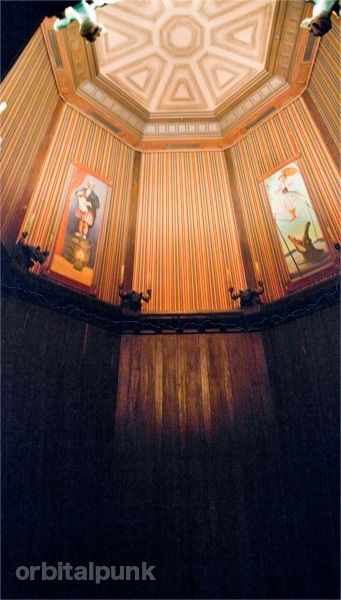
(pic by Mina Hart)


In some late 90s photos you can see the same type of deterioration begin-
ning to eat away the remaining stones.  The handwriting was on the wall.
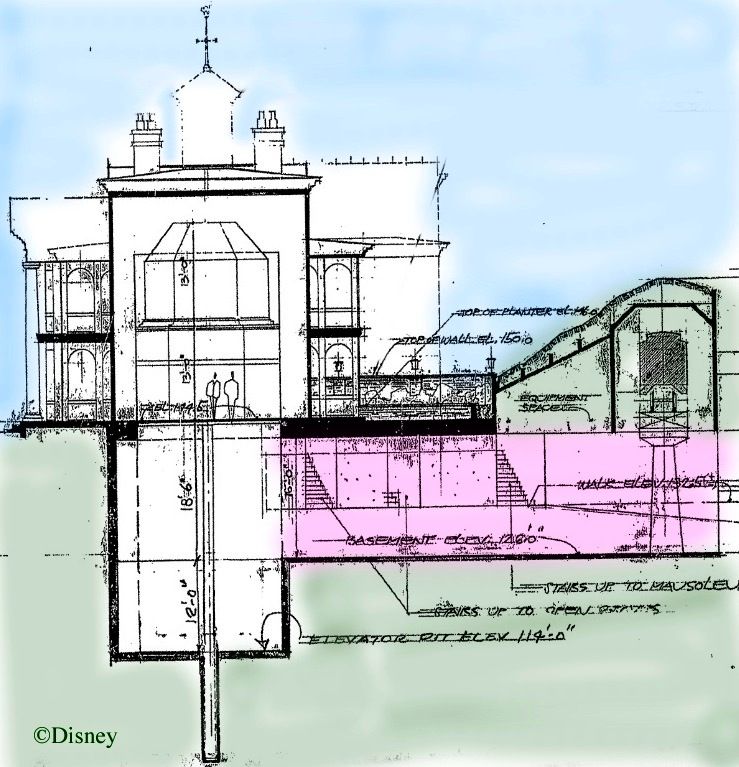


Epitaph for a Graveyard

And so, dear friends, you now know why the berm graveyard was removed in 2000:  It was falling apart.  Time and the elements took
their toll.  Aye, but in's prime, wasna it a bonny sight to see? (I'm thinking how good "Amazing Grace" on bagpipes would sound here.)

A recreation of the graveyard at its apogee.
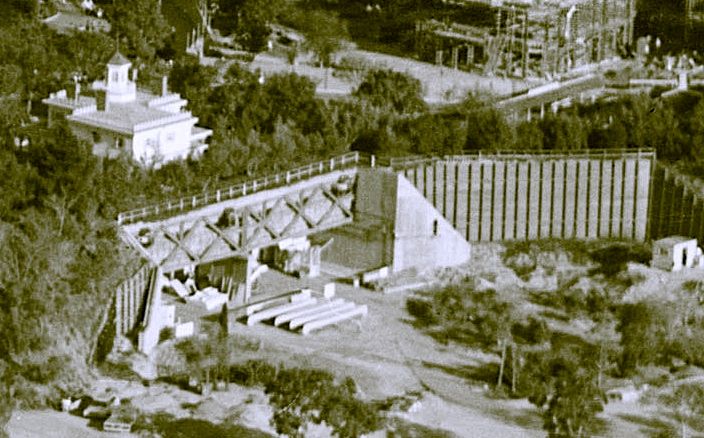
And the Tombstones Quake

Believe it or not, there are a couple of curious ironies (or ironic curiosities) nestled deep within that safe and sane history you have just read. First, it seems that between 1986 and 1990 the natural elements replicated outside in excruciatingly slow motion what the Imagineers did inside as a special effect. Second, between 1991 and 1999 the maintenance folks inadvertently replicated a "real" paranormal phenomenon in their attempts to deal with an utterly normal phenomenon. A happy accident, you might call it.  I prefer to think of it as extra value. Anyway, let us take up each of these oddities in turn.


1986 - 1990: Nature Imitates Art

As you know, some of the tombstones in the graveyard scene are animated.  There are actually two kinds, "jigglers" and "rumblers," and there are four of each.  The others behave themselves and stand still.  For you hypergeeks, here is a DL blueprint showing you exactly where they are, with jigglers in green, rumblers in red.


The jiggler variety is ingenious and ridiculously simple, probably another Yale Gracey invention.  The tombstone is very lightweight and suspended on a metal frame by means of springs.  A motor in the back spins an off-center weight around, and ta da, the tombstone wiggles and wobbles like nobody's business.  I've colored the weight red.


The rumblers are more complex, featuring a mechanized tombstone sticking up through a hole in the floor, rising, sinking, and rocking back and forth.  You can see one of these in the 1970 "Disneyland Showtime" TV special, still in the shop and bobbing up and down like a hyperactive five-year-old who really needs to find a restroom soon (notice also the pop-up spook). If Sigmund Freud were here, he'd probably have some things to say about it as well.
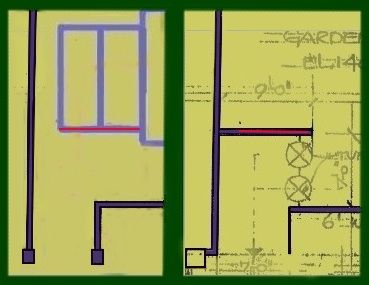

That gif is a little fast, but even at normal speed, it's clear that the rumblers were slowed down
for the ride.  One can also see some fore-and-aft movement along with the side-to-side rocking.


And now,
through the miracle of fake time-lapse photography, look what transpired
on the berm between 1986 and 1990.  Like I said,  it's Nature imitating Art!


Restless Bones

I'm not aware of any precise parallel in traditional ghost lore to supernaturally wobbling tombstones, but in England and elsewhere in the
Old World they've got hundreds, if not thousands of old churchyards showing how the markers do indeed move, tilting in different directions.
Plenty of examples can be seen in the older cemeteries of New England as well.
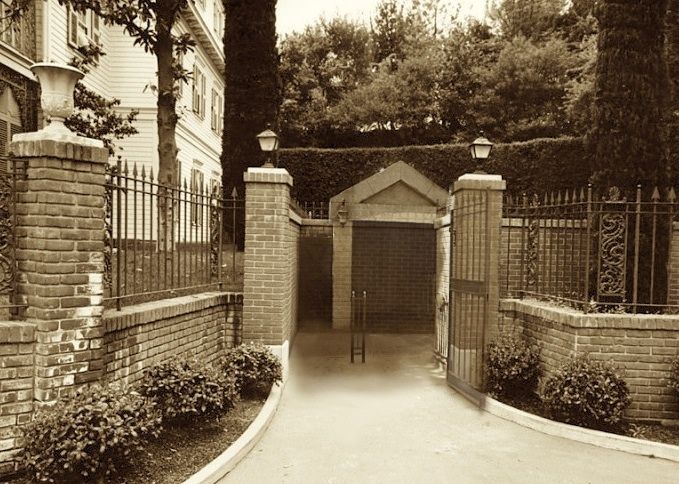

This is, of course, simply what happens over a long period of time as the stones settle, but to someone scouting around for haunted house ideas,
a sight like this might give rise in the imagination to restless spirits below pushing upwards.  We're back to Art imitating Nature.  Beyond this conjecture, can we find anything specific that may have served more directly as a genuine inspiration?  Perhaps.
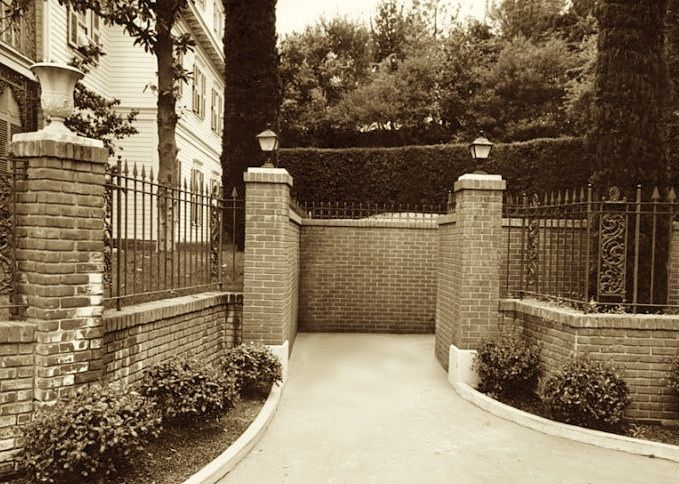
The first thing to note is that the jigglers and rumblers are part of a larger chorus of animated grave markers.  There are three crypts with bulging stonework, plus a couple of sarcophagi with moving lids.

Those are pretty realistic-looking sarcophagi, by the way.
The top one is real; the bottom two are from the Mansion.


While the idea that ghosts might wiggle grave markers has no exact parallel that I know of, one might nevertheless consider the notorious mystery of the moving coffins of Barbados.  We know that the Imagineers researched all manner of ghostly and paranormal phenomena, looking for ideas, and it's very hard for me to believe that this item wasn't part of that research at some point.  It's too well-known.  At least I think so, but if perchance you've never heard of it, well, look HERE or HERE. Or you can be satisfied with this thumbnail sketch: For a few decades early in the 19th c., the Chase family would find the heavy lead coffins in the family vault all helter-skelter every time they opened the crypt for a new occupant.  After the first few occurrences, the vault was carefully sealed each time, but in vain.  No trace of human activity in the vault nor any other satisfactory natural explanation for the disturbance was ever discovered.  Conceptually, this isn't too far distant from the Mansion's muscular ghosts pushing around inside crypts and sarcophagi.  Tottering tombstones are simply more of the same, evidence of coffin occupants below growing impatient and starting to push up something a bit more substantial than daisies.  It's not a direct inspiration, but I think the animate grave markers in the Haunted Mansion may very well owe something to the intriguing Chase vault mystery.


No word yet on whether the crypt doors creaked.


1991 - 1999: The Normal Parrots the Paranormal

Or, "The Merely Mundane Merrily Mirrors the Miraculous." Or... go make up your own title. As we have seen, Disneyland guests showed up one day in 1991 and found that several graves had suddenly and inexplicably switched places or moved to different locations. We have also learned that this phenomenon recurred several times over the course of the next decade. Tombstones disappeared and shifted around. It wasn't supposed to be an "effect"; it was repair work intended to keep the hillside cemetery from falling apart . . .

. . . or is that only what they would LIKE us to believe?

I don't think anyone will be surprised to hear that many cemeteries in the U.S. are reputedly haunted, but it may not be so well known that some of these graveyards include among their reported supernatural activity "moving tombstones." And when I say "moving tombstones," friends, I'm not talking about tear-jerking epitaphs. Let's look at the facts.

FACT:


FACT:
There are rumors of tombstones that glow and others that move by themselves at the Silver Terrace cemeteries outside of Virginia City, Nevada.


FACT:
Some say that Bachelor's Grove cemetery in Chicago, reputedly one of the most haunted places in the country, is another good place to find restless tombstones:


FACT:
There are some mighty strange (but by now familiar) things reported at Hazel Ridge Cemetery in Brunswick, Missouri:


INESCAPABLE CONCLUSIONS:

We have argued before that any changes to the building and grounds at a haunted house attraction tend to get sucked into its imaginary world. It's the nature of the beast: the building itself is part of the show. In the present case, however, supposedly innocent repair operations outside the Haunted Mansion bear an eerie resemblance to a ghostly phenomenon, and not just any ghostly phenomenon but a ghostly phenomenon which has been authenticated by statements which are indisputably reported and absolutely genuine, and you just can't argue with evidence like that.


Viewing all 128 articles
Browse latest View live